Could a single phishing email halt an entire international event? That question still nags IT teams and event planners.
On February 9, 2018, during the opening ceremony in Pyeongchang, a destructive cyber incident disrupted Wi‑Fi, ticketing, and access systems.
Operators traced a months-long pre‑positioning campaign that began with a fake “List of Delegates” email. Once live, the tool stole credentials, moved across networks, and wiped boot configuration data on key domain controllers.
Rapid containment, an AhnLab signature, and fast restores kept events running by morning. This guide lays out the chain of compromise, real impact on systems and data, and practical lessons for large events and enterprises.
Key Takeaways
- Learn how a simple phishing lure led to broad system compromise during the 2018 winter games.
- See the technical chain: credential theft, lateral movement, and BCD corruption.
- Understand incident response steps that restored services before events resumed.
- Learn why segmentation, backups, and drills reduce risk for major gatherings.
- Review how careful forensic work changed early attribution and led to indictments.
- Gain practical steps defenders can apply now to protect high-profile systems and data.
Why this Ultimate Guide and who it’s for
This guide gives clear definitions and a compact playbook for defenders and planners. It walks readers from core concepts to practical steps that improve resilience for major events.
We aim to serve security leaders, IT teams, tabletop facilitators, and small‑business owners who need concise, reliable information. The article defines key terms such as Olympic Games, Sandworm, and false flag so readers can follow technical sections without confusion.
Reader intent centers on three needs: understand the incident, measure impact, and apply fixes. You’ll find a structured process for incident response, fast containment, and recovery that maps to real‑world lessons. This resource curates vetted findings from vendors and public reports to reduce guesswork.
User intent: understanding the attack, impact, and mitigation
Follow sections by goal: forensics, remediation, or resilience planning. If you want a timeline and curated analysis, start with our concise case review and then jump to playbooks and controls.

For a broader timeline and related incidents, see this roundup from Malwarebytes: timeline of scams and hacks.
Setting the stage: the 2018 Winter Olympics and a perfect storm
A volatile geopolitical climate and a huge, distributed IT estate set the stage for a high-risk opening night. Sanctions, intense media attention, and tens of thousands of endpoints made ceremony systems a strategic target.
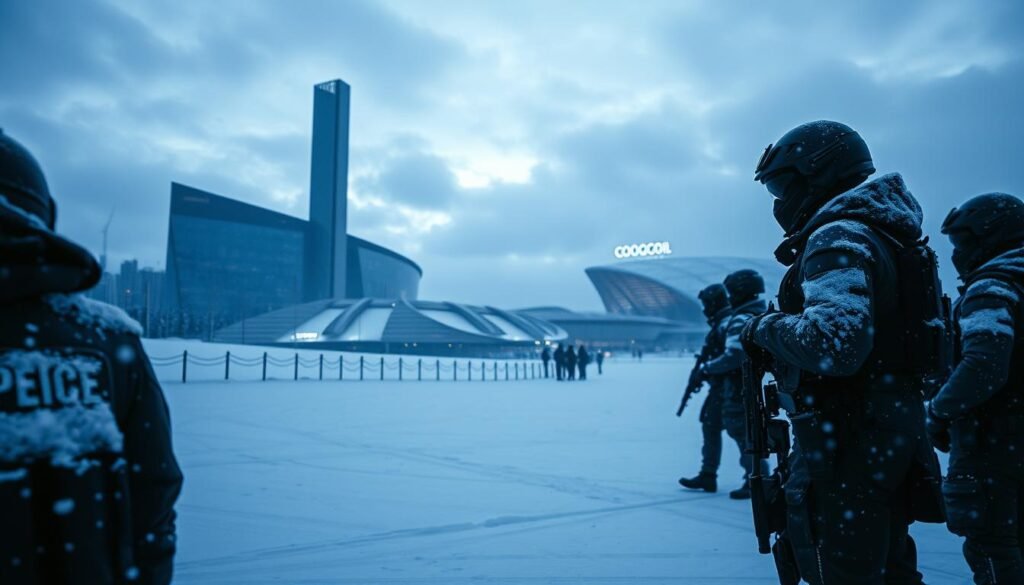
Sanctions and tensions: the doping scandal and Russia’s banned status
The international olympic committee banned Russia after proof of state-backed doping. Selected athletes competed under a neutral banner with no anthem and a $15 million fine imposed.
Political leaders framed this as humiliation, and that rhetoric heightened the symbolic value of the games for many actors.
High-profile target: Pyeongchang’s massive IT footprint and the opening ceremony
Pyeongchang’s organizing team ran a vast estate: over 10,000 PCs, 20,000+ mobile devices, 6,300 Wi‑Fi routers, and 300 servers across two Seoul data centers.
This scale meant identity, wireless, broadcast, and ticketing systems overlapped. At showtime, that overlap compressed defender choices and raised risk.
| Factor | Detail | Impact on ceremony |
|---|---|---|
| Political backdrop | IOC sanctions; neutral athletes | Increased symbolic incentive to disrupt |
| Host infrastructure | 10,000+ PCs; 6,300 Wi‑Fi APs; 300 servers | High interdependency; single faults cascade |
| Regional dynamics | North Korea diplomacy and joint team | Media focus but persistent tension |
| Threat signals | Observable pre-event activity | Elevated alert level before showtime |
What was the Olympic Destroyer malware attack
Two things made this operation succeed: a deceptive phishing lure sent months earlier and a timed sabotage during the opening ceremony in february 2018.That combination let attackers move quietly, then trigger broad failures that were visible to attendees and media.
A booby‑trapped Word document named “List of Delegates” landed in many inboxes across the olympic committee and vendors. Recipients saw garbled text and were prompted to click Enable Content.
Clicking ran a PowerShell dropper that fetched a backdoor. Over weeks, intruders harvested stored browser and network credentials and mapped trust paths between suppliers and core systems.
From phishing to pre-positioning
Attackers used targeted phishing and supplier compromise to gain persistent footholds. They moved laterally using stolen credentials and staged access to directory services and ceremony systems.

Activation night: february 2018 during the opening ceremony
As the opening ceremony began, the payload woke across networks. It rapidly scavenged credentials and pivoted into domain controllers.
Destructive commands wiped Boot Configuration Data on critical servers, which crashed Active Directory and prevented normal reboots. That outage disabled Wi‑Fi, ticketing, RFID gates, and internet‑connected displays.
| Phase | Method | Immediate effect |
|---|---|---|
| Initial access | Phishing zip with weaponized Word and PowerShell dropper | Backdoor installed; persistent foothold |
| Pre‑positioning | Credential theft; lateral movement via suppliers | Reach into ceremony systems |
| Activation | Simultaneous destructive commands on February 9, 2018 | BCD wiping on domain controllers; service outages |
| Misdirection | False flags suggesting a north korean source | Early confusion around attribution |
For a deeper narrative of how investigators pieced events together, see this detailed report on the incident.
How the malware worked: infection, lateral movement, and destruction
This section walks through the full process—from a clicked macro to a timed sabotage on identity servers. It shows how credential theft enabled rapid spread and why boot data deletion crippled availability.
A single user action triggered a PowerShell chain that seeded a long-lived backdoor inside critical IT estates.

Initial access: weaponized Word and a PowerShell dropper
User-enabled macros launched a PowerShell downloader that installed a persistent backdoor. That backdoor kept remote access ready and staged follow-up processes.
Lateral movement via stolen credentials and supplier links
The payload harvested credentials from browser stores and memory, then used built‑in Windows remote features to reach other systems. Valid credentials let operators hop from partner networks into core environments.
Destructive payload: wiping boot data on domain controllers
At ceremony time, a destructive routine deleted Boot Configuration Data on key domain controllers. That removal severed authentication and left many services unbootable.
Comparisons and technical notes
Researchers noted echoes of NotPetya and Bad Rabbit in the process: credential-driven propagation and a final-stage sabotage that prioritized availability loss over data theft. Cisco Talos and other analysts flagged behavioral overlap, even as codebases differed.
“Credential theft plus worm-like spread, then a wiping phase aimed at identity systems,” observed multiple technical reports.
- Summary: phishing to PowerShell, backdoor persistence, credential theft, lateral movement, and a destructive wipe aimed at identity.
- Defender takeaways: enforce credential hygiene, restrict lateral access, monitor built‑in remote tool use, and harden identity systems and backups against sabotage.
Operational impact and rapid remediation at the Games
Stadium systems collapsed quickly once domain controllers stopped responding, forcing urgent operational choices. High‑visibility services failed during the ceremony, but disciplined response limited downtime and preserved the schedule.

What failed first and why
All nine Domain Controllers were paralyzed, halting authentication across the estate. That single failure cascaded into outages for stadium Wi‑Fi, internet‑linked TVs at 12 venues, RFID gates, and ticket printing.
Event apps and live ticket validation lost access, so staff shifted to offline checks and manual scans to keep lines moving.
Containment under pressure
Operations teams bypassed dead controllers to restore minimal Wi‑Fi and display service before the ceremony ended. Around midnight, leaders cut internet connectivity to isolate the network and stop further activity.
The turnaround and timeline
By 5:00 am an AhnLab signature arrived; at 6:30 am admins reset passwords to revoke stolen credentials. Teams rebuilt critical systems from clean backups and brought core ticketing and service flow back before morning events.
- Bold summary: The incident knocked out Wi‑Fi, TVs, RFID gates, and tickets, yet containment kept games running by morning.
- Bold summary: Isolation, rapid signatures, password resets, and tested restores were decisive under time pressure.
Attribution untangled: a masterclass in false flags
At first glance, clues pointed in many directions. Analysts found copied code, swapped headers, and reused servers that pushed discussion toward several state actors. This section untangles those threads and explains how careful correlation led to a firm conclusion.
Conflicting clues: Lazarus lookalikes and Chinese overlaps
Early artifacts mimicked Lazarus toolsets, which suggested a north korea source. Other routines overlapped with APT3 and APT10 patterns tied to China, adding confusion.
Those similarities were deliberate. Analysts learned to treat matching code alone as weak evidence for attribution.
Kaspersky’s Rich Headers insight and the infrastructure reuse mistake
Kaspersky’s Igor Soumenkov found swapped Rich Headers that did not match a genuine build process. That detail flagged intentional framing.
An operational slip sealed a stronger lead: reused command‑and‑control hosts linked back to prior election‑related activity. That reuse became a key source signal.
Sandworm and the GRU: Cisco Talos to DOJ indictments
Cisco Talos noted behavioral echoes of NotPetya and Bad Rabbit—rapid spread plus destructive sabotage. Later, U.S. prosecutors indicted GRU officers and tied Sandworm to these events, aligning legal and technical findings.
| Clue | Observed artifact | Impact on attribution |
|---|---|---|
| Code overlap | Lazarus-like routines; APT3/APT10 similarities | Raised multiple origin theories |
| Rich Headers | Swapped header values | Indicated deliberate false flag |
| Infrastructure reuse | C2 tied to 2016 election activity | Provided decisive operational link |
| Behavioral analysis | Destructive wipe pattern | Matched Sandworm tradecraft per Cisco Talos |
- Bold summary: Attribution was messy by design; layered false flag techniques pointed analysts toward north korean and Chinese sources before deeper telemetry reversed that view.
- Bold summary: Kaspersky’s Rich Headers finding plus an infrastructure reuse mistake helped investigators link this operation to Sandworm and GRU operators.
Defender insight: expect sophisticated false flags in high‑profile cyber activity. Corroborate multiple independent artifacts and prefer operational links over single code matches when making attribution calls.
Lessons for defenders: preventing the next Olympic Destroyer
Treat months of hidden activity as an operational norm and plan exercises that reflect that timeline. Mix technical controls with repeated crisis drills so teams can act fast under pressure.
Pre-positioning risk: assume months-long dwell and rehearse responses
Adversaries often prepare quietly for months before any visible sabotage. Build hunting playbooks that look for lateral activity, odd credential use, and supplier anomalies.
Run tabletop and live drills quarterly. Practice credential resets, isolation, and bare-metal restores until the process is smooth.
Hardening essentials: phishing defence, segmentation, backups, and AD resilience
Invest in ongoing phishing training, strict segmentation, and robust backups stored offline. Protect Domain Controllers with tiered admin roles, privileged access management (PAM), and tested recovery plans.
Event-time vigilance: C2 monitoring, preapproved cuts, and rapid signatures
Monitor for command‑and‑control patterns, unusual SMB/WMI/PSExec use, and rapid credential reuse. Preapprove when to cut external links and how to keep essential on‑site services running.
“Preparedness comes down to practiced isolation, identity hygiene, and fast, coordinated response.”
Looking ahead to major events: Paris 2024 threats and disinformation
Elevate threat levels around big games. Watch for destructive technical operations and coordinated disinformation campaigns that aim to confuse response efforts.
| Focus | Practical step | Benefit |
|---|---|---|
| Pre‑positioning | Quarterly threat hunting; supplier audits | Early detection of months‑long activity |
| Identity | PAM, JIT, separate management forest | Limits credential abuse; speeds recovery |
| Event ops | Preapproved cutover plans; offline backups | Maintains critical service during isolation |
| Communications | Disinformation monitoring and partner coordination | Protects trust and reduces confusion |
Conclusion
This article frames Olympic Destroyer as a defining case in event-time resilience. It shows how rehearsed process, clear roles, and clean backups let hosts restore services under intense pressure.
Key lesson: treat months-long pre‑positioning as normal and harden identity systems first. Protect credentials, segment networks, and rehearse restores so a ceremony can keep running if core systems fail.
Practical steps: run tabletop scenarios that match your operations, share post-incident information with partners, and plan for coordinated information and cyber threats around major games.
Resilience is not a one-time fix. Build capabilities now so when a high-profile threat arrives, you protect people, services, and trust.
