What happens when nation-aligned actors turn social engineering into an industrial-scale weapon? This introduction maps why these actors are the apex predators of modern email-based attacks and what that means for U.S. organizations.
Clear numbers drive the argument: Verizon found 68% of breaches involve the human element, the FBI IC3 logged 193,407 complaints in 2024, and average breach costs reached $4.88M (IBM). Phishing volume exploded with AI adoption, and BEC losses hit billions.
We set expectations with plain language and hard data so security leaders can align investments to real impact. This section previews verified findings, practical actions, and sector-level consequences. For deeper context about network and espionage tradecraft, see our summer analysis at the summer 2025 landscape review and a technical summary of actor activity at APT42 analysis.
Key Takeaways
- Human risk drives breaches: 68% involve human error; training and simulation matter.
- Costs are high: Average breach cost is roughly $4.88M, and BEC losses reached billions.
- AI magnifies scale: Generative tools increased phishing volume dramatically since 2022.
- Actionable focus: Prioritize phishing-resistant MFA, edge patching, and email defenses.
- Translate intelligence: Use verified metrics to justify investments and cut organizational risk quickly.
Executive summary: How state-aligned actors weaponize phishing at scale
This executive summary condenses recent U.S. incidents and measurable losses into clear priorities for defenders. Focus: people-first defenses, identity controls, and faster containment to reduce breach impact.
This executive snapshot uses hard data to show where risk concentrates and what works. Phishing was the top reported cybercrime in 2024 with 193,407 complaints and about $70M in losses. Verizon found 68% of breaches involve a human element and 32% include a phishing component.
Key takeaways from recent U.S. cyber incidents and losses
- High volume, high impact: BEC-linked losses tied to phishing reached $2.9B; average breach costs range from $1.29M to $4.88M.
- Blended tradecraft: Nation-aligned attackers pair social engineering with criminal ecosystems and Phishing-as-a-Service.
- Detection gaps persist: Email filtering improved, yet 11% of zero-day URLs still bypass gateways.
Why phishing remains the dominant initial access vector
“People are the fastest route from a message to account takeover.”
Phishing offers low-cost, high-yield access for credential theft and session hijack. Attackers use email, SMS, voice, and collaboration tools to pivot quickly into cloud and identity systems.
Executive priorities: adopt phishing-resistant MFA (FIDO2/WebAuthn), integrate identity telemetry, and track reporting and time-to-contain metrics. See deeper tactics at Axiom group analysis.

Scope, methodology, and data sources for this Trend Analysis/Report
This analysis synthesizes multi-vendor telemetry and public datasets from 2024–2025. We normalize metrics across sources to surface converging signals about email-borne attacks and actor behavior.
We prioritized primary sources (Verizon DBIR 2025, FBI IC3 2024) and validated them against vendor telemetry from Check Point, Arctic Wolf, Vipre, OpenText, BlackBerry, Cisco, and Red Canary.
Temporal frame: datasets cover late 2023 through 2025, with emphasis on month-over-month trends in 2024–2025.

Key inputs and normalization
- Primary statistics: Verizon (68% human element; 32% phishing in breaches) and FBI IC3 (193,407 complaints; ~$70M losses).
- Corroborating telemetry: Check Point (+13% YoY), Arctic Wolf (72.9% BEC via phishing), Vipre (URL redirection 48%, .zip 53% attachments).
- Platform signals: OpenText (235M quarantined malware-attachment emails), BlackBerry (mobile +22%), Cisco (AI incidents in 86% of organizations).
Quality controls and limits
We cross-checked incident types, attachment formats, and URL techniques to reduce vendor bias. Metrics are labeled by source type: simulation, user-reported, or gateway detection.
| Source | Key metric | Scope |
|---|---|---|
| Verizon DBIR 2025 | 68% human; 32% phishing | Breach analysis (global, focus U.S.) |
| FBI IC3 2024 | 193,407 complaints; $70M losses | User-reported incidents (U.S.) |
| Vendor telemetry (Check Point, Vipre) | 13% YoY phishing rise; 48% redirects; .zip 53% | Platform detections and sandboxing |
| OpenText / Cisco / Arctic Wolf | 235M quarantined emails; AI incidents 86%; 72.9% BEC via phishing | Cloud and endpoint telemetry |
We disclose attribution limits: short-lived infrastructure and AI-generated content complicate longitudinal tracking. For a linked actor analysis, see our Sowbug analysis at Sowbug analysis.
Threat report on state-sponsored phishing campaigns
State and state-aligned operations use precise social engineering to gain access, influence decision cycles, and collect sensitive information. Attribution is probabilistic: overlapping infrastructure and similar tradecraft blur clean lines between espionage and financially motivated attackers.
Nation-aligned actors favor spearphishing over mass spam. OpenText telemetry shows 56.56% of November 2024 emails were spearphishing. Verizon noted a 22% rise in AI-generated content, and BlackBerry flagged deepfakes in 7% of cases.

How tactics map to strategic objectives
- Precision lures: Microsoft and DocuSign spoofing plus HR themes target identity and workflows.
- Multilingual and cultural tailoring: Localized messages improve success against regional targets.
- Deepfakes and voice cloning: Used in high-value interactions to amplify trust.
- Staged tradecraft: Benign-looking emails, legitimate cloud links, and short-lived infrastructure limit detection windows.
Defensive implication: Treat executives, admins, and privileged teams as top-tier assets. Apply targeted controls, continuous monitoring, and strict verification rituals to defend systems and information.
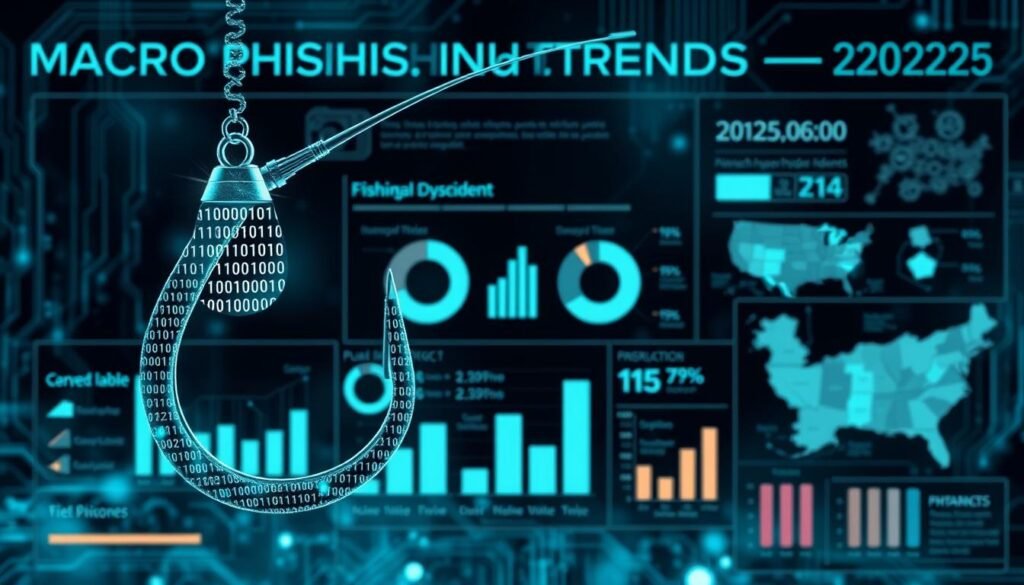
Macro phishing trends and statistics shaping 2024-2025
Phishing volume and success indicators remain elevated, with rapid clicks and delayed reporting sustaining attacker advantage.
The human element anchors most breach chains, keeping email-based initial access and escalation central to organizational risk.
Growth metrics: incidents, complaint volumes, and click behaviors
Public filings show 193,407 complaints and roughly $70M in losses (FBI IC3 2024). Vendor telemetry reports a 13% year-over-year rise in attacks (Check Point).
Average click rates sit near 2.7%. Median time to click is just 21 seconds, while median time to report is 28 minutes (Verizon DBIR 2025). Fast engagement plus slow reporting increases attacker dwell.
Human element in breaches and prevalence in initial compromise
Verizon notes a human factor in 68% of breaches, with 32% including credential-based email intrusions. Training cuts click rates: sustained programs reduce failures by roughly 32–38% among trained users.
Top spoofed brands and sector exposure
Ubiquitous brands lead lures—Microsoft, Apple, and DocuSign top the list—and payment services are frequent decoys. The U.S. receives the bulk of global attempts, with financial services, healthcare, education, manufacturing, and public administration most exposed.
- Action: baseline click and report times, then shorten reporting windows through practice and tooling.
- Action: prioritize layered detection for cloud links and URL redirection used to evade static filters.
Financial and operational impact in the United States
Phishing translates directly to financial loss and operational disruption, with BEC as a leading cost driver for U.S. organizations. Time magnifies loss—faster detection and containment materially reduce breach costs.
The economic toll is concrete. IBM estimates an average phishing-related breach costs about $4.88M. Verizon places the average for phishing-driven breaches near $1.29M.
Business email compromise (BEC) compounds this exposure. Combined losses near $2.9B across 21,489 cases, with initial losses often exceeding $160,000.

Direct and operational costs
Direct costs include incident response, legal fees, regulatory fines, customer notifications, and system recovery. These hit budgets fast and can force delayed payments or suspended supplier workflows.
Operational impacts often manifest as cloud-account lockouts, identity remediation, and halted projects. Phishing is also a common vector to seed ransomware or data theft, increasing outage and recovery costs.
Cost accelerators and mitigations
Time matters: IBM data shows breaches detected or contained after 200 days cost roughly $1.2M more. Weak reporting cultures and limited training raise click rates.
Training works. Sustained programs lower click-through by roughly 32–38%, reducing incident frequency and dwell time.
| Metric | Value | Impact | Recommended KPI |
|---|---|---|---|
| Average phishing breach cost | $4.88M (IBM) | Major budget and recovery burden | Cost per incident |
| Average phishing-driven breach | $1.29M (Verizon) | Frequent business disruptions | Mean time to contain (MTTC) |
| BEC national losses | $2.9B / 21,489 cases | High single-loss events; payment risk | Average initial loss |
| Training effect | 32–38% reduction in clicks | Lower incident counts and dwell | Click rate & report rate |
Where to invest: prioritize phishing-resistant MFA (FIDO2/WebAuthn), identity-anomaly detection, and behavior-change training. Enforce dual approvals for financial flows and require verification playbooks for executive requests.
State-aligned TTPs: Social engineering, spearphishing, and brand impersonation
State-aligned operators rely on precise social engineering to reach high-value personas in finance, HR, and government. Credential harvesting often precedes multi-stage efforts, while malware delivery is tailored to purpose and defenses.
OpenText logged that 56.56% of observed activity in November 2024 was spearphishing. Red Canary found that of confirmed messages, roughly 43% aimed to harvest credentials, 6% used malicious attachments, and 51% relied on generic social engineering.

How tailored lures win access
Spearphishing enables tight pretexting: payroll notices, benefits updates, invoice approvals, and MFA reset prompts that match duties. Brand impersonation—Microsoft and DocuSign plus HR portals—raises trust and click rates.
Malware delivery versus credential theft
Verizon notes 94% of malware was delivered via email attachments, so attachments remain a key vector even if fewer messages carry them. Typical multi-stage chains begin with a cloud link, move to a fake SSO page, and then trap MFA to escalate access.
- Tradecraft: benign PDFs with embedded links, obfuscated HTML attachments, and QR redirects evade controls.
- Localization: realistic language variants lower friction and defeat static filters.
- Infrastructure agility: short-lived domains, redirects, and cloud hosting shrink detection windows.
Defensive implication: map common lures to controls—verify finance workflows, strengthen HR portal SSO, and run simulated exercises like the threat intelligence guide. For tactical context about common attacks and vectors, see this primer at understanding common types of cyber attacks.
AI’s double edge: How generative techniques reshape state-level phishing
Generative AI raises the ceiling on realism and lowers the barrier for large-scale, targeted deception. Tools now produce localized, timely lures that mimic real workflows and public events, increasing success against government-adjacent targets.

Election-focused lures, deepfakes, and language realism
Election-themed spear attempts exploit urgency and policy debates to reach officials and contractors. AI speeds translation and removes grammar giveaways.
Voice and video deepfakes appear in about 7% of incidents (BlackBerry) and amplify social proof for executive and finance approvals.
Scale vs. detection: false negatives and bypass
AI-generated content rose ~22–24% across vendor datasets (Verizon; Cybersecurity Foundation & Gruppo Tim). Vipre found 40% of BEC emails were AI-derived in Q2.
Gateways improved accuracy ~14%, yet 11% of zero-day URLs still bypass filters (Check Point). That gap lets short-lived lookalike domains and redirects succeed.
PhaaS, automated domain spoofing, and defenses that work
PhaaS growth (~21%) bundles templates, hosting, and evasion for less skilled operators. Lookalike domains appear in roughly 62% of attacks (Cybersecurity Foundation & Gruppo Tim).
- Action: monitor election narratives and lock high-risk approval paths.
- Action: enforce verification for finance requests and brief executives on deepfake cues.
- Action: invest in tooling that correlates sender reputation, URL behavior, and content at click time.
Multi-channel campaigns beyond email: Mobile, SMS, voice, and collaboration apps
Modern social-engineering blends desktop and mobile interactions to bypass conventional controls. Attackers pair email with SMS, calls, QR links, and chat tools to push users toward unsafe portals or MFA prompts.
Smishing grew 19% and vishing rose 11% (Check Point). Quishing—QR-code-based lures—climbed about 11% year-over-year (Verizon DBIR 2025). Mobile-based attacks increased roughly 22% (BlackBerry), and Hoxhunt data shows ~40% of campaigns extend beyond email.
How multi-channel flows enable MFA bypass
Smishing and vishing use urgency and spoofed caller IDs to rush decisions. QR codes embedded in PDFs and signage route devices around gateway previews.
Collaboration apps, BYOD, and unmanaged device exposure
Slack, Teams, and social DMs carry believable internal messages with links that harvest credentials. Unmanaged devices lack enterprise controls, so tokens and sessions become high-value access points.
- 45–50% of links use redirection chains (Vipre: 48%), and file-hosting hides destinations (26%).
- Multi-step handoffs—email then text then call—raise credibility and lower user suspicion.
- Defenses: extend link protection to mobile and chat, enforce enterprise browsers or protective DNS, and teach users to treat QR codes as untrusted links.
Track incidents across channels, and use coordinated telemetry to spot linked attacks and close verification gaps. For operational guidance, see the phishing trends guide.
Business Email Compromise as a state-favored monetization and access vector
Business Email Compromise (BEC) now blends financial fraud with strategic access, letting attackers turn a single inbox into a persistent foothold. Credential reuse and weak identity controls keep this vector effective, but disciplined controls and training cut risk dramatically.
Credential reuse, mailbox control, and sector targeting
Arctic Wolf telemetry shows 72.9% of BEC incidents start with phishing, while 18.9% rely on previously compromised credentials.
Mailbox control—silent rules, auto-forwarding, and conversation hijack—lets attackers reroute payments or quietly siphon data. API or configuration weaknesses account for 4.3% of incidents; malicious insiders are rare (0.8%).
Sectors hit most: finance & insurance (26.5%), legal & government (13.3%), and manufacturing (11.4%). These align to payment volume and regulatory sensitivity.
Training, phishing-resistant MFA, and practical defenses
Seventy-six percent of affected organizations lacked phishing-resistant MFA. Teams with active training saw ~30% fewer successful BEC incidents.
- Require out-of-band verification for wire changes and supplier updates.
- Deploy phishing-resistant MFA (FIDO2/WebAuthn) to stop token replay and prompt bombing.
- Instrument mailbox telemetry for anomalous rules, impossible travel, and mass forwarding.
- Document and drill playbooks for containment, payment recall, and legal response.
“Mailbox compromise is rarely loud — it is effective because it is trusted.”
Credential theft and cloud account compromise at scale
Credential theft remains the quickest route to cloud takeover; kits now proxy logins and capture MFA tokens. Abuse of legitimate cloud links, redirects, and file-hosting raises trust and bypasses simple filters.
Attackers used MFA proxy kits in about 15% of credential-harvest cases. Roughly 43% of lures used real cloud service links, and redirection chains appeared in 48% of tracked links.
MFA proxying, link abuse, and redirection chains
- MFA kits proxy logins and intercept one-time codes for immediate session hijack.
- Trusted services and file-hosting (26%) hide malicious pages behind familiar domains.
- Redirection chains obscure destinations and defeat hover and preview checks.
Password reuse, identity signals, and takeover outcomes
Password reuse caused secondary compromises in about 16% of cases. Across incidents, 27% of successful attacks resulted in cloud account compromise leading to mailbox access, OAuth abuse, and data exfiltration.
| Metric | Value | Common outcome | Recommended control |
|---|---|---|---|
| MFA proxy kits | 15% | Immediate session hijack | Phishing-resistant MFA |
| Legit cloud links used | 43% | Higher click & trust | Link detonation & content scanning |
| Redirection chains | 48% | Scanner evasion | Real-time URL behavior analysis |
| Password reuse secondary | 16% | Lateral access | Continuous identity risk scoring |
Defensive moves: enforce phishing-resistant MFA, use conditional access, instrument cloud audit logs, and pair user reporting with automated URL detonation and token revocation.
For broader context about targeted corporate users and susceptibility, see this analysis at corporate user targeting study.
Detection gaps and evasion techniques used by sophisticated actors
Sophisticated actors focus their resources at the moment a user clicks, weaponizing brief windows of opportunity. Embedded links, QR codes, and trusted hosts push risk past email filters and into endpoints where detection is weakest.
Zero-day URLs, short-lived sites, and redirect abuse
Email gateway accuracy improved about 14%, yet 11% of zero-day URLs still bypass filters. Fast-rotating pages live under 12 hours, so blocks often arrive too late.
Document links, file-hosting, and QR-code lures
Links embedded in PDFs and HTML rose 8% versus 2023. File-hosting and collaboration suites lend reputation and raise deliverability. Quishing (QR lures) grew 11% and targets mobile, where previews are limited.
Multilingual, brand-consistent lures
Actors craft localized, brand-matched messages to defeat simple heuristics. AI refines tone and logos, making detection by language or image heuristics less reliable.
- Key evasions: open redirects and shorteners that hide final destinations.
- Endpoint risk: embedded links route users outside email scanning.
- Mobile exposure: QR and SMS handoffs skip enterprise previews.
Defenses that work: real-time link analysis at click, computer vision for QR decoding, automated detonation of document-embedded links, and correlation of sender, link, and content signals with user behavior.
| Gap | Data point | Impact | Defensive control |
|---|---|---|---|
| Zero-day URLs | 11% bypass | Immediate click risk | Real-time URL behavior analysis |
| Short-lived sites | <12-hour lifespan | Blocks lag behind | Reputation + behavioral telemetry |
| Embedded doc links | +8% vs 2023 | Bypass email scanners | Automated detonation & content scanning |
| Quishing / mobile | +11% YoY | Unmanaged device exposure | Computer vision QR checks; enterprise browser |
Insider risks and human factors that amplify state-level phishing
A single unverified message can cascade into weeks of compromise and costly recovery work. Most insider incidents begin with human error—social engineering and careless inbox behavior unlock access that leads to data loss and privilege abuse.
A Ponemon study found 55% of insider security incidents start with phishing or social engineering, and 31% began when users clicked or opened malicious attachments.
Containment takes time. Mean time to contain these insider-driven breaches is 77 days, with an average cost near $804,997 (up 14%). Nearly 46% led to data exfiltration and 44% to unauthorized privileged use. Seventy-two percent occurred because sender authenticity was not verified.
Practical safeguards defenders should apply
- Verification discipline: require confirm calls or secondary approval for payment and HR changes.
- Behavioral monitoring: watch email forwarding spikes, odd access times, and large downloads.
- Limit blast radius: enforce least-privilege, just-in-time elevation, and session timeouts for critical systems.
- Protect sensitive data: classify files, restrict exfil paths, and audit transfers from high-risk endpoints.
- No-fault reporting: encourage quick near-miss reporting to improve organizational detection and response.
See human-focused findings in a detailed human-factor study, and for tactical context review this tactical analysis.
Training and behavior change: What works against advanced phishing
Continuous, measured training reshapes user choices and cuts successful attacks quickly. Focus on rapid reporting, careful attachment handling, and verification rituals for high-risk actions.
Reporting benchmarks and click-rate gains
Baseline simulations typically show about 20% of users report suspicious emails. Mature programs lift that to roughly 60% after 12 months.
Across vendor datasets, trained users click 32–38% less. That drop lowers immediate account compromise and shortens containment time.
Adaptive training outcomes and measurable wins
Programs that tailor content to common lures—Microsoft, DocuSign, HR notices—and risky behaviors yield the best results.
- Attachment drills: failure rates fall from ~11% to below 2% within 12 months.
- Reporting latency: target minutes, not hours; faster reports cut attacker dwell.
- Cadence: higher simulation frequency produces richer data and faster behavior change.
Practical actions: give users a one-click report tool, run role-specific scenarios for finance and admins, and track progress at months 3, 6, and 12. Measure both click rates and report time to prove ROI and reduce organizational risk.
Sector targeting in the U.S. public and private sectors
Attackers focus where money, sensitive files, and mission-critical processes intersect. Targeting follows value: financial services, healthcare, education, manufacturing, and government receive persistent, tailored assaults.
Who bears the brunt and why
Financial services accounted for roughly 24% of phishing incidents, with BEC tactics hitting finance and insurance hardest (Arctic Wolf: 26.5%).
Healthcare (17%) combines highly sensitive data with many vendor touchpoints, while education (11%) sees seasonal lures around enrollment and payroll.
High-value personas and common lures
Finance teams, executives, and admins are top targets because they control payments, approvals, and access.
Finance departments and executives faced tailored payment lures in about 43% of payment-related attempts. Typical pretexts: urgent invoices, payroll edits, benefits updates, and executive sign-offs.
- Manufacturing & public administration: supply-chain impersonation and vendor-account hijacks tied to schedules.
- Admins/IT: SSO and MFA-themed emails seek elevation and session access.
Practical action: tune training and playbooks to department workflows, and monitor hotspots such as vendor changes, wire approvals, and document signing flows. For guidance on government-focused attacks, see government cyber attacks.
Governance, compliance, and readiness actions for U.S. organizations
Governance must treat email deception as a business control, with named owners and formal escalation paths. Platformization and identity-first controls close gaps faster than point tools alone.
Start by assigning clear ownership and metrics, then make reviews routine. Email gateway accuracy improved ~14% (Check Point), and AI upgrades after July 2024 raised phishing-site detection to 87.3% and lookalike domain detection to 85.94% (Cyberint). Yet AI-based detection still missed about 9% of malicious messages (Verizon DBIR 2025).
Platformization, telemetry integration, and phishing KPI tracking
Platformize detection and response to unify email, web, and collaboration telemetry. Shorten time-to-contain by correlating clicks, URL behavior, and user reports.
- Track KPIs: reporting rate, median time-to-report, click rate, false positive/negative rates, and percent of messages scanned at click.
- Close the 29% visibility gap by operationalizing metrics and building executive dashboards.
Identity-first security, phishing-resistant MFA, and cloud abuse mitigation
Enforce phishing-resistant MFA, conditional access, device trust, and least privilege. Monitor OAuth grants, app consent, and anomalous egress across cloud storage and mail systems.
- Integrate secure email gateways, API scanners, protective DNS, and browser isolation for layered defense of systems and tools.
- Codify verification for payments and supplier changes, audit compliance, and protect sensitive data with classification and DLP tuned for cloud channels.
- Run time-bound exercises to test detection, triage, and executive communications.
For compliance context and funding approaches, review recent compliance grants coverage, and for practical hardening of web services see secure web applications guidance.
Conclusion
The evidence is clear: human trust still gives attackers fast access. The path forward is clear — measure, train, and modernize identity and detection to cut risk at scale.
Key data points drive urgency: 68% of breaches involve a human element and 32% include phishing; BEC losses near $2.9B; average phishing-related breach cost about $4.88M. AI-generated content rose ~22% and 11% of zero-day URLs still bypass filters.
Durable attacker advantages include rapid clicks, realistic lures, and agile infrastructure. Yet organizations that invest in behavior change, phishing-resistant MFA, and platformized detection cut incidents and impact. Track KPIs monthly, harden finance and admin paths, run tabletop exercises, and treat user reports as frontline intelligence. Use this report to brief stakeholders and sequence practical actions for the next 3–6 months.
