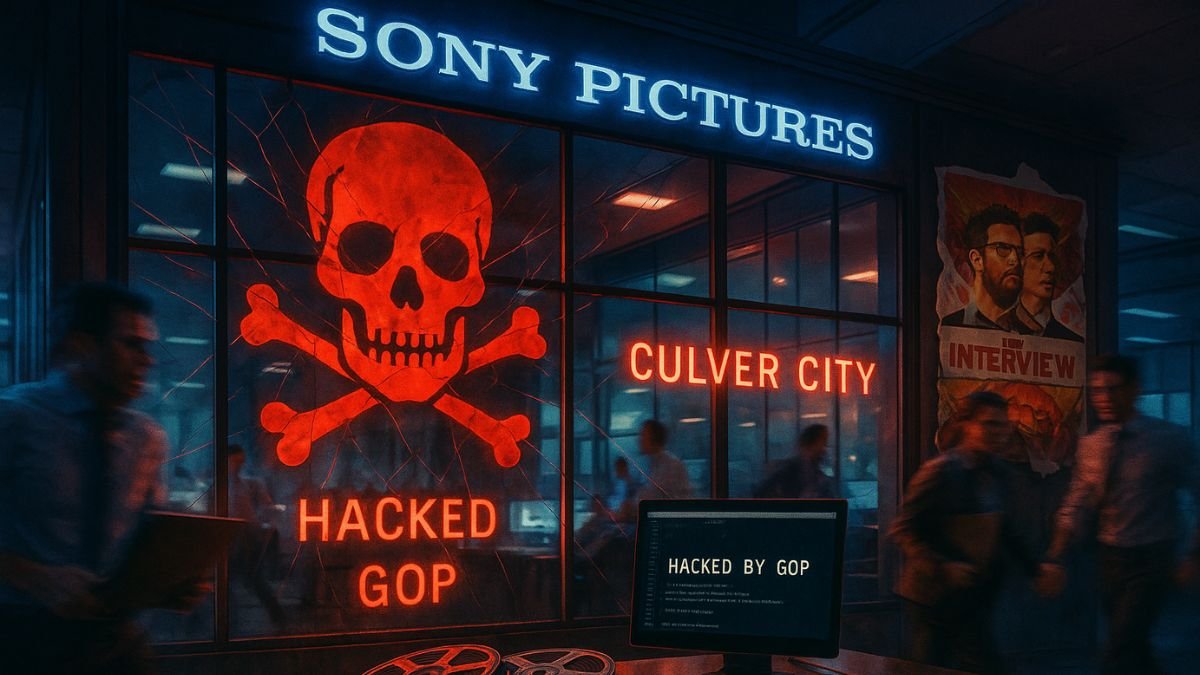
On November 24, 2014, workstations at Sony Pictures Entertainment lit up with a red skull and a blunt message from a group calling itself “Guardians of Peace.” Minutes later, systems began to fail. What looked like a leak campaign was a carefully staged destructive attack that erased boot records, leaked unreleased films and emails, and forced a major Hollywood studio to rebuild from the ground up.
Article Summary:
- Highly destructive breach at Sony Pictures Entertainment in late 2014 combined data theft with a wiper that crippled operations.
- “Guardians of Peace” leaked emails, films, and HR datasets, then triggered a disk-destroying payload.
- U.S. authorities later attributed the operation to North Korea, and researchers aligned tooling with Lazarus Group activity clusters.
- Key dates center on Nov 24 to Dec 19, 2014, covering lock screens, leak waves, public threats, and FBI attribution.
- The Destover wiper overwrote master boot records and files, while custom backdoors enabled staging and exfiltration.
- Fallout included operational disruption, legal exposure, and a costly rebuild.
- Defenders can apply lessons around identity hardening, segmentation, immutable backups, and destructive-attack drills.
- The incident reshaped Hollywood security and set a pattern for enterprise-scale destructive attacks.
What happened in the Sony Pictures hack?
The 2014 Sony Pictures breach paired large-scale data theft with a destructive wiper that knocked systems offline. Attackers calling themselves “Guardians of Peace” claimed responsibility, publishing internal data and issuing threats.
Sony Pictures Entertainment (SPE) faced a two-phase hit. First came stealthy reconnaissance and exfiltration of emails, unreleased films, and internal documents. Then the attackers detonated a wiper across Windows endpoints. With master boot records overwritten, thousands of systems would not boot. SPE shut down segments, pulled in incident responders, and began a long rebuild.
How did the breach unfold—day by day?
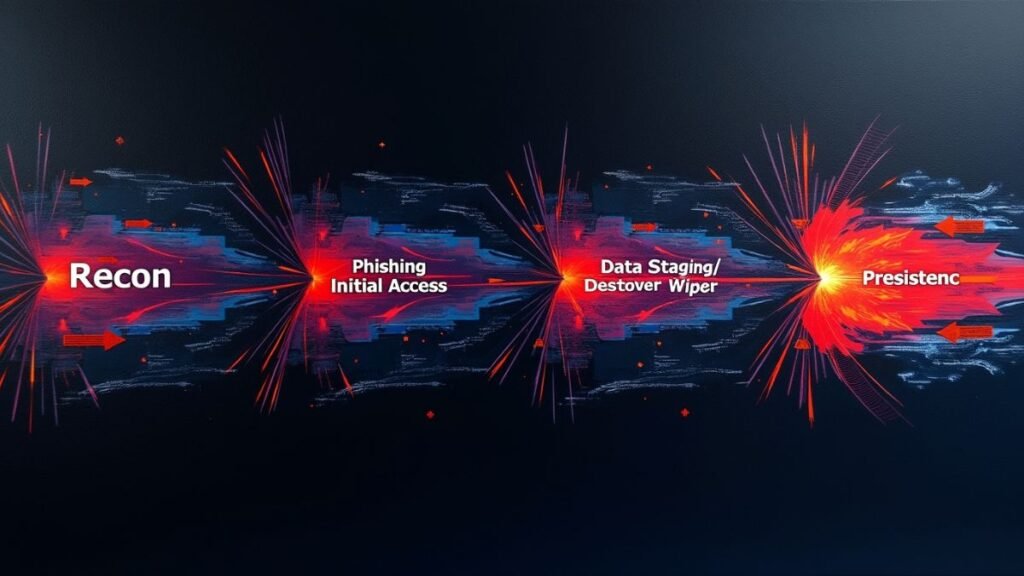
The breach progressed in phases. Infiltration and dwell time were followed by the November 24 lock-screen reveal, leak waves through December, threats tied to a film release, and public U.S. attribution on December 19.
Below is a concise timeline. Dwell time remains uncertain, yet evidence points to significant pre-positioning before the destructive stage.
| Date (2014) | Milestone | What changed inside SPE |
|---|---|---|
| Prior to Nov 24 | Stealth phase | Initial access via spear-phishing and stolen credentials. Data staging begins. |
| Nov 24 | “Hacked by #GOP” lock screens | Workstations display a ransom-style note. Wiper activity disrupts boot. |
| Late Nov | Network containment | Segments taken offline. Incident response mobilizes. First leak parcels appear. |
| Early Dec | Leak waves intensify | Unreleased films and troves of emails and HR data leak publicly. Scrutiny surges. |
| Mid Dec | Threats escalate | Public messages reference The Interview. Distribution plans change. |
| Dec 19 | FBI attribution | U.S. publicly attributes the attack to North Korea. |
| Late Dec–Jan | Aftershocks | Sanctions, litigation, and rebuild. Industry-wide security reassessments follow. |
Which tools and tactics were used by the attackers?
Attackers used spear-phishing and credential theft for entry, custom backdoors for persistence and control, and Destover as the wiper payload. Strong responses include Multi-factor Authentication (MFA), tight network segmentation, Endpoint Detection and Response (EDR), and offline, immutable backups.
Initial access. Spear-phishing and credential theft opened the door. Valid logins masked abnormal activity.
Persistence and C2. Custom implants, scheduled tasks, and scripts kept control and staged payloads.
Lateral movement. Credential dumping and Windows administration tooling moved the intrusion forward. Server Message Block (SMB) shares such as ADMIN$ and C$ enabled rapid spread.
Data exfiltration. Archives were staged internally, then moved in batches to external infrastructure.
Wiper mechanics. Destover targeted boot sectors and files. Overwritten master boot records left devices unbootable. Even recoverable disks required time-consuming reimaging, which disrupted operations at scale.
What data was exposed and what damage followed?
Leaked material included unreleased films, executive emails, salary and HR data, and employee personal information. Operational interruption, legal exposure, and reputational harm continued long after systems were restored.
Categories of leaked data
- Unreleased films and screeners
- Contract drafts, budgets, and strategy decks
- Executive email archives and internal chats
- HR datasets such as salaries and Social Security numbers (SSNs)
- Partner correspondence and distribution plans
Operational impact
- Enterprise reimaging at scale
- Core business applications offline and manual workarounds in place
- Partner relationships strained due to shared data exposure
Financial and legal
- Significant incident-response and rebuild costs in early filings
- Class actions from current and former employees over personal data exposure
- Insurance activity, regulatory notifications, and years of reputational repair
How was the attack attributed—and what was contested?
The FBI publicly attributed the attack to North Korea based on malware overlap, infrastructure reuse, and intelligence reporting. Some researchers questioned early public indicators, yet multi-year analyses aligned tooling with Lazarus Group activity.
Evidence cited by authorities
- Overlap between Destover and prior destructive malware
- Reused IP ranges, command infrastructure, and compilation artifacts
- Classified intelligence beyond public indicators
“The North Korean government is responsible for these actions.” — FBI, public update on the Sony investigation, December 19, 2014
Community debate
Some analysts asked whether open indicators alone proved state responsibility. Independent code-family clustering, key reuse, and operator habits later reinforced the government position.
Policy outcomes
Public attribution was followed by diplomatic statements and sanctions. The response set a precedent for handling destructive attacks tied to geopolitics.
What should defenders learn—and apply now?
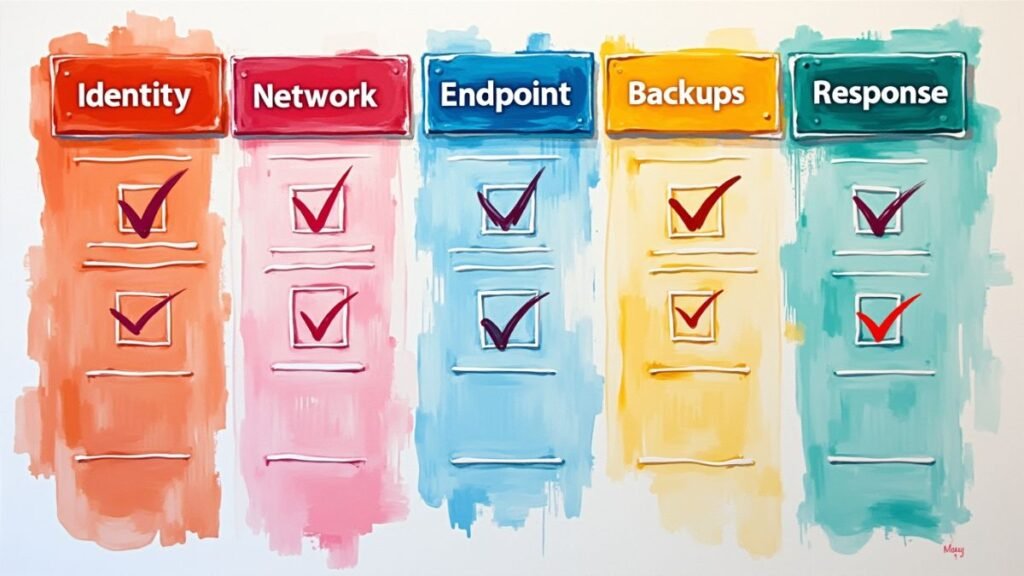
Plan for destructive scenarios. Harden identity, segment aggressively, keep offline and immutable backups, and drill fast isolation and rebuild. Align playbooks to known tactics so recovery meets business goals.
A prioritized control stack
- Identity first. Phishing-resistant MFA such as FIDO2. Conditional access for risky sign-ins. Privileged access workstations for admins.
- Segmentation. Break up flat networks with tiers. Apply strict SMB hardening.
- Detection and response. Endpoint Detection and Response (EDR) rules for wiper indicators, mass file operations, and boot-sector tampering.
- Backups. Offline and immutable backups with routine restore tests. Maintain golden images for rapid reimaging.
- Hardening. Application allow-listing and script-control baselines. PowerShell Constrained Language Mode where feasible.
- Data governance. Least privilege and Data Loss Prevention (DLP) for sensitive archives to shrink the blast radius.
Tabletop for destruction
- Simulate wiper at scale. Isolate segments, cut lateral paths, and trigger gold-image redeployments.
- Pre-stage crisis communications. Legal, PR, partner notifications, and employee support ready to go.
- Measure recovery. Track hours to isolate, reimage, restore core apps, and resume payroll and billing.
Quick wins
- Rotate and vault domain admin credentials and remove standing privileges.
- Block legacy protocols and restrict Remote Desktop Protocol (RDP) to just-in-time access.
- Baseline outbound traffic and alert on bulk exfiltration patterns.
The complete timeline at a glance
Key dates cluster around Nov 24 to Dec 19, 2014. Lock screens and wipe came first, then escalating leaks and threats, followed by public U.S. attribution. Rebuild and policy actions continued into early 2015.
| Phase | Date | Event |
|---|---|---|
| Reveal and wipe | Nov 24, 2014 | “GOP” lock screens appear and destructive malware disrupts boot across SPE systems. |
| Leak waves | Early to mid Dec 2014 | Unreleased films, email archives, and HR datasets leak in batches. |
| Threat escalation | Mid Dec 2014 | Public threats reference a film release. Major theater chains adjust plans. |
| Attribution | Dec 19, 2014 | FBI publicly attributes the attack to North Korea. |
| Aftermath | Late Dec 2014–2015 | Sanctions, litigation, and steady rebuild. Industry raises destructive-attack readiness. |
What changed in enterprise defenses after Sony?
- Contract language shifted toward destructive-attack service levels and clear Recovery Point Objective (RPO) and Recovery Time Objective (RTO) guarantees.
- Studios and media firms adopted identity-first roadmaps and tiered administrator models.
- Backup programs moved to immutable snapshots with quarterly restore drills and documented owner playbooks.
- Cyber insurance questionnaires began to ask about wiper-specific procedures, isolation steps, and rebuild speed.
Key takeaways
- Destructive attackers often exfiltrate first and wipe second to increase leverage.
- Identity controls, segmentation, and offline backups determine survivability more than any single product.
- Practice destructive-attack playbooks as routinely as fire drills.
- Public debate over attribution is common. Operator tradecraft and code lineage reveal long-run patterns.
- Clear communication with employees and partners is part of incident response.
Conclusion
The Sony Pictures breach marked a turning point for destructive cyber operations. Credential abuse, lateral movement, and a timed wiper turned a targeted intrusion into a business crisis. The durable playbook is direct and repeatable. Build identity-centric defenses, segment networks, maintain immutable backups, and rehearse fast recovery that brings core services back within your stated RTO.
Want a ready-to-use drill? Adapt our Red vs Blue destructive-attack checklist to your environment, assign owners, and run a one-hour tabletop this week. Measure time to isolate, reimage, and restore your top three business services.
FAQ
Did the attackers only wipe, or did they also steal data?
Both. Exfiltration preceded the wiper, which increased pressure and reputational damage.
Was this linked to a film release?
Threat messages referenced a specific release. The operational playbook aligns with other state-linked campaigns that use credential abuse, staged exfiltration, and a final wiper.
How much did it cost?
Early disclosures cited tens of millions in direct costs. The broader impact covered legal actions, rebuild labor, and brand damage.
What is Destover?
A destructive malware family that overwrites master boot records and files. The goal is to render devices unbootable and force large-scale rebuilds.
What should small teams prioritize first?
MFA everywhere, admin tiering, tight SMB and RDP controls, offline backups with restore drills, and a tested imaging pipeline.
About the Author
Ethan Cross is the Lead Analyst at HakTechs.com with more than 10 years of hands-on experience in ethical hacking, incident response, and malware analysis. He has advised studios, SaaS providers, and regulated enterprises on wiper-specific recovery and identity-centric defense. His work focuses on clear steps teams can take under pressure.
To ensure the highest level of accuracy, every technical claim in this article was verified against primary sources and reviewed by our editorial team.
Sources
- FBI — Update on Sony Investigation (Dec 19, 2014): https://www.fbi.gov/news/pressrel/press-releases/update-on-sony-investigation
- CISA/US-CERT — Targeted Destructive Malware (TA14-353A): https://www.cisa.gov/uscert/ncas/alerts/TA14-353A
- Kaspersky Securelist — Destover: Mystery of the Wiper (Dec 2014): https://securelist.com/destover/67795/
- Novetta Coalition — Operation Blockbuster (Lazarus tooling analysis): https://operationblockbuster.com/
- Los Angeles Times — Sony says studio hack cost it $15 million (Feb 4, 2015): https://www.latimes.com/entertainment/envelope/cotown/la-et-ct-sony-hack-cost-20150204-story.html
