
What common mistake let attackers turn a single stolen credential into millions of exposed records?
This long-form analysis sets the scope: we examine major incidents to explain how each breach unfolded, what information was taken, and which defenses failed. The focus is on enterprise and consumer systems such as CRM, collaboration, HR, and vendor platforms.
The threat climate blended social engineering, vendor weaknesses, and targeted exploitation. Attackers moved from small footholds to broad data compromise by abusing credentials, third-party integrations, and poor authentication.
We verify incidents against official disclosures and reputable sources, separating confirmed facts from rumor. Each case study will show the breach vector, exposed information, operational impact, and repeatable security lessons teams can act on.
Key Takeaways
- Focus on authentication. Weak or shared credentials were a common root cause.
- Assume third parties matter. Vendor controls and supply chains were frequent failure points.
- Protect sensitive data. SSNs, financial and medical records surfaced in many incidents.
- Detect early. Faster detection limits impact and recovery time.
- Verify sources. We rely on official advisories and reputable reporting to separate fact from noise.
Lede: A forensic snapshot of 2025 app breaches, exposed data, and the attackers’ favorite doors
Most incidents clustered around business applications and third‑party platforms, where integrations and vendor gaps gave attackers repeatable access paths. This section summarizes how those common doors worked and what types of information were at stake.
A string of high‑impact incidents showed attackers favoring business software and partner links as routes to large‑scale data theft. Compromised credentials, voice and email social engineering, and vulnerable vendor systems opened entry into collaboration tools, CRM records, and HR platforms.
What sat behind those doors mattered. Contact lists and customer data were often the first items taken. In many cases the exposed information escalated to bank details and Social Security numbers, raising the severity from a routine data incident to a full data breach.
Operational reality: even when core infrastructure stayed intact, connected systems amplified risk and allowed lateral movement into sensitive stores. We next move from this snapshot into a timeline and deep dives, then extract patterns and practical countermeasures.

To understand common vectors in detail, read a concise primer on common types of cyber attacks.
The year at a glance: Timeline of major 2025 app breaches and escalating attack patterns
The calendar traced a shift from targeted social engineering to wide vendor compromise. Early phishing and credential theft tested human defenses; later failures in vendor controls multiplied the fallout across linked systems.
What began as focused email and account tricks moved into mass exposure when vendors and integrations were exploited. Attackers used stolen credentials and convincing prompts to gain persistent access and harvest high‑value records.
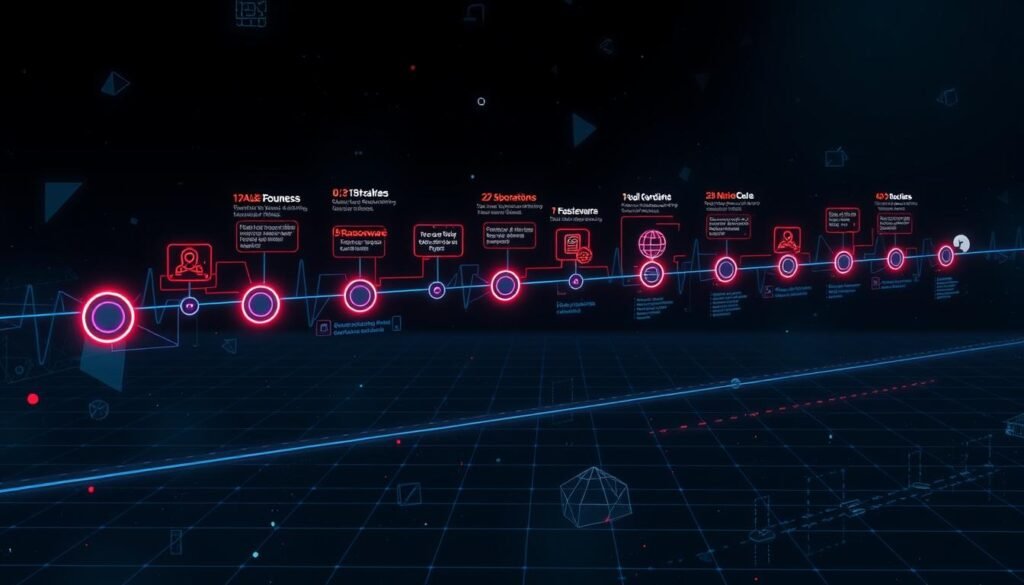
Quarterly momentum: From social engineering to mass vendor exposure
The year opened with scaled social engineering and phishing campaigns probing CRM and collaboration tools. By late summer and fall, incidents at major brands showed a clear pivot: vendors became force multipliers for attacks.
Most targeted data: What attackers sought
High‑value information included Social Security numbers, passwords, payment details, and customer records. These items enabled identity fraud and account takeover at scale, which is why they were prioritized by threat actors.
Common vectors: How access was gained
Dominant vectors were compromised credentials, phishing, third‑party SaaS weaknesses, and ransomware with extortion. Notable incidents ranged from Google/Salesforce social engineering to Qantas (5.7M) and SimonMed (1.27M), with others exposing SSNs and employee data.
| Month | Incident | Notable impact |
|---|---|---|
| Aug | Salesforce/Drift social engineering | Vendor-level access tested |
| Sep | Harrods, Kering, Volvo/Miljödata | Customer IDs, SSNs, ~430k+ exposed |
| Oct–Nov | Qantas, SimonMed, Washington Post, UPenn | Millions of records; SSNs and bank data |
| Nov | Nikkei Slack, DoorDash | Account and contact data; social engineering |
Want a deeper look at attacker tactics and group techniques? Read a focused primer to learn more: learn about Axiom hacker group techniques.
DoorDash breach: Social engineering turns customer and partner data into exposed targets
A targeted scam against staff and partners allowed attackers to collect names, emails, phone numbers and addresses. The incident shows how easily contact records become a vector for follow‑on fraud when human trust is exploited.

Data exposed and impact on customers, employees, and partners
The information taken included customer and worker names, email addresses, phone numbers, and physical addresses. This mix of contact data makes victims vulnerable to realistic, targeted phishing and voice‑based scams.
Cause and response: Social engineering, authentication, and malware monitoring
Attackers used social engineering rather than cracking encryption or network defenses. They manipulated trust to gain access and pivot into relevant accounts and systems.
- User risk: Expect convincing refund, delivery, or support lures via phone or email. Verify sender domains and prefer in‑app messages.
- Company response: DoorDash emphasized education and plans to expand malware monitoring and staff training. Read the reported contact exposure on contact information exposure.
- Immediate actions: Reset reused passwords, enable multi‑factor authentication (MFA), and apply least‑privilege controls to related accounts.
“When contact points are exposed, attackers use them to craft believable, high‑impact scams.”
Washington Post and the Oracle-linked breach: When third‑party systems leak SSNs and bank data
The Washington Post confirmed that an exploited vendor module exposed payroll and tax records for thousands of staff. The incident shows how a single enterprise system flaw can turn archived files into a high‑value target for extortion.
A security incident affected 9,720 current and former employees and allowed attackers to access roughly 180 GB of archives.

What sensitive information was taken?
Exposed categories included names, bank account and routing numbers, Social Security numbers, and tax ID numbers. That mix raises the risk of identity theft and payment fraud for impacted workers.
How did attackers get in?
Threat actors leveraged a vulnerability in Oracle E‑Business Suite (EBS). That software weakness gave the group access to archived systems and files, and it supported extortion attempts tied to Clop/FIN11 activity.
Security lessons and recommended controls
- Vendor risk management: require fast vulnerability disclosure, compensating controls, and contractual security obligations for critical third‑party systems.
- Access controls: enforce multi‑factor authentication for admin and remote logins and apply least privilege to archive stores.
- Data protection: encrypt and tokenize bank details, segregate archives, and apply data‑centric safeguards to limit exposed information.
“A vendor flaw can become an enterprise breach; protect the data at rest and the paths that reach it.”
University of Pennsylvania double hit: Compromised SSO credentials and an Oracle zero‑day
Two separate incidents combined stolen single‑sign‑on tokens with an exploitable enterprise module, widening impact across email and cloud stores. The result placed extensive personal data and sensitive records at elevated risk.

Incident one: SSO credential abuse, email system access, and data exfiltration
Attackers used stolen SSO credentials to log into university accounts. They gained unauthorized email access and moved laterally into SharePoint and Box.
UPenn reported roughly 1.2 million individuals possibly affected. That scale means a large pool of information for follow‑on phishing and fraud.
Incident two: Oracle exploitation, scope uncertainty, and third‑party exposure
A separate event exploited an Oracle vulnerability. Initial notices named 1,488 impacted people, but third‑party exposure left the scope uncertain.
PII at risk: names, phone, addresses, demographics, donation history
Exposed items included names, birthdates, addresses, phone numbers, demographics, and donation history. Those attributes help attackers craft precise scams and social engineering.
- Reconstruct: federated identity abuse enabled deep cloud access when guardrails failed.
- Quantify: ~1.2M potential records in the first event; smaller but sensitive Oracle impact in the second.
- Mitigate: deploy phishing‑resistant MFA, segment cloud repositories, and reduce stored sensitive attributes via retention limits and tokenization.
“Treat SSO as a high‑value target: protect tokens, limit scope, and audit every cross‑system access.”
For context on similar incidents, review recent data breaches and vendor advisories to strengthen your security posture.
Nikkei Slack app compromise: Malware-stolen credentials expose chats and email addresses
Malware on a single employee workstation turned a messaging integration into a doorway for large-scale data exposure. The incident shows how unmanaged endpoints can negate enterprise controls and leak sensitive records held in collaboration systems.

What attackers accessed?
Names, email addresses, and chat history from roughly 1,700 Slack accounts were taken after a credential harvester infected an employee device. That set of information lets attackers craft highly targeted social engineering against customers and colleagues.
Where the failure occurred and how to harden systems
The entry point was malware on a personal computer that captured login data and tokens. This proves unmanaged endpoints can undermine corporate authentication and broaden access across interconnected systems.
- Reduce scope: enforce app allowlists and limit third-party scopes to what is strictly needed.
- Strengthen authentication: enable multi-factor authentication (MFA) for collaboration tools and monitor unusual token use.
- Operational steps: revoke stale tokens, audit app permissions, and isolate compromised accounts fast.
Training and detection
Teach staff to spot suspicious prompts, unexpected login requests, and unknown device authorizations. Regular security awareness and simulated phishing help stop credential theft before it becomes a full data breach.
“Protect endpoints and limit integration scopes—those two controls cut the easiest paths attackers use to reach chat history.”
Qantas frequent flyer data exposure: Vendor vulnerability leads to millions of customer records
A flaw in a partner contact platform opened a direct route to millions of loyalty profiles. The incident exposed names, email addresses, frequent flyer numbers, phone numbers, dates of birth, and home addresses for roughly 5.7 million people.

The affected dataset creates a long‑lasting risk for account takeover and targeted loyalty scams. Stolen information and frequent flyer numbers let attackers try credential stuffing, social engineering, or fraudulent redemptions.
The root cause was a vulnerability in third‑party software, showing how a single vendor weakness can defeat upstream defenses. This is a clear supply‑chain failure that demands continuous monitoring and contractual controls.
- Immediate steps: rotate loyalty credentials, enable multi‑factor authentication where available, and monitor for suspicious redemption or profile‑change alerts.
- Containment: isolate vendor integrations, apply least‑privilege data sharing, and revoke exposed tokens or keys.
- Ongoing: require vendors to run joint incident response drills and report findings promptly to shorten detection and containment time.
“Vendor software can be the weakest link; enforce controls and test them regularly.”
For reported coverage of the incident, see the reported Qantas incident.
SimonMed Imaging ransomware lag: Months between attack and notification magnify risk
When notification lags months behind an attack, exposed patient records face prolonged risk from opportunistic attackers. The long delay after the Medusa ransomware incident widened the window for identity theft, insurance fraud, and targeted phishing.
The SimonMed cyberattack began in January, but patients were not told until October. That months‑long gap allowed attackers extra time to reuse credentials, test access to related systems, and monetize stolen information.
The exposed information was broad and sensitive: names, addresses, dates of birth, service dates, provider details, medical record and patient numbers, diagnoses, medications, insurance data, and driver’s license numbers. This mix raises long‑term risks beyond immediate financial loss.
- Why the delay matters: longer windows let credential stuffing and spear‑phishing campaigns succeed against customers and staff.
- Defensive steps for providers: maintain immutable backups, segment clinical systems from administrative networks, and enforce egress controls to detect abnormal data movement.
- Advice for affected individuals: watch explanations of benefits (EOBs), place fraud alerts with credit bureaus, and consider credit monitoring because driver’s license and insurance numbers were exposed.
“A late notification turns a one‑time intrusion into a prolonged attack surface—speed matters as much as containment.”
For teams reworking vendor and incident timelines, review coordinated vulnerability guidance and disclosure practices at vendor vulnerability advisories.
Motility Software Solutions breach: Insider malware deployment and exposed customer PII
An internal operator’s trusted access became the attack vector when malware was intentionally introduced from within. The event encrypted systems and led to the theft of sensitive customer information for roughly 766,000 people.
The insider angle matters: a permitted user deployed malware that bypassed perimeter controls. This shows why behavioral monitoring and least‑privilege rules are critical for every account with elevated access.
Exposed personal information included names, portal addresses, email addresses, phone numbers, dates of birth, Social Security numbers, and driver’s license numbers. Those identifiers raise the risk of identity fraud and new‑account creation attacks.
Technical controls to reduce risk:
- Privileged Access Management (PAM): limit who can run sensitive processes and log all privileged sessions.
- Anomalous process detection: monitor for unusual binaries, scripting, or bulk encryption activity from internal accounts.
- Data Loss Prevention (DLP): block and alert on mass exports of customer records and high‑risk fields.
What affected users should do now: change portal credentials, enable strong authentication where possible, monitor credit reports, and consider a credit freeze if Social Security numbers or driver’s license numbers were exposed.
“Insider threats combine trust with capability—treat internal access as high risk and verify actions continuously.”
For related analysis on attacker tactics and group behavior, see our analysis of SOWBUG.
SitusAMC vendor incident: Corporate records and potential customer data exposure
SitusAMC reported a security incident that exposed corporate records and may have included customer information. Because the cause was not identified at disclosure, treat all connected systems and integrations as potentially at risk until forensic scoping finishes.
The likely sensitive sets include accounting documents and legal agreements. Those files can reveal confidential terms, customer identities, and internal process details that attackers prize.
Until investigators confirm scope, assume that adjacent repositories, backups, and third‑party feeds could carry the same exposure. Limit access, revoke temporary credentials, and freeze data transfers to stop further spread.
- Strengthen vendor assurance: require discovery scans, encryption at rest and in transit, and continuous scanning for exposed repositories across vendor systems.
- Treat records as sensitive: apply tokenization or redaction for legal and accounting files when possible.
- Communicate clearly: publish timelines, affected categories, and remediation steps so downstream banking clients can protect customers promptly.
“Transparency shortens the window for harm—notify fast, scope thoroughly, and protect access while you investigate.”
For practical steps on reducing vendor risk and securing third‑party integrations, see guidance on secure web applications.
Supply chain shockwaves: Volvo/Miljödata ransomware and U.S. employee Social Security numbers
A single HR vendor incident turned into a mass exposure affecting many employers, including Volvo North America. The ransomware attack on Miljödata exposed roughly 870,000 records and included Social Security numbers, names, addresses, and dates of birth for some U.S. employees.
A compromise at Miljödata created a broad blast radius. When the HR platform was held by the DataCarry group, sensitive employee identifiers propagated across client systems.
Scope and exposure: SSNs, addresses, and employee identifiers
The incident exposed large sets of personal information and made HR stores a high‑value target. In some cases, U.S. staff at Volvo had their social security numbers and related records leaked.
Supply‑chain failure modes and vendor account controls
Attackers used vendor credentials and broad platform permissions to aggregate data. A single vendor account with wide access becomes a central point for harvesting employee information.
- Governance: enforce vendor account segregation and periodic credential rotation.
- Conditional access: apply least‑privilege policies and monitor anomalous authentication in real time.
- Data minimization: avoid copying Social Security numbers across systems; tokenize or vault identifiers to reduce exposure.
Practical step: treat HR platforms as critical systems and test vendor controls during contract reviews and incident drills.
“A vendor compromise can turn one failure into many — limit where sensitive numbers live and lock down vendor access.”
For related analysis of group behavior and supply‑chain risk, see our review of OrangeWorm techniques at this analysis.
Banking and insider risk: FinWise-American First Finance prolonged data exfiltration
A trusted operator quietly siphoned customer records over years, showing how insider access can erode protections one export at a time. The incident underscores long dwell time and why continuous monitoring matters for financial systems.
FinWise disclosed that a former employee misused trusted access for roughly two years and exported records for about 689,000 American First Finance customers. Exposed items included full names, personal identifiers, and sensitive financial account data.
Dwell time enabled systematic harvesting: prolonged access let the actor query and copy high‑value tables without immediate detection. Continuous auditing and alerts on unusual exports are essential.
- Risk: combined identity details and account numbers let attackers set up fraudulent payments or make unauthorized transfers.
- Controls: deploy just‑in‑time access, strict segregation of duties, and immutable audit logs tied to automated anomaly detection for high‑risk records.
- Customer guidance: verify statements, enable transaction alerts, and rotate online banking credentials if you use overlapping logins.
“Treat long‑running access as high risk — short lived privileges and tight logging shrink the attack surface.”
Luxury retail under siege: Harrods and Kering face customer data theft and extortion
Two high-profile incidents laid bare different failure points: a partner compromise that exposed loyalty profiles, and a ransomware extortion that claimed broad corporate files. Both events show how retail data and customer trust can be lost through vendor gaps or aggressive extortion tactics.
Harrods
Harrods: Loyalty data and customer identifiers exposed via third‑party provider
Harrods confirmed a breach that affected about 430,000 individuals. The incident came through a third‑party e‑commerce provider and exposed names, contact information, loyalty program details, and membership IDs.
This set of customer data is valuable for social engineering, account takeover, and unauthorized reward redemptions. Tokenizing loyalty IDs and limiting linked contact fields reduces combined risk.
Kering
Kering: Ransomware with double extortion and unknown scope
Kering disclosed a ransomware incident with data theft and double extortion. Attackers claimed customer, employee, and business files, but the exact numbers affected remain undisclosed.
When scope is uncertain, treat archives and backups as at‑risk and tighten access controls until forensic work confirms what leaked.
| Incident | Primary data exposed | Key risk / note |
|---|---|---|
| Harrods (third‑party) | Names, contacts, loyalty IDs, membership details | Identity misuse; reward fraud; vendor supply‑chain risk |
| Kering (ransomware) | Customer & employee files (claimed) | Double extortion; unclear scope increases exposure window |
| Retail sector | Purchase history, payment tokens, account links | Mass phishing and credential stuffing risk |
- Protect loyalty accounts. Require multi‑factor authentication (MFA) for portals and monitor mass points redemptions.
- Reduce joined data. Decouple loyalty IDs from contact fields and avoid storing payment details with membership records.
- Vendor oversight. Enforce quarterly assessments and event‑driven notification clauses with e‑commerce providers.
- Incident response. Freeze exposed integrations, rotate keys, and verify backups before restoring access.
“Loyalty systems are low-hanging fruit for fraudsters; protect them like payment rails.”
For tactics and group analysis relevant to supply‑chain intrusions, see our analysis of DragonOK.
Kido and public sector breaches: Children’s data and county networks caught in ransomware crossfire
When threat actors hit youth services and local government systems, the harms are both digital and physical. Stolen photos, home addresses, and official identifiers create long‑term risks that go beyond a single data incident.
Radiant’s ransomware theft at Kido International affected about 8,000 children. The stolen information included names, photos, home addresses, and family contact details. Some content was posted publicly before a partial takedown, which increased the exposure and immediate safety concerns.
Why children’s records are uniquely sensitive
Children’s photos and home addresses raise physical safety and privacy stakes. Public posting compounds harm even after removal because copies can circulate. Parents and guardians face long, unpredictable recovery tasks.
Union County, Ohio: scale and consequences
Union County reported a ransomware incident that touched more than 45,000 residents and employees. Exposed items reportedly included social security numbers, financial details, and medical information. County network and systems failures can leak comprehensive resident records that enable long‑tail identity and healthcare fraud.
- Defensive actions: segment networks, enforce application allowlists, and keep offline, MFA‑protected backups to recover without paying a ransom.
- Citizen guidance: enroll in credit monitoring, place fraud alerts, and avoid responding to unsolicited county‑related messages asking for more personal details.
“Treat child and public‑sector data as high‑risk: protect access, isolate backups, and notify quickly to limit downstream harm.”
Salesforce-linked compromises: Google, TransUnion, and others highlight CRM exposure
CRM integrations proved a fast route for attackers who used social engineering to secure permissions and pull contact records. The result: large pools of business and consumer data were harvested and reused for targeted fraud.
A small phone call and a clicked approval opened wide access to customer records in several CRM systems.
Attackers impersonated IT or vendor staff, asked admins to approve a legitimate-looking OAuth consent, and then read or exported databases through the cloud API.
How fake support and malicious authorizations worked
Attackers secured app authorization through phone-based social engineering and forged consent flows. In one reported campaign, members of ShinyHunters impersonated IT to trick a Google employee into approving a malicious integration. That approval gave the actor downstream access to Salesforce and marketing platforms like Drift.
How exposed contacts amplify follow‑on attacks
Harvested contact lists fuel spear‑phishing and voice phishing (vishing). Even when consumer logins remain uncompromised, exposed business contacts let attackers craft believable messages and target account recovery processes.
Practical defenses and team behaviors
- Technical: enforce app allowlists, require admin approval via documented workflows, and monitor for anomalous API exports and large CRM export jobs.
- Operational: require secondary verification for any requester claiming IT, rotate credentials tied to third‑party tokens, and limit integration scopes.
- Education: train staff to verify install requests through separate channels and report suspicious prompts immediately.
| Vector | Typical impact | Recommended control |
|---|---|---|
| OAuth consent via phone social engineering | Mass contact export; targeted phishing | App allowlist; admin approval logs |
| Malicious marketing integration (e.g., Drift) | Email lists and CRM fields leaked | Restrict third‑party scopes; revoke unused tokens |
| Stolen CRM credentials | Persistent access to accounts and records | Phishing‑resistant MFA; monitor API anomalies |
“If an integration asks for broad permissions, treat the request like a security incident until proven safe.”
2025 app breaches: Patterns in authentication, phishing, and exposed databases
Across incidents, credential theft repeatedly let attackers step into trusted sessions and act like legitimate users. These common patterns explain why simple login failures turned into large‑scale data exposure and long recovery timelines.
Credentials and login abuse: Weak passwords, MFA gaps, and session hijacking
Credential theft and session hijacking were the repeatable first step. Attackers used stolen passwords, replayed tokens, or tricked admins into granting OAuth scopes.
Fixes: enforce phishing‑resistant multi‑factor authentication (MFA), remove shared passwords, and revoke stale sessions fast.
Cloud, web, and databases: Misconfigurations, vendor access, and data leaks
Misconfigured cloud buckets and overly broad vendor permissions created easy paths to databases and backups. Third‑party integrations often acted as the initial foothold.
Operational controls include strict admin allowlists, object‑store write monitoring, and capped egress per identity to stop mass exfiltration.
Data types most at risk: Social security numbers, payment data, account credentials
SSNs, payment details, and login credentials were the most monetizable items across incidents. Prioritize discovery and protection of these fields with tokenization and targeted monitoring.
- Connect the dots: credential theft + weak MFA = impersonation at scale.
- Surface the layer: scan web and cloud configs; limit vendor scopes.
- Prioritize: protect SSNs, payment numbers, and credential stores first.
- Improve resilience: seed honeytokens, enforce immutable backups, and log admin actions centrally.
| Pattern | Typical impact | Recommended control |
|---|---|---|
| Stolen credentials / session hijack | Persistent access; lateral movement | Phishing‑resistant MFA; session anomaly detection |
| Cloud/web misconfigurations | Unintended public data exposure | Automated config scans; object‑store alerts |
| Overbroad vendor access | Supply‑chain data harvesting | Vendor allowlists; contract SLAs; continuous monitoring |
| High‑value data leakage | Identity theft; payment fraud | Tokenization; DLP; prioritized alerting |
For an analysis of large incidents and defensive takeaways, review our roundup of major compromises at biggest data breach analysis and guidance on finding vulnerabilities in web systems at how to find the latest web.
From exposure to protection: Practical steps to reduce breach impact and recovery time
Fixing what was exposed starts with clear, repeatable steps that protect identity, limit vendor scope, and shield sensitive records. These are not optional checkboxes — they are the essentials that let teams stop damage and restore trust.
Enforce multi‑factor authentication, phishing‑resistant methods, and least privilege
Raise the bar on identity: deploy phishing‑resistant multi‑factor authentication (MFA) for high‑risk systems and backups. Rotate keys, remove shared passwords, and recertify access regularly.
Vendor governance: Continuous assessments, contract controls, and third‑party monitoring
Fortify vendors: require explicit security clauses, continuous external scanning, and joint incident response SLAs. Limit third‑party scopes and revoke unused tokens promptly.
Data‑centric safeguards: Encryption, tokenization, and automated data discovery
Protect the data itself: encrypt sensitive fields, tokenize SSNs and payment attributes, and run automated discovery to find hidden concentrations. Use DLP and egress monitoring to detect mass exports fast.
- Recovery readiness: protect backups with MFA and immutability, isolate backup networks, and test restores on schedule.
- Reduce footholds: enforce email authentication standards, train staff against phishing and social engineering, and disable unaudited remote admin tools and risky macros.
“Prioritize identity and data controls first — they shrink the attack surface and speed recovery.”
| Priority | Action | Benefit |
|---|---|---|
| Identity | Phishing‑resistant MFA, key rotation, least privilege | Limits attacker pivot and reduces credential reuse impact |
| Vendor | Continuous assessments, contract SLAs, token revocation | Shortens blast radius from third‑party exposures |
| Data | Encryption, tokenization, automated discovery, DLP | Reduces usable information and supports faster containment |
| Recovery | Immutable, MFA‑protected backups; isolated restores | Enables timely recovery without paying ransom or exposing more data |
Conclusion
Many companies found that weak identity checks and broad vendor privileges, not perimeter firewalls, determined exposure. Protecting credentials, limiting third‑party access, and treating sensitive fields as first‑class assets reduces the chance a single incident becomes a large‑scale data breach.
Take three actions now: strengthen authentication, minimize where sensitive data lives, and test incident response with data‑centric recovery goals.
Apply the patterns in this analysis to harden your systems and cut both the likelihood and the impact of future breaches. Use vendor SLAs, tokenization for high‑value information, and routine verification of admin access to keep customer and company records safer.
