Can one clear plan really take you from zero to job-ready in a high-stakes security field? This guide answers that question with practical steps and honest milestones.
We break complex topics into short, actionable lessons you can practice today. You’ll get plain definitions, real-world context, and a sequence that builds skills and proof of work.
Digital attacks now hit systems every 39 seconds. That pace raises risk across businesses, devices, and personal data. This guide explains core protections, how to pick a focus area, and which hands-on skills hiring managers expect.
Who benefits: career changers, IT generalists, ethical hackers in training, small-business owners, and students launching their first role. You’ll learn what employers list in job ads, how to set up a home lab, and how to build a portfolio that proves your knowledge.
What to expect: we cover threat understanding, IT basics, practical tools, role paths, and job prep. Step-by-step practice beats cramming—build skills in layers and apply them as you go.
Key Takeaways
- Attacks occur frequently; consistent practice matters more than quick study.
- Start with clear IT basics, then add hands-on projects and tools.
- Choose a focus area and map it to real job skills and certifications.
- Build a home lab and a portfolio that hiring managers can test.
- Use industry terms and documented examples to boost credibility.
Search intent and who this beginner’s guide is for
This section clarifies why you landed here and links that intent to a practical, step-by-step learning plan. You’ll see who benefits, which outcomes to expect, and how to choose the right next step.
If your goal is plain understanding of core concepts, this guide serves that need. If you want to compare paths, find entry-level certifications, or get hands-on fast, read on.

Who this helps: complete newcomers, IT support staff shifting into security, college students, career changers from non‑IT roles, and small‑business owners who need defensive basics.
Expected outcomes: a clear plan, a prioritized skill list, and the confidence to build projects and apply for junior roles. The sequence is modular—follow start to finish or jump to urgent topics like which entry-level certificates to target.
No advanced math or prior coding required. You need curiosity, steady practice, and tasks that create real artifacts: scripts, configs, or project notes that show measurable knowledge to hiring managers and professionals in U.S. markets.
Understanding cybersecurity and today’s threat landscape
The modern threat landscape centers on access, data theft, extortion, and service disruption. You’ll get a concise view of what attackers target, how they break in, and why the attack surface keeps growing.
Modern digital life widens the attack surface, turning small mistakes into big incidents. This expands risk to both personal devices and larger organization systems.

From unauthorized access to ransomware: what you must know now
Common attacker goals include:
- Credential theft and business email compromise.
- Ransomware: malware that encrypts files and often steals data to demand payment.
- Data exfiltration and financial fraud harming individuals and the organization.
How always‑online life and IoT increase exposure
Initial access often starts with phishing, social engineering, weak passwords, or unpatched systems. Exposed services and misconfigured cloud storage are frequent entry points.
Defense starts with a mindset: map an attacker’s path—reconnaissance, exploitation, lateral movement—and break it at multiple layers. Keep devices patched, enforce multi‑factor authentication, and segment IoT. Read vendor advisories weekly and learn what is cybersecurity to stay current.
Core IT foundations before security
Strong IT fundamentals make every later security concept easier. You’ll build confidence by learning how networks work, how operating systems behave, and how light scripting automates repeatable tasks.

How TCP/IP, subnets, and traffic flow matter
Understand the TCP/IP stack practically: packets, ports, and protocols. Know which ports map to common services and how routing moves traffic between subnets.
Why it helps: packet captures reveal anomalies and firewall rules, and subnet layout defines what you can monitor or filter.
Windows, Linux, and virtualization basics
Learn user accounts, processes, services, file permissions, logs, and package management. These are the building blocks for hardening and troubleshooting systems.
Use a hypervisor to run isolated Windows and Linux VMs, and add containers to test modern apps without touching production.
Scripting to automate repeatable tasks
Pick one small script each week. Use Python for parsing logs and calling APIs, Bash for Linux admin, and PowerShell for Windows tasks.
Impact: scripts speed incident triage, collect consistent baselines, and save hours when analyzing event data.
Hands-on labs to try:
- Capture traffic with tcpdump or Wireshark and inspect a suspicious flow.
- Practice Linux file permissions and audit logs.
- Write a PowerShell script to gather event logs across machines.
| Skill | Tool/Command | Practice |
|---|---|---|
| Network basics | ping, traceroute, tcpdump | Map subnet, capture and label a packet trace |
| OS fluency | ps/top, ls, chmod, Event Viewer | Track a process tree and check logs for errors |
| Scripting | Python, Bash, PowerShell | Automate log collection and parse outputs |
Tip: Document commands and outputs as you work. A short playbook becomes proof of knowledge you can discuss in interviews and link to in your portfolio. If you want a structured path to piece these skills together, see this learning guide.
Beginner skills that translate into real security impact
Practical security skills prove their value fast—spot anomalies, lower exposure, and document wins. You’ll focus on monitoring, tuning, and simple controls that reduce real risk and are useful across roles.

Network building blocks that matter
Start with segmentation, least privilege, and clear firewall rules. Baseline normal traffic so unusual flows jump out.
These steps make anomalies easier to spot and contain when incidents happen.
Intrusion detection made practical
Learn signatures versus behavior-based detection and how to tune alerts.
Reduce noise, validate alerts with test events, and measure false positives to improve precision.
Risk analysis, controls, and policy awareness
Identify assets, threats, and vulnerabilities, then pick controls that lower likelihood or impact.
Link daily tasks to policies like acceptable use, MFA, and incident reporting so decisions stay consistent.
Habits that build lasting knowledge
Read daily briefings, try a new detection each week, and log outcomes. Small wins—like a login-failure rule or a control mapping—show progress and transfer to SOC, testing, and engineering roles.
Tools and technologies you’ll actually use
Learn the core stack you’ll encounter in real environments—from network controls and EDR to practical testing toolkits. You’ll know what each tool does and when to use it for defensive and assessment workflows.
Start with a simple mental model: controls at the perimeter, visibility on endpoints, and a separate kit for authorized testing. Below are practical roles and examples you’ll see in many U.S. teams.

Firewalls, IDS/IPS, and secure network architectures
Firewalls enforce least privilege at network boundaries, log traffic for later analysis, and help anchor segmenting of critical assets. They filter flows between internal networks and the internet based on policies.
IDS/IPS (intrusion detection/prevention) flags suspicious patterns and can block known-bad activity. Use IDS alerts to guide triage and to refine intrusion detection playbooks.
Endpoint detection and response (EDR) and SOAR for modern ops
EDR gives process-level visibility and alerts that reveal post-compromise behavior. Integrate EDR findings with SOAR (Security Orchestration, Automation, and Response) to automate repeatable steps and speed containment.
Kali Linux, Metasploit, and practical testing kits
Use Kali Linux as a lab OS and Metasploit for controlled exploitation during authorized exercises. Tools like Nikto scan web apps for common vulnerabilities, while John the Ripper checks password strength.
Cain & Abel can assist with legacy Windows password recovery in sanctioned tests. Always get written permission and a clear scope before any testing.
| Tool | Role | Typical Output |
|---|---|---|
| Firewall | Traffic filter / segmentation | Access logs, rule hits, blocked flows |
| IDS/IPS | Intrusion detection and prevention | Alerts, signatures, blocked events |
| EDR | Endpoint visibility | Process traces, alerts, forensic artifacts |
| Metasploit / Kali | Penetration testing toolkit | Exploit logs, proof-of-concept reports |
| Nikto / John | Vulnerability and password testing | Scan reports, cracked-password summaries |
Show your work: save screenshots, redacted reports, and short playbooks. These artifacts prove you can run tests safely, interpret results, and harden systems afterward.
Want a structured learning path that ties these tools to hands-on labs? See this structured learning path to map tools to skills and portfolio outputs.
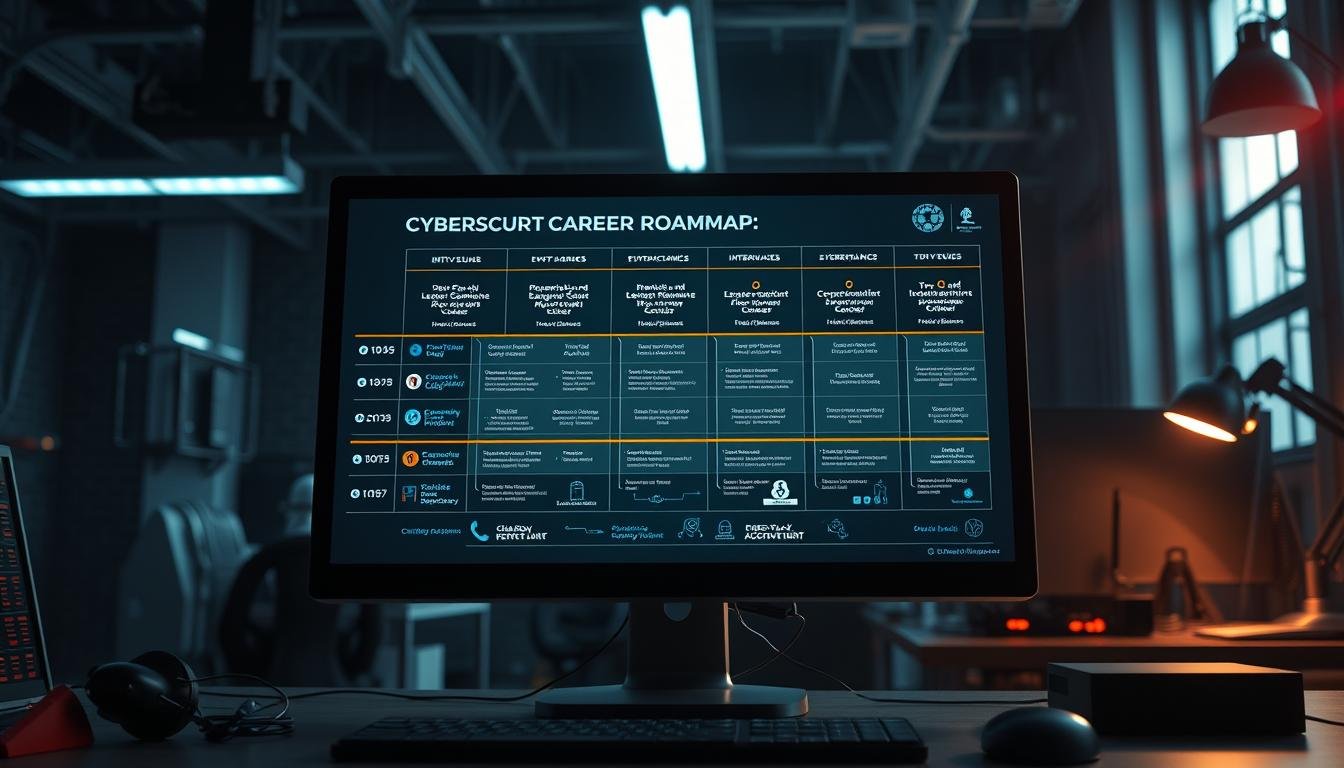
Cybersecurity career roadmap for beginners
Follow a clear sequence from IT basics to specialization with measurable milestones. This plan keeps you moving with realistic timelines and deliverables that hiring teams recognize.
Build a stepwise plan that turns basic IT skills into measurable security outputs you can show hiring teams.

From foundations to specialization: a practical learning sequence
Start with 8–12 weeks on foundations: networking, operating systems, and scripting. Aim to build a small home lab and document basic admin tasks.
Add 8–12 weeks focused on defensive basics: log analysis, alert triage, network visibility, and endpoint hygiene. Produce a playbook that shows how you investigate simple cases.
Mapping milestones by time and outcomes
By month 4–6 choose a direction—SOC analysis, ethical testing, GRC, incident handling, or engineering—and align projects to that path.
Set milestone outputs: a lab write-up, a detection-rule collection, a simulated vulnerability assessment, or a mini architecture diagram with controls.
- Weekly practice: 5–8 hours labs, 1–2 hours reading, 1 hour portfolio updates.
- Mock interviews: explain projects and tradeoffs; focus on clear reasoning.
- Track outcomes: labs completed, issues found and fixed, new techniques learned.
Seek early feedback from mentors or community groups and keep a living plan. Adjust milestones as your strengths and opportunities become clearer.
Education pathways that hiring managers recognize in the United States
Employers look for clear evidence you can solve real problems, not just a transcript. Understand how degrees, bootcamps, and targeted courses are weighed and when strong projects plus certifications make you competitive.

Which credentials hiring teams value
Associate and bachelor degrees in computer science or information systems show broad technical depth.
Targeted bootcamps and certificates focus on hands‑on labs and speed up practical readiness.
When less than a bachelor’s is acceptable
Junior SOC analyst roles, some compliance positions, and apprenticeships often accept an associate degree or a solid portfolio with one or two entry-level certifications.
How to choose and document programs
Prefer programs with labs, mentor access, and current syllabi. Pair study with at least one practical project and a certification that matches the role you want.
- Highlight transferable skills: IT support, networking, and systems admin work translate well.
- Be cost-aware: use free or low-cost resources before taking on debt.
- Keep proof: transcripts, project summaries, and course outlines ready to show interviewers and hiring professionals.
Entry-level certifications that signal readiness
Certifications help hiring managers gauge your baseline quickly. Start with one broad credential, then pick a specialty and prove it with labs and projects.
CompTIA Security+ and CySA+ for defensive analysis
CompTIA Security+ validates foundational security knowledge: networking basics, cryptography, and risk concepts. It is often listed in job descriptions for junior analyst roles.
CompTIA CySA+ builds on that base and focuses on detection, log analysis, and incident response workflows used in SOC teams.
PenTest+ and practical pentesting credentials
CompTIA PenTest+ covers planning, scoping, discovery, attack techniques, and reporting. Pair it with hands-on platforms like Hack The Box (HTB) to show real testing skills.
Study smart: map exam objectives to notes, make a checklist of weak areas, and rehearse in timed labs.
- Pick two–three strong credentials and back them with projects rather than collecting many outdated certs.
- Track maintenance dates and CEUs so credentials remain valid and talkable in interviews.
| Certification | Focus | Employer signal |
|---|---|---|
| CompTIA Security+ | Foundations: network, cryptography, risk | Readiness for junior analyst and entry security roles |
| CompTIA CySA+ | Detection, triage, response | Prepared for SOC analyst and threat hunting tasks |
| CompTIA PenTest+ | Testing: reconnaissance, exploitation, reporting | Practical testing skills for junior pentester roles |
Cyber defense and analysis inside a SOC
Inside a SOC, analysts turn raw alerts into action: triage, investigate, and contain incidents fast. You’ll see daily tasks, key skills, and the certifications that help you stand out.
What SOC teams do
SOC analysts monitor systems 24/7, scan for suspicious activity, and act to contain events. Typical workflows include triage, deep investigation, escalation, and clear documentation.
Threat intelligence teams collect indicators, track attacker tactics, and convert findings into detections and mitigations.
Core skills and soft skills
Build strong log analysis skills to correlate events across endpoints, network sensors, and identity systems. Learn basic malware behavior and intrusion detection patterns.
Crisp writing and calm under pressure matter as much as tool fluency during incident response.
Certifications and growth
Start with CompTIA Security+ for fundamentals, then CompTIA CySA+ for analyst depth. The HTB Certified Defensive Security Analyst (CDSA) validates hands-on SOC operations and incident handling.
Analysts often move into detection engineering, threat hunting, or consulting as they gain experience. On day one, learn the ticketing tool, request past playbooks, and document repeatable triage steps.
| Role | Focus | Starter cert |
|---|---|---|
| SOC analyst | Alert triage & response | Security+ |
| Threat intel analyst | Indicators & tactics | CySA+ |
| Security consultant | Assessments & guidance | HTB CDSA |
Ethical hacking and testing systems
A good penetration test exposes gaps an attacker could exploit, then maps fixes to business risk. Ethical testing proves value by producing clear, reproducible findings that teams can act on.
Learn how testers think, work, and prove value. Testers plan assessments, agree scope and rules of engagement, and then search for weaknesses. They verify findings and deliver reports with prioritized remediation.
- Common roles: penetration tester, security auditor, vulnerability assessor.
- Core methods: reconnaissance, enumeration, exploitation, post‑exploitation, and reporting—always within authorized boundaries.
- Scripting: automate scans and parsing to make checks repeatable and auditable.
Stay current: track new vulnerabilities and exploit trends so your tests reflect real threats. The report is your product: make it objective, reproducible, and tied to business impact.
Recommended training: hands‑on labs like Hack The Box’s Penetration Tester path, the Hack The Box Certified Penetration Testing Specialist (CPTS), and CompTIA PenTest+ to validate practical skills.
Responsibility and teamwork: ethical hacking requires strict consent, evidence handling, and collaboration with defenders to validate fixes and reduce recurrence. As you grow, specialize in web apps, cloud, or Active Directory testing to deepen your portfolio.
Governance, risk, and compliance for business impact
Good GRC turns vague security tasks into tracked, auditable projects that leaders can budget and approve. It connects controls to measurable business outcomes and helps reduce legal and operational exposure.
GRC professionals develop policies, run risk assessments, and oversee audits so controls support the organization’s priorities.
Common job titles
Cyber risk analyst, compliance consultant, and a senior executive like a CISO all work with GRC to shape strategy and governance.
Skills to build
- Frameworks & mapping: map controls to GDPR, PCI DSS, and ISO 27001 to cut regulatory exposure.
- Project & stakeholder management: translate technical issues into business terms and prioritize fixes.
- Evidence discipline: maintain control maps, risk registers, and audit trails that stand up to review.
Relevant certifications
Common certifications include Certified in Governance, Risk and Compliance (CGRC), CISA, CRISC, and CISSP. These validate the knowledge employers expect when linking security to operations.
Entry paths: junior compliance roles often hire people with strong writing, attention to detail, and foundational cybersecurity knowledge. Teamwork with engineering and SOC proves controls work in practice.
Tip: Track artifacts and show how controls reduced measurable risk. For a data-driven view of certs and pay impact, see this certification salary analysis.
Incident response and digital forensics
A well‑drilled incident team turns confusion into clear action within the first hour. When an incident occurs, defined roles, fast decisions, and repeatable steps limit damage and speed recovery.
Define the mission: limit damage, restore operations, and learn to prevent repeat incidents. Use the NIST Incident Response (IR) lifecycle as your guide: prepare; detect and analyze; contain; eradicate; recover; and run post‑incident reviews.
Common job titles
Incident responder and forensic analyst focus on triage, deep analysis, and preserving evidence so teams can act and legal needs are met.
Skills and tools to build
Practical skills include the NIST IR process, strict evidence handling, and clear report writing.
- Tools: Endpoint Detection and Response (EDR) for endpoint timelines, IDS/IPS for network indicators, and SOAR to automate containment and notifications.
- Processes: chain of custody, timelines, and documented playbooks for phishing, ransomware, and suspicious logins.
Training focus
Run tabletop drills and simulated alerts to build muscle memory. Prioritize concise updates to stakeholders and write reports that list root cause, impact, timeline, and assigned corrective actions.
Build resilience: track mitigation results and feed lessons back into detection and hardening efforts so systems and teams improve after each event.
Cybersecurity engineering and operations
Engineers and architects build the defenses others rely on. This section outlines typical role scopes, core technical skills, and the certifications that help you secure cloud and on‑prem systems at scale.
Security engineering blends practical architecture, code-driven controls, and continuous monitoring. Teams deliver secure designs, enforce network controls, and treat hardening as a repeatable product.
Common job titles
Typical roles include security engineer, security architect, and DevSecOps. Each title shifts focus from hands-on implementation to long‑term design and platform integration.
Skills to build
- Design and systems: secure architecture diagrams, control matrices, and runbooks.
- Cloud-first practices: identity-centric access, secrets management, and zero trust across hybrid environments.
- Network and automation: implement network controls and use infrastructure-as-code and policy-as-code to enforce baselines.
- Operations & metrics: logging, monitoring, and continuous improvement to verify controls perform as intended.
“Treat hardening baselines as products—version them, test them, and measure their impact.”
Relevant certifications
Consider CompTIA SSCP for core implementation work and CASP+ for enterprise planning. Add cloud depth with AWS Certified Security or Microsoft Azure Security Engineer (AZ-500) to show platform expertise.
Cross-team collaboration matters: partner with developers, platform teams, and SOC analysts to align technical controls with business risk. Design artifacts and tested runbooks become the portfolio items that prove you can secure systems and guide growth into architecture or platform leadership.
Hands-on experience: labs, projects, and competitions
Practice labs teach patterns that books rarely capture. Do small, repeatable projects and join timed challenges to turn knowledge into demonstrable output.
Doing beats reading. Build an isolated home lab with virtualization, take snapshots, and practice installation, hardening, and monitoring. Use version control to save configs and scripts so employers see change history and growth.
Build a home lab and ship small projects
Start with one manageable project: collect logs, parse them with a script, and write a short remediation note. Run simple web scans in a contained VM and document findings.
Tip: store playbooks, screenshots, and post‑mortems in a public repo and include clear readme files that explain impact.
Join CTFs to sharpen practical skills
Capture the Flag (CTF) events teach enumeration, exploitation, and reporting under time pressure. They speed up learning of testing, penetration tactics, and hands-on tool use while building community ties.
“Solve, document, and share—the simplest route to real-world experience.”
- Use checklists to reduce errors during complex exercises.
- Rotate tasks between detection and assessment to balance skills.
- Respect ethics: test only in your lab or with written authorization.
Portfolio, GitHub, and proof of work for entry-level roles
Your portfolio is tangible proof you can do the work. Structure repositories so reviewers see impact fast: defensive analysis, a scripting utility, and a short assessment report.
Write crisp READMEs that state context, objectives, steps taken, and measurable results. Keep language simple so non-technical reviewers can map your output to job needs.
- Pin 3–5 repos: each should show a different skill—detection rules, parsing scripts, and a redacted report.
- Show progression: include change logs and improved versions to prove learning.
- Protect data: redact secrets and use lab-generated information only.
- Include artifacts: runbooks, diagrams, timelines, and lessons learned notes.
- Keep it fresh: update deps and fix links so repos stay credible.
Make a simple landing page that guides recruiters to your top projects and clarifies the roles you target. Mirror key responsibilities from job descriptions and link projects to those needs.
Need tips on presenting remote work and interviews? See these remote job tips to align your portfolio with hiring expectations and open more opportunities.
| Item | Example | Why it matters |
|---|---|---|
| Pinned repos | Defensive rule, parser, report | Shows range of skills |
| Readme | Context, steps, results | Speeds reviewer understanding |
| Artifacts | Runbooks, diagrams, logs | Demonstrates applied knowledge |
Networking and professional development that opens doors
People accelerate your growth. Strategic networking and ongoing development expose you to opportunities, mentorship, and real-world problem solving.
Connections you make today often unlock the roles and mentors that shape your next steps. Join focused groups that match your technical interests and time frame.
Join communities, attend meetups, and connect with professionals
Start local and go global: attend nearby meetups, virtual study groups, and industry Slack or Discord channels. These channels surface job leads and hands-on projects.
Seek mentors who can review your portfolio and suggest realistic next steps. Volunteer to run a short session or write a recap; it builds credibility fast.
- Practice informational interviews: ask about day-to-day tasks, hiring signals, and skill gaps.
- Share work online: post write-ups, comment helpfully, and protect sensitive data.
- Track progress: keep a learning log with courses, labs, and outcomes.
| Action | Why it helps | Sample outcome |
|---|---|---|
| Attend meetups | Meet local professionals and recruiters | Referral or project invite |
| Find a mentor | Get tailored guidance and portfolio reviews | Clear study plan and interview prep |
| Volunteer | Build visibility and speaking experience | Public write-up and credibility |
Applying for jobs and breaking in without prior experience
A strategic application beats mass-sending resumes: focus on a few roles, tune your resume, and prepare for scenario screens. You can land your first role without prior security job titles by showcasing relevant projects, aligned certifications, and practical problem-solving.
Which roles to target
Prioritize entry openings that value demonstrable work: SOC analyst, junior risk or compliance analyst, security operations intern, or junior tester.
How to tailor resumes and applications
Mirror language from job descriptions and lead with measurable outcomes from labs and projects.
Highlight one or two matching certifications and list specific artifacts: a detection rule, a redacted test report, or a short runbook.
Preparing for technical screens and interviews
Practice concise explanations of a detection you wrote, an incident you simulated, or an architecture you designed.
Walk through scenario answers: phishing alerts, suspected ransomware, and a cloud misconfiguration. Use clear steps and outcomes.
- Show transferable experience: IT support or networking tasks map directly to monitoring and access management.
- Get references: mentors or community leaders who saw your work can vouch for readiness.
- Track applications: keep a sheet of roles, contacts, feedback, and next steps.
| Role | Target cert | Hiring signal |
|---|---|---|
| SOC analyst | Security+ | Log triage and alert handling examples |
| Junior tester | PenTest+ | Lab exploit write-ups or HTB boxes |
| Risk/compliance analyst | CGRC / CISA | Policy mapping and audit notes |
Stay consistent: block weekly time for applications, study, and lab work so momentum builds and you iterate faster.
Conclusion
You now have a clear, practical roadmap to start and grow in cybersecurity.Keep focus on fundamentals, hands-on practice, and artifacts that prove your skills.
Small, consistent steps—labs, projects, and ethical practice—create lasting momentum. Learn IT basics, build defensive habits, explore tools responsibly, and pick the path that matches your strengths.
Commit to regular updates: refresh your portfolio, rehearse a lab every two weeks, and set a review cadence. Schedule your first lab, choose a certification target, and join a community this week.
Respect ethics: always get written permission, redact sensitive data, and follow responsible disclosure. Defenders, testers, GRC, IR, and engineers all add value—collaboration opens opportunities.
Finish your study plan, document short goals, and lean on this complete guide as a reference while you adapt and grow.
