Could a staged breach reveal the true strength of your defenses? That question drove my past one-day experience inside a professional red team operation.
The session used live-fire realism to push defenders into urgent decision-making. Operators sometimes employ strategic shortcuts—like planting a hidden laptop on the corporate network—to create a controlled worst-case scenario and force real incident response under pressure.
This account focuses on business impact, rules of engagement, and disciplined execution rather than tool lists. Readers will see how goals and scope protect critical functions, where assume-breach fits, and why knowledge transfer through post-operation re-enactments matters.
The narrative previews planning cycles, role clarity, safe controls (Game Master and escalation paths), and the human side: confidence, tempo control, and story design that shape detection and learning outcomes.
For a complementary case study on tactics and timelines, review this minute-by-minute drill and this practical reflection.
Key Takeaways
- Live-fire realism exposes gaps faster than tabletop drills.
- Clear rules and safe controls protect production while forcing realism.
- Scope and objectives keep focus on business-critical functions.
- Assume-breach is a deliberate, useful stance during operations.
- Post-op re-enactments help defenders retain lessons.
- Unity during execution and dissent beforehand improve outcomes.
Setting the scene: a live-fire day in the life of a red team case study
I arrived to find a compact operation built to mirror real incident pressure and strict safety limits. The session was tightly scoped: a morning pre-brief that set objectives and rules, followed by a fixed execution window and a Game Master to arbitrate risk.
The exercise used real systems and tools, not scripts on paper. Defenders worked through live alerts, logs, and playbooks while operators introduced calibrated shortcuts—staged access points or a planted endpoint—to simulate a fast, deep compromise.

This structure creates business value. The company treats the run like athletic training: short bursts to get teams sharp at the right time. Announced windows in later cases drove prep and morale; unannounced elements preserved honest detection metrics.
Regulatory-quality frameworks such as CBEST and TIBER informed scenario design: threat-intel shaping, minimal broad awareness, and an emphasis on undetected response. That mix keeps realism plausible while protecting production and measuring true response time.
- Cadence: pre-brief → execution window → debrief.
- Controls: Game Master, escalation paths, and safe kill switches.
- Cultural effect: clearer empathy between security and IT, stronger IR capability.
What “red teaming” really means in practice, not just in theory
Red team work emulates real adversaries using threat intelligence to test if defenses stop, spot, and respond to realistic attacks. It focuses on mission outcomes, not only cataloging vulnerabilities.
Threat intelligence-driven operations vs. broad assessments (CBEST/TIBER-EU)
Frameworks such as CBEST and TIBER-EU formalize intelligence-led scenarios that target business-critical functions.
These operations use narrow knowledge compartments. Only minimal staff know. The goal is credible, relevant intrusion paths rather than broad coverage. Purple team work fills that coverage role by testing many tactics, techniques, and procedures.
Why “remain undetected” and assume-breach can both be valid in an exercise
Stealth helps complete mission objectives so defenders learn real detection gaps. If initial access stalls, planners may insert a documented foothold (assume-breach) to preserve learning objectives.
Red teaming ends with deep knowledge transfer: reenactments, telemetry comparisons, and rule tuning with the blue team. That operational focus produces fixes that matter to business risk.
| Approach | Primary Goal | Best used when |
|---|---|---|
| Red team | Emulate adversary to test response | Need mission-focused realism |
| Purple team | Maximize TTP coverage and tuning | Improve detection across many controls |
| Assessment | Catalog vulnerabilities and gaps | Baseline coverage and compliance |
For a guided service that blends intelligence and operations, review red teaming offerings that align scenario design to critical risk.
Framing the objectives: goals, scope, and agreed rules of engagement
Before any keystroke, the operation began by translating business risk into measurable objectives. This section explains how planners tie mission success to continuity, safety, and clear learning outcomes.
Critical business functions matter more than trophy credentials. Planners choose targets like payment rails, ATM/POS networks, or broadcast systems because those hits show board-level impact. The priority is to test resilience where downtime or fraud creates real loss.
Defining scope and safe boundaries
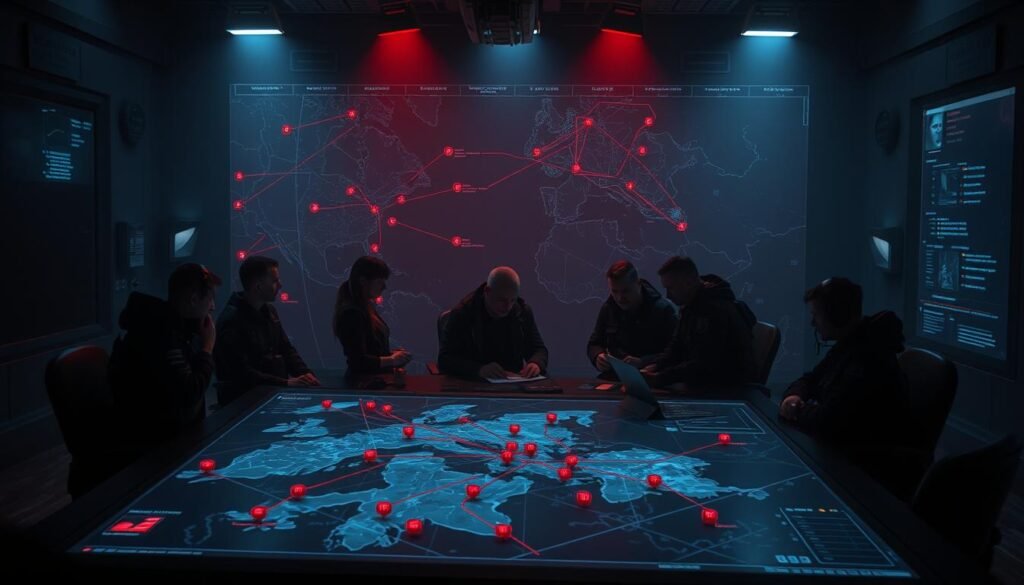
Scope documents list in-bounds systems, prohibited actions, and escalation contacts. They include safety stops, data-handling rules, and explicit no-destruct clauses. That clarity protects production while preserving realism.
Aligning to the kill chain
Operations map each step—reconnaissance, delivery, exploitation, lateral movement, and action on objectives—to expected telemetry. That mapping shows where defenders should see alerts and where lessons will be captured.
- ROE guardrails: no destructive payloads, staged artifacts, and immediate abort paths.
- Access constraints: handled credentials, logged assume-breach footholds, and minimal data sampling.
- Checkpoints: planned step reviews to validate safety and to create teachable moments for the blue team.
“Intelligence-led objectives make scenarios credible and replayable for after-action analysis.”
The operational order: planning, PACE, and adapting to atmospherics
An explicit operations order keeps everyone aligned when plans change under pressure. The OPORD lays out roles, phases, communications, and contingencies so the team can act fast and stay safe.
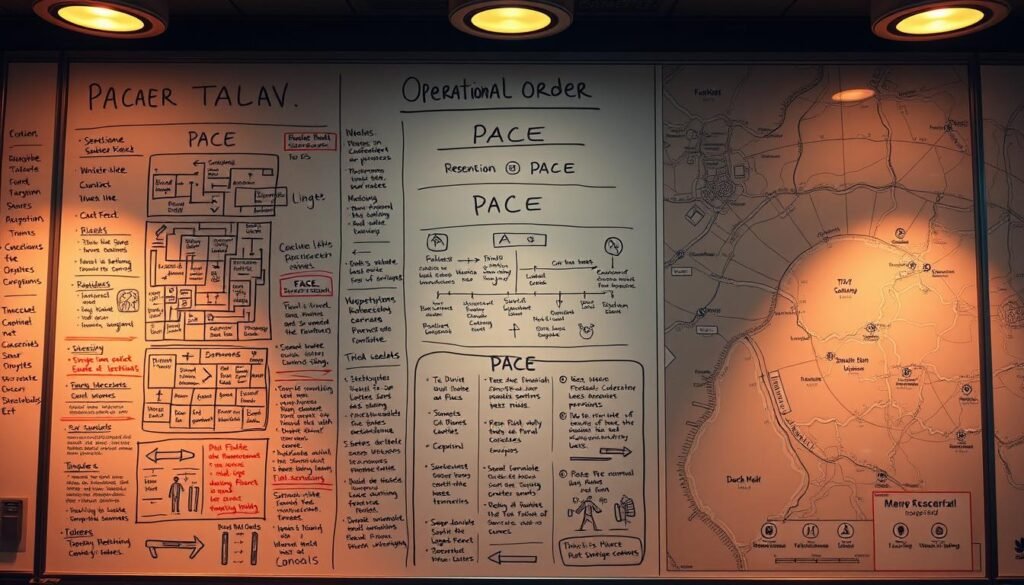
PACE planning—Primary, Alternate, Contingency, Emergency—makes pivots routine. If a primary phish fails, the team shifts to a prepared alternative. If controls react, the contingency kicks in. If safety risks rise, an emergency exit ends the run.
Primary, alternative, contingency, emergency plans that actually get used
Time-boxed rehearsals verify each plan. Pre-staged communications and backup resources prevent stalls. This way, operators avoid scrambling and preserve learning value.
Knowing the point of no return—and when to call it
Teams set clear stop markers tied to business impact and safety. Empowered leaders can call the point when continuing risks undue harm or mission failure.
Game Master control: safety, escalation paths, and note-keeping
The Game Master approves scope changes, mediates questions, and logs every decision. They link leadership, PR, and legal while enforcing rules of engagement.
| Element | Purpose | Example |
|---|---|---|
| OPORD | Align roles, comms, phases | Pre-brief, execution window, debrief |
| PACE | Planned pivots and exits | Primary phish → alternate delivery → safe abort |
| Game Master | Safety, escalation, notes | Approve scope change; contact legal |
Inside the scenarios: phishing, perimeter compromise, insider, and physical access
Operators ran focused attacks that combined low-noise reconnaissance with staged footholds to force deep response play. Each scenario aimed to expose how detection, escalation, and containment behave when defenders face realistic pressure.
Operators used four common tracks: tailored spear phishing, perimeter or cloud misconfiguration exploitation, insider misuse, and controlled physical ingress.

Strategic “cheating” to simulate worst-case and stress response
Strategic cheating means staged footholds, escorted pivots, or handed credentials that accelerate an attack to mission depth. This deliberate shortcut forces the security team into play at scale and surfaces gaps that slow, low-level probes might never reach.
From reconnaissance to lateral movement: living off the land
Reconnaissance focused on quiet mapping: enumerating shares, identity relationships, and cloud roles to find viable laterals. Living off the land reduced noise by using native admin tools and memory-resident techniques.
- Pivoting: proxying and relays to cross subnets without heavy endpoint footprints.
- Context: minor misconfigs plus weak segmentation create real vulnerabilities in depth.
- People: social vectors and approval gaps often grant access without malware.
Every step mapped to observable artifacts so defenders could learn even if the adversary stayed hidden. That alignment turns stealthy tradecraft into measurable lessons for future hardening.
Tools, tradecraft, and opsec: how tactics shape detection risk
Tradecraft choices often decide whether an intrusion triggers an alert or slips by unnoticed. Think of command channels, pivots, and payload delivery as part of the same risk control system. Each choice changes the signal defenders see.
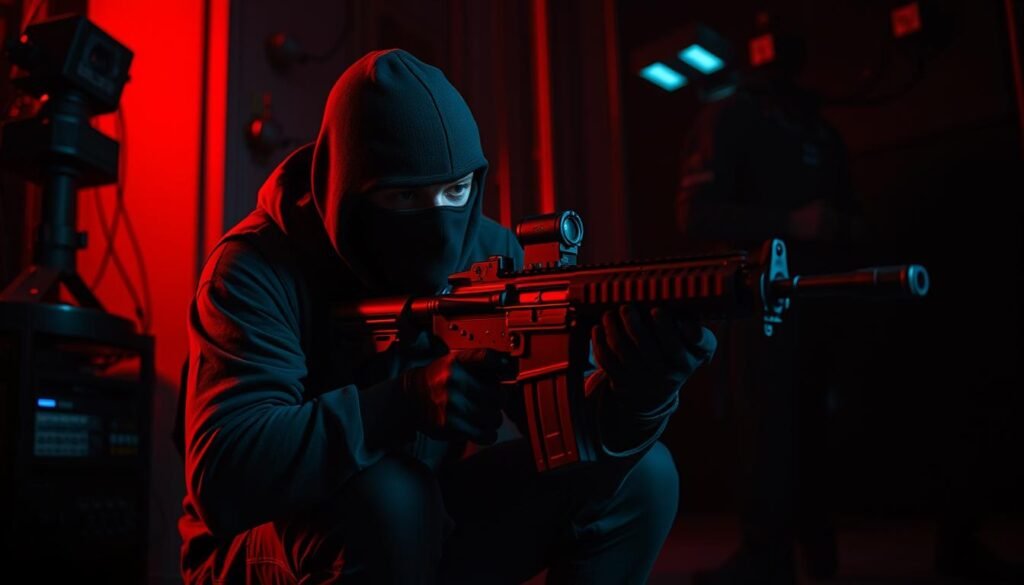
C2 frameworks matter. Operators who master multiple command-and-control options can shift profiles to match the target environment and protect client data. Peer-to-peer setups reduce single-point failure, while centralized servers simplify teardown and logs.
How C2 and pivots protect data and reduce exposure
Layered redirectors and segmented staging separate payloads from sensitive data. Strict credential rules and rapid teardown lower lingering risk. Proper egress design limits noisy domains and reduces suspicious traffic.
When to build custom loaders and inject processes
Custom loaders and tailored process injection cut collisions with mass detections. They require deep knowledge of IoCs and vendor signatures. Use them when default tools would flag benign detections or when the environment demands stealth.
- Reconnaissance limits: prefer in-memory discovery and native telemetry over noisy scanners.
- Tooling risks: track popular framework IoCs and randomize delivery patterns.
- Operational logs: store replay data but never retain secrets or payloads.
Knowledge matters: teams that understand techniques under the hood make safer, smarter trade-offs.
| C2 Model | Visibility | Suitability |
|---|---|---|
| Peer-to-peer | Low central fingerprint | Resilient, complex to manage |
| Centralized | Easier to detect, easy teardown | Good for rapid ops and clean logs |
| Domain fronting | High stealth if misused | Use with strict legal review |
Team composition that multiplies success, not groupthink
A compact roster of complementary skills shapes whether an operation finds blind spots or reinforces them. Design roles to match risks, then let people focus on their lane.
Map the roster clearly before the pre-brief. The Red Team Lead (RTL) sets goals and translates business risk into mission tasks. The Project Manager / analyst tracks the OPORD, evidence, and timeline so debriefs are usable.
Roles that matter
- RTL: strategy and business translation; swap leads by domain when mission needs shift.
- PM / analyst / writer: keeps the plan on track and collects replayable evidence for knowledge transfer.
- Business analyst: maps processes to find high-impact targets and test real controls.
- Technical & social analysts: network and exploit specialists plus OSINT and social engineering.

Physical specialist and cross-training
Physical security specialists handle on-site reconnaissance, wireless testing, and control checks. Cross-training helps when timelines shift: analysts learn enough of each domain to step in when needed.
“Diverse experience surfaces blind spots early; dissent in planning improves execution.”
- Assign members by mission: pick an RTL with physical, cloud, or enterprise strength as required.
- Rotate people to manage fatigue and protect operational quality.
- Measure success by decision speed, safety of operations, and clarity of post-exercise reporting.
Running the “day”: execution tempo, windows, and gamified IOCs
Execution compresses planning into short, measured bouts that sharpen defenders and preserve safety. Announced windows drive preparation; boxed indicators keep lessons paced and actionable.
Execution day compresses strategy into timed bursts that test both tools and temperament.
Announced windows that weaponize defender readiness
Announced windows send a clear signal: defenders rally, patch, and rehearse playbooks. Facebook-style month windows produced measurable improvements in incident response and readiness.
The Box: controlled IOCs, time-boxing, and morale
The Box uses sealed IOC envelopes. Teams open them on schedule to advance learning without collapsing into chaos. This method makes one strong indicator unravel the scenario and trains a single lead to drive triage.
How plan and order intersect during the run
Operators follow the OPORD but change pace when defenders react or safety limits hit. Pauses let blue teams pivot after a single lead. Time-boxing limits panic and keeps the exercise under strict control.
Risk is limited by staged artifacts and rollback paths, preserving production while creating richer telemetry for after-action analysis.
| Element | Purpose | Outcome |
|---|---|---|
| Announced window | Drive readiness | Improved patching and playbook alignment |
| The Box | Controlled IOC pacing | Measured learning and morale wins |
| Time-box | Limit panic | Keep focus and preserve production |
What I learned from training with a red team for a day
Direct tempo and clear goals beat paralysis. That one intense run taught how rapid choices beat perfect plans when pressure rises. Trust informed instincts and move the operation forward; hesitation often produces noise and wasted effort.
Don’t overthink—trust instincts and set tempo
Decisive tempo separates clean progress from cascading alerts. If the situation feels off, adjust early and pivot to a prepared branch rather than grind on a failing line of effort.
Encourage dissent in planning; unify command when live
Healthy pushback during design surfaces blind spots. Debate hard in planning, then collapse authority in execution so comms stay crisp and teams do not thrash.
Detection equals tradecraft plus story design, not just tooling
The detection signal improves when tactics follow a believable adversary arc. Realistic storylines produce coherent telemetry that defenders can piece together more easily than random noisy probes.
Practical takeaways:
- Ground goals in business impact to avoid flashy, low-value detours.
- Build two viable branches before launch so pivots are instant.
- Know the point to stop—measured risk preserves safety and credibility.
- Keep disciplined notes and crisp comms; respect defenders’ experience.
“Speed, clear command, and a believable narrative made the exercise useful far beyond tool checks.”
| Lesson | Why it matters | Practical action |
|---|---|---|
| Trust instincts | Prevents noisy failure | Pivot early to backup branch |
| Encourage dissent | Surfaces blind spots | Debate in planning; unify in ops |
| Story-driven tactics | Yields coherent telemetry | Design scenarios with realistic arcs |
| Measured stop point | Protects systems and credibility | Define abort criteria in OPORD |
Measuring success: time-to-detect, response quality, and knowledge transfer
Success hinges on measurable signals, not impressions. Define clear metrics before the exercise so outcomes link to business risk and resourcing needs.
Time-to-detect measures seconds or minutes from the first observable to an alert. Time-to-contain tracks how long the team takes to limit blast radius across the network.
From a single lead to full blast radius: “One Lead Is All You Need”
A single IOC should let responders map scope when process and tools are mature. The Box method proved this: most IOCs were visible with existing tooling, so one lead triggered full hunts and containment.
After-action reviews that turn stress into maturity gains
Post-mortems compare defender telemetry to red team notes. Track lag between milestones—imaging, IOC deployment, and endpoint clearing—to spot friction. Emphasize empathy and avoid blame so teams own fixes.
| Metric | Why it matters | Practical action |
|---|---|---|
| Time-to-detect | Shows visibility gaps | Tune SIEM rules; add hunts |
| Time-to-contain | Measures response order | Practice imaging and isolation drills |
| Knowledge transfer | Locks in improvements | Reenact phases; update playbooks |
Focus on behaviors, not just vulnerabilities. Prioritize fixes that close access paths and improve choreography. Share concise, business-friendly summaries so company leaders fund lasting change.
From lessons to strategy: making this exercise repeatable for your company
Translate one run into a lasting program by setting cadence, scope bands, and measurable goals. Make live-fire windows annual or semiannual so leadership can align budgets and resources. This keeps exercises from being one-off events and ties outcomes to maturity targets.
Involving leadership, legal, PR—and avoiding shame
Secure executive sponsorship early. Pre-wire Legal and PR to approve rules, escalation paths, and secrecy levels. That reduces risk and prevents knee-jerk pauses during runs.
Psychological safety matters. Encourage frank reporting and avoid blame so people will surface vulnerabilities fast. Celebrate progress and reward cross-team collaboration.
Choosing providers: reputation, research capability, and real operations
Prioritize firms that show documented R&D, custom tools, and real operational experience. Validate that providers run intelligence-led scenarios that mirror your sector’s threats and adversary behavior.
“Treat assessment outputs as inputs — put owners on fixes and schedule retests.”
| Area | Practical action | Why it matters |
|---|---|---|
| Cadence & plan | Annual/semiannual windows; scope bands | Drives budget, readiness, and predictable time to peak |
| Governance | Executive sponsor; Legal/PR pre-wired | Reduces operational risk and preserves credibility |
| Provider vetting | Check R&D, tradecraft, and sector TI capability | Ensures scenarios are realistic and actionable |
| After-action | Assign owners, backlog fixes, schedule retests | Turns knowledge into lowered risk and fewer vulnerabilities |
Conclusion
Short, focused runs that mimic adversary logic deliver clearer telemetry and faster fixes. Disciplined exercises, governed by clear ROE and a Game Master, turn high-risk lessons into repeatable improvements.
Short, controlled engagements—announced windows, The Box, and careful post-mortems—accelerate security maturity without blame. Keep objectives tied to business impact, measure time-to-detect and time-to-contain, and pick providers who run intelligence-led scenarios.
Build a sustainable strategy: schedule regular windows, fund provider quality, and rehearse response paths. Foster dissent in planning, unify command during execution, and prioritize empathy so lessons stick across the team.
Narrative design and tradecraft shape detection more than tool lists. Convert findings into owned fixes, schedule retests, and keep the group sharp with periodic rehearsals that protect people and production. For teaming context, see this purple team primer.
