
Did you know your network has 131,072 potential entry points? That’s right—65,536 TCP and UDP ports each, waiting to be checked. Hackers and security pros alike use port scanning to see which doors are unlocked, like digital detectives mapping a building’s weak spots.
An open port is like a welcome sign for intruders, while a closed one slams the door. Filtered? That’s just silence—no response at all. The infamous SUNBURST attackers used this tactic to chart their targets, proving why security matters.
By the end of this guide, you’ll know how to flip your network from “easy target” to “fortress.” No jargon, just straight-up useful insights.
Key Takeaways
- Port scanning checks for open, closed, or filtered entry points.
- Your system has over 130,000 ports—each a potential risk.
- Open ports invite trouble; closed or filtered ones block it.
- Cybercriminals use scans to plan attacks, like the SUNBURST breach.
- Locking down ports boosts your network security fast.
How Does Port Scanning Work in a Network?
Think of your computer as a high-rise building—ports are its doors and windows. Some are VIP entrances (we’re looking at you, port 80 for HTTP), while others are service elevators (port 22 for SSH). Hackers and admins alike ring these doorbells to see who answers.

The Role of Ports in Network Communication
The first 1,023 TCP ports are the celebs of the internet—reserved for big names like HTTP (80) and HTTPS (443). Open ones shout, “Come on in!” Closed ports? They’re the bouncers with a firm “Nope.”
TCP vs. UDP: Protocol Showdown
TCP is the overthinker:
- SYN → “Hey, you there?”
- SYN-ACK → “Yeah, what’s up?”
- ACK → “Cool, let’s talk.”
UDP? The reckless speedster—it yeets packets without waiting for replies. Great for streaming, risky for security.
Interpreting Port Responses
Here’s how to decode the chatter:
| Response | Meaning | Example |
|---|---|---|
| Open | SYN-ACK | Port 80 welcoming web traffic |
| Closed | RST packet | Port 22 rejecting uninvited guests |
| Filtered | Silence | Firewall playing hide-and-seek |
Pro tip: Windows spills the beans with RST replies—even during stealthy FIN scans. Use Wireshark to spot sneaky XMAS scans (🎄-shaped packets).
Common Port Scanning Techniques
Ever seen a burglar jiggle doorknobs? That’s essentially what port scanning does—digitally. Hackers and security pros use different scanning techniques to map vulnerabilities, from polite knocks (TCP) to silent prowling (NULL scans). Here’s the toolkit they wield.

SYN Scan (Half-Open Scan)
🥷 The half-open scan is the digital peeping Tom. It sends a SYN packet to a port but ditches the convo before the handshake finishes. No logs, no traces—just a sneak peek at open doors.
Why it’s sneaky: Firewalls often miss these unfinished connections, making it a hacker favorite. But tools like Nmap can weaponize it for good.
TCP Connect Scan
🔌 This one’s the polite guest—it completes the full TCP handshake. Problem? It leaves cookie crumbs (logs) everywhere. Admins use it for audits; attackers avoid it like bad Wi-Fi.
| Scan Type | Stealth Level | Best For |
|---|---|---|
| SYN Scan | High | Quick recon |
| TCP Connect | Low | Legit audits |
UDP Scan
🌌 UDP scans are like shouting into a void—no guaranteed reply. They fire empty packets and hope for a “port unreachable” error. Slow but deadly for exposed DNS or VoIP services.
Stealth Scans: FIN, XMAS, and NULL
🕶️ These scans bypass basic defenses by breaking protocol rules:
- FIN scan: Sends a “goodbye” packet (FIN flag) to trick ports into responding.
- XMAS scan: Lights up packets like a Vegas sign 🎰 (FIN+URG+PSH flags).
- NULL scan: The digital mime—sends packets with zero flags.
Pro tip: Windows hates stealth scans—it’ll reply with RST packets anyway. Linux? Plays harder to get.
Popular Port Scanning Tools
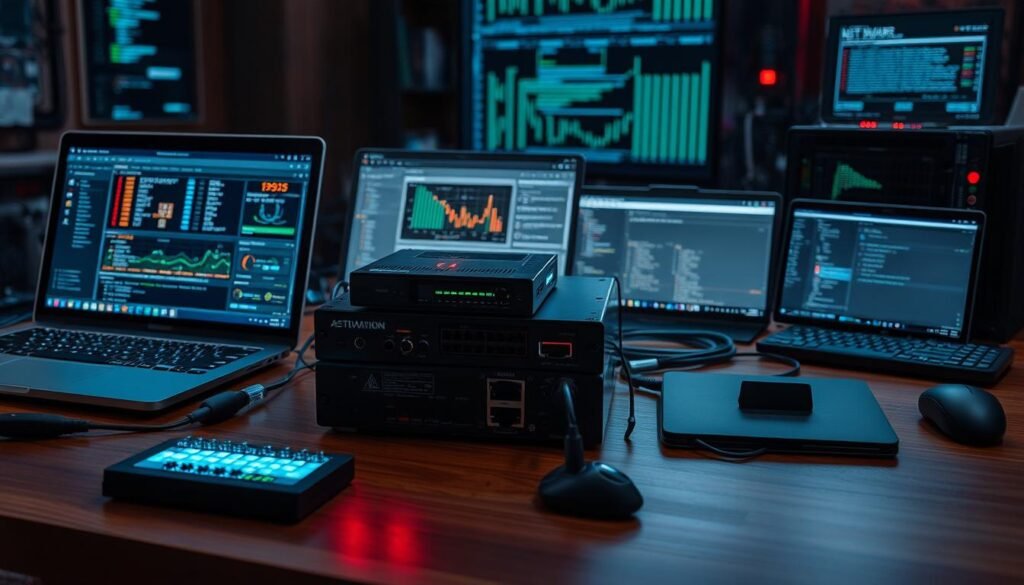
Ever wondered what tools the pros use to poke around your digital doors? Whether you’re defending or probing, the right scanners turn guesswork into precision. Here’s the elite squad that’ll make your port scan game unstoppable.
Nmap: The Industry Standard
🛠️ Meet Nmap—the Swiss Army knife of scanners. It’s like giving a hacker a PhD in network espionage. Need a stealthy TCP sweep? A vulnerability check? Nmap’s scripting engine even sniffs out weak spots automatically.
Pro tip: Its famous port scan command (nmap -sS) is the go-to for admins and cyber ninjas alike.
SolarWinds and Advanced Port Scanner
🌞 Prefer pretty graphs over command lines? SolarWinds serves up applications with drag-and-drop simplicity. Its GUI maps open services like a heatmap—perfect for visual learners.
- Real-time dashboards
- Auto-discovery of devices
- One-click reports for bosses who hate jargon
Netcat for Manual Testing
⚡ Dubbed the “hacker’s LEGO set,” Netcat lets you build custom probes brick by brick. Spin up a chat server, test connections, or even transfer files—all with a few keystrokes.
“Netcat is the duct tape of networking—ugly but unstoppable.”
| Tool | Best For | Stealth Level |
|---|---|---|
| Nmap | Deep scans, scripting | High |
| SolarWinds | GUI lovers, audits | Medium |
| Netcat | Custom tests | Variable |
🤖 Bonus tool: Nessus transforms raw port data into a vulnerability treasure map. It’s like Google Maps for security holes—pinpointing risks in your system with scary accuracy.
🧪 Lab rat tip: Always test scans in a sandbox first. Your production network will thank you.
How Cybercriminals Use Port Scanning
Cybercriminals treat your network like an all-you-can-hack buffet—and port scanning is their menu. Before launching an attack, they’ll probe every digital nook for weak spots. It’s not just about finding open doors; it’s about discovering which services are running outdated software or have glaring vulnerabilities.

Reconnaissance in the Cyber Kill Chain
🔍 Step one in every hacker playbook: reconnaissance. Scans map your network like a dating profile—showing what’s exposed (FTP on port 21), what’s guarded (SSH on 22), and what’s hilariously outdated (looking at you, Telnet on 23).
Prime targets include:
- Unpatched VPNs (hello, SMBv3 vulnerabilities)
- Forgotten IoT devices chatting on odd ports
- Kerberos authentication gaps (port 88)
Identifying Vulnerabilities and Services
🎯 Hackers love services that scream “I’m neglected!” A Redis server on port 6379 without a password? Jackpot. Even obscure stuff like Minecraft servers (port 25565) can become attack vectors if left unsecured.
Pro tip: Your firewall logs tell stories. Frequent connection attempts to port 1433? Someone’s fishing for Microsoft SQL servers.
| Port | Common Service | Hacker Interest Level |
|---|---|---|
| 445 | SMB | 🔥🔥🔥🔥 (EternalBlue exploits) |
| 3389 | RDP | 🔥🔥🔥 (Ransomware’s BFF) |
| 5900 | VNC | 🔥🔥 (If passwords are ‘admin’) |
Case Study: SUNBURST Attack
☀️ The 2020 SUNBURST attack showed port scanning’s dark potential. State-sponsored hackers spent months mapping targets through:
- DNS queries to identify subnets
- TCP sweeps on ports 80/443 for web apps
- Slow, stealthy scans to avoid firewall triggers
Result? A supply chain breach affecting 18,000 organizations. All because someone missed the reconnaissance phase.
💰 Dark web fact: Fresh port scan results sell for 0.5 Bitcoin on hacker forums. Your neglected Jenkins server might fund someone’s crypto wallet right now.
Detecting and Preventing Port Scan Attacks
Spotting a port scan is like catching someone casing your house—subtle but deadly obvious once you’re tuned in. Hackers leave breadcrumbs in your logs, from sudden SQL Server pings to firewall alerts. Here’s how to flip the script and turn your network into a fortress.

Signs of a Port Scan in Progress
🚨 Your logs are screaming if you listen:
– A flood of RST packets from random ports? That’s digital door rattling.
– Repeated hits on port 1433? Someone’s fishing for SQL Server vulnerabilities.
– Pro tip: Tools like PortSentry auto-block shady IPs—like a bouncer with a blacklist.
Using Firewalls and IDS/IPS
🛡️ Firewalls are your velvet rope, but next-gen ones (think Check Point Quantum) analyze traffic like a CIA profiler. Pair them with:
– IDS/IPS: The neighborhood watch logging every weird knock.
– Honeypots: Fake open ports that glue hackers in place like digital flypaper.
Best Practices for Network Hardening
🔒 Channel your inner Marie Kondo:
– Close unused ports—if it doesn’t spark joy, nuke it. ❌
– Patch faster than a TikTok trend dies (yes, even that legacy system).
– Segment networks like you’re building panic rooms—contain breaches before they spread.
“The SUNBURST hackers scanned for months undetected. Don’t be their next meal.”
| Tool | Role | Hacker Deterrence |
|---|---|---|
| Next-gen Firewall | Traffic analysis | 🔥🔥🔥🔥 |
| IDS | Alert system | 🔥🔥 |
| Honeypot | Decoy | 🔥🔥🔥 (Delays attackers) |
Conclusion
Port scanning is a double-edged sword—security pros use it to defend, while hackers exploit it to attack. The difference? Who’s holding the scanner. 🎯
Here’s your action plan:
– Audit monthly like clockwork (seriously, set reminders).
– Assume you’ve already been probed (because, let’s face it, you have).
– Lock down internal systems as if they’re already compromised. 🔒
In the cyber world, paranoia pays off. Scan your own network before someone else does it for you—with way worse intentions. Stay sharp, patch often, and never trust an open port without a good reason. 🚀
