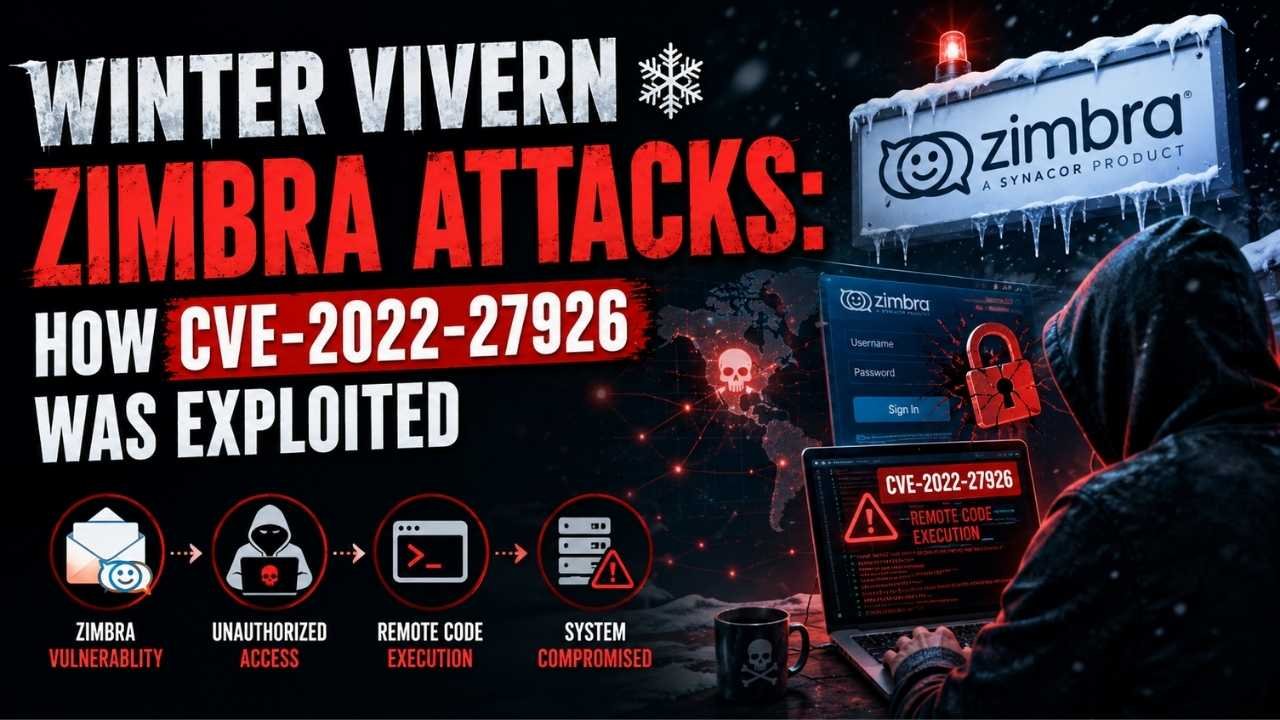
Winter Vivern did not need a new Zimbra zero-day to find an opening. The threat actor, tracked by Proofpoint as TA473, targeted European government organizations through vulnerable public-facing Zimbra webmail systems using CVE-2022-27926, a reflected cross-site scripting flaw that had already been disclosed and patched.
Zimbra fixed CVE-2022-27926 in Zimbra Collaboration 9.0.0 Patch 24 on March 30, 2022. Proofpoint later reported active exploitation against European government entities beginning in early 2023. CISA added the vulnerability to its Known Exploited Vulnerabilities catalog in April 2023.
The campaign is a useful example of the difference between a vendor releasing a patch and organizations actually installing it. Winter Vivern combined reconnaissance, phishing, exposed webmail infrastructure and customized JavaScript to pursue credentials and session-related information.
Quick Answer: What Happened in the Winter Vivern Zimbra Campaign?
Proofpoint observed Winter Vivern, which it tracks as TA473, exploiting CVE-2022-27926 against vulnerable internet-facing Zimbra Collaboration webmail portals used by European government organizations. The campaign was focused on espionage rather than broad, indiscriminate exploitation.
The flaw is a reflected cross-site scripting (XSS) vulnerability in Zimbra Collaboration 9.0. A specially crafted request could cause attacker-controlled script to run in the context of the targeted webmail site. Zimbra had already addressed the vulnerability in Patch 24 before Proofpoint documented the 2023 activity.
Winter Vivern made the attack more targeted by studying individual webmail environments and adapting its JavaScript to those systems. The important point is simple: a vulnerability can remain useful to attackers long after a patch has been released if exposed systems are still running vulnerable software.
Who Is Winter Vivern?
Winter Vivern is a cyberespionage threat actor known for targeting government, diplomatic and related organizations, particularly in Europe and Central Asia. Security companies and government agencies may use different names for the same or overlapping activity.
TA473 and UAC-0114
Proofpoint tracks the actor as TA473 and has linked its activity to public reporting about Winter Vivern. The actor has also appeared in reporting under identifiers including UAC-0114.
Threat-actor naming can get messy because research organizations maintain their own tracking systems. A label such as TA473 or UAC-0114 should not be treated as definitive proof of who controls an operation or which government, if any, directs it.
Why Government and Diplomatic Organizations Are Attractive Targets
Government webmail can contain diplomatic exchanges, policy discussions, schedules, internal documents and communications with other agencies. Access to a mailbox can therefore be valuable to an espionage actor even without deeper control of the organization’s network.
Webmail also presents an obvious attack surface because its login interface often needs to be reachable from the internet. If that exposed application is running vulnerable software, attackers do not need to cross an internal network boundary before attempting exploitation.
What Is CVE-2022-27926?
CVE-2022-27926 is a reflected XSS vulnerability associated with the /public/launchNewWindow.jsp component of Zimbra Collaboration 9.0. It can allow an unauthenticated attacker to execute arbitrary web script or HTML through crafted request parameters.
How Reflected XSS Works
Reflected XSS happens when a web application accepts attacker-controlled input and sends it back to a user’s browser without safely neutralizing it.
An attacker can build a malicious URL containing script content. If the victim follows that URL and the vulnerable application processes the input, the browser may run the injected JavaScript as though it came from the legitimate site.
That is particularly concerning in a webmail application because JavaScript running in the site’s context may be able to interact with information tied to the user’s active session.
Why the Existing Patch Matters
CVE-2022-27926 was already known by the time Winter Vivern was seen exploiting it in 2023. Zimbra’s Patch 24 release notes, dated March 30, 2022, list the vulnerability among the security fixes.
That makes the defensive lesson less about discovering a new flaw and more about how long vulnerable systems can remain exposed after a fix becomes available.
How Winter Vivern Exploited Vulnerable Zimbra Servers
Reconnaissance of Public-Facing Webmail
Winter Vivern was not simply sending the same exploit to every target. Proofpoint reported that TA473 performed reconnaissance and reverse-engineered webmail portals before creating bespoke JavaScript payloads for targeted government environments.
That preparation gave the attacker a better understanding of each target’s webmail portal, URLs and request behavior. It also made later phishing and exploitation steps easier to adapt to the environment.
Phishing Links and Vulnerability Exploitation
Proofpoint observed phishing messages that displayed legitimate-looking or familiar URLs while the underlying hyperlink redirected recipients through attacker-controlled infrastructure or toward exploitation of the vulnerable Zimbra environment.
In attacks involving CVE-2022-27926, malicious URLs could contain encoded or plaintext JavaScript that was processed by the vulnerable webmail functionality.
This is a good example of why phishing and software exploitation are not always separate problems. In a targeted campaign, the phishing message may simply be the delivery mechanism that brings the victim to the vulnerable application.
Customized JavaScript Payloads
After script execution, Proofpoint documented JavaScript tailored to the targeted webmail portal. The payloads were designed to reproduce parts of the legitimate application’s request behavior and collect authentication-related information.
Credential and Session-Data Theft
Proofpoint reported that the JavaScript attack chain targeted information including usernames, passwords and CSRF tokens. Data of that kind could help an attacker gain or maintain unauthorized access to sensitive mailboxes.
The practical risk went well beyond seeing unwanted JavaScript in a browser. The attack was aimed at obtaining information that could be used to compromise government webmail accounts.
Why European Government Agencies Were at Risk
Proofpoint reported targeting of European government entities and exploitation of publicly exposed Zimbra webmail portals beginning in early 2023. That does not mean every European government organization or every Zimbra deployment was compromised.
The systems most directly exposed were affected deployments that remained reachable from the internet without the relevant patch.
The campaign also shows why public-facing enterprise applications need close attention. Internal applications may sit behind several network controls. A webmail portal is intentionally exposed, which gives attackers a chance to identify the software in use and look for known weaknesses.
Why an Already-Patched Vulnerability Still Worked
Vulnerability disclosure and vulnerability remediation do not happen at the same time.
- Disclosure tells defenders that the weakness exists.
- Patch availability gives administrators a way to fix it.
- Patch deployment determines whether a particular server is actually protected.
- Post-compromise investigation helps determine whether the flaw may have been exploited before remediation.
Patch deployment can be delayed by compatibility testing, change-control requirements, unsupported systems, administrative mistakes or incomplete asset inventories.
Attackers can take advantage of that delay. Once a vulnerability is public, they can continue looking for organizations that have not finished remediation. CISA’s later addition of CVE-2022-27926 to the Known Exploited Vulnerabilities catalog confirmed that the flaw was being used in real attacks rather than remaining a theoretical concern.
Zimbra vs Roundcube: Do Not Confuse the Two Winter Vivern Campaigns
Winter Vivern’s exploitation of CVE-2022-27926 in Zimbra should not be confused with the group’s later exploitation of CVE-2023-5631 in Roundcube Webmail.
The two vulnerabilities are separate:
- CVE-2022-27926: a previously disclosed reflected XSS vulnerability in Zimbra Collaboration. A vendor fix was available before Winter Vivern’s observed exploitation in 2023.
- CVE-2023-5631: a separate XSS vulnerability in Roundcube that ESET observed Winter Vivern exploiting as a zero-day in October 2023.
ESET reported that the Roundcube zero-day could execute arbitrary JavaScript when a specially crafted email was viewed. A later payload could access and exfiltrate messages from the victim’s Roundcube account. ESET also described Winter Vivern’s earlier activity as involving known vulnerabilities in Zimbra and Roundcube.
The technical paths were different, but both campaigns focused on the same high-value target: webmail accounts.
What Zimbra Administrators Should Check
Verify Versions and Security Updates
Administrators should identify the exact Zimbra versions and patch levels running in their environment and compare them with current Zimbra security guidance. The age of CVE-2022-27926 is not a reason to assume an older server is protected.
Zimbra publishes security vulnerability information and advises administrators to keep supported deployments updated.
Review Internet-Facing Exposure
Inventory externally accessible webmail services and confirm that each exposed system is necessary, supported and maintained. A forgotten or rarely administered portal can still be found by attackers even if internal teams no longer consider it an important production asset.
Investigate Suspicious Authentication and Webmail Activity
Patching closes the vulnerable path, but it does not prove that the system was never exploited.
Organizations that operated vulnerable deployments during a period of possible exposure should review relevant authentication events, unusual webmail requests, unexpected account activity and whatever historical logs remain available.
Strengthen Phishing and Account Protections
The campaign also shows why patch management and phishing defenses need to support each other. Users should be cautious with links that appear to point to familiar government or organizational resources, while defenders should use appropriate account protections and monitoring to limit the damage from stolen credentials.
Generic consumer antivirus software does not replace patching the vulnerable server application.
What This Campaign Tells Us About Modern Cyberespionage
Winter Vivern’s Zimbra operation is notable because it did not depend on an unusually sophisticated new exploit.
A vulnerability can be old on paper and still be useful to attackers when exposed servers remain unpatched.
The campaign also shows how several familiar techniques can work together. Reconnaissance identifies the target. Phishing gets the victim to interact with the attack. XSS provides script execution inside the trusted webmail context. Customized JavaScript then attempts to collect information that can help compromise the account.
For an espionage actor, that may be more practical than developing a new exploit against a well-defended target.
Winter Vivern’s later activity reinforces the same point. The group continued targeting European governments through phishing and weaknesses in internet-facing applications that had not always been updated quickly enough.
Frequently Asked Questions
Who is the Winter Vivern APT group?
Winter Vivern is a cyberespionage actor associated in public threat-intelligence reporting with attacks against government and diplomatic organizations, particularly in Europe and Central Asia. Proofpoint tracks related activity as TA473.
What is CVE-2022-27926 in Zimbra Collaboration?
CVE-2022-27926 is a reflected cross-site scripting vulnerability in a component of Zimbra Collaboration 9.0. Crafted request parameters can allow an unauthenticated attacker to cause arbitrary web script or HTML to execute in a user’s browser.
How did Winter Vivern exploit the Zimbra vulnerability?
Proofpoint reported that TA473 combined phishing links with CVE-2022-27926 exploitation and JavaScript customized for targeted webmail environments. The attack chain was designed to collect authentication-related information from victims.
Was CVE-2022-27926 a zero-day vulnerability?
No. Zimbra listed a fix for CVE-2022-27926 in Zimbra Collaboration 9.0.0 Patch 24, released March 30, 2022. Proofpoint observed Winter Vivern exploiting vulnerable systems in 2023.
What information could Winter Vivern obtain?
Proofpoint reported JavaScript designed to capture information including usernames, passwords and CSRF tokens, which could provide a path toward unauthorized webmail access.
Which organizations did Winter Vivern target?
The Zimbra campaign documented by Proofpoint included European government entities. This does not mean that all European governments or all Zimbra users were targeted or compromised.
Is the Zimbra campaign related to Winter Vivern’s Roundcube attacks?
The campaigns involve the same publicly tracked threat actor and both focused on webmail, but they used different vulnerabilities. CVE-2022-27926 affected Zimbra, while CVE-2023-5631 was a separate Roundcube XSS zero-day documented by ESET in October 2023.
What should Zimbra administrators do?
Administrators should verify their exact software and patch level against current Zimbra security guidance, remove unnecessary internet-facing exposure, investigate suspicious activity when historical exposure is possible and maintain appropriate account and phishing protections.
Final Takeaway
The defining detail of the Winter Vivern Zimbra campaign is that CVE-2022-27926 already had a fix before the observed 2023 attacks.
Winter Vivern combined reconnaissance, phishing and a known webmail vulnerability to target organizations that still had exploitable infrastructure exposed to the internet.
For defenders, the difference between patch available and patch deployed is a real security boundary. On an internet-facing system carrying sensitive email, leaving that gap open can give an attacker exactly the opportunity it needs.
