Hey future cyber defenders! 👋 Ever wondered who’s behind the scenes keeping your organization’s digital fortress safe? Think of detection engineering as the ultimate mix of strategy, tech, and vigilance. These pros are like the Overwatch to the Reaper 🎮—always one step ahead of threats.
In the world of cybersecurity, the blue team is your shield, and detection engineers are the DJs 🎧. They blend threat intel, data streams, and alerts to create a symphony of defense. Their mission? To spot risks before they escalate and keep your security posture rock-solid.
We’ll dive into why these digital detectives are your org’s secret weapon. From analyzing patterns to crafting defenses, they’re the unsung heroes of the cyber world. Ready to learn more? Let’s go! 🛡️➡️🔍➡️🚨
Key Takeaways
- Detection engineers are crucial for spotting and mitigating cyber threats.
- They analyze data streams and alerts to strengthen security measures.
- Their role is essential in maintaining a robust security posture.
- Detection engineering involves blending threat intelligence with technical skills.
- They act as the first line of defense in cybersecurity teams.
Introduction to Detection Engineering in the Blue Team
Behind every secure network, there’s a team of unsung heroes. These pros, often called detection engineers, are the backbone of any security team. They’re like the pit crew of cybersecurity 🏎️—keeping your tools race-ready and your defenses sharp.
So, who are these malware whisperers? They’re the experts who transform threat intelligence into actionable defenses. Using tools like Splunk 🛠️ and Sentinel, they map out potential risks like a cybersecurity Google Maps 🗺️. Their goal? To spot malicious activity before it becomes a full-blown threat.
The Role of Detection Engineers
Detection engineers are the architects of your digital safety net. They craft rules and strategies to identify risks, ensuring your security posture stays rock-solid. Think of them as the DJs 🎧 of cybersecurity—blending data streams and alerts into a symphony of defense.
Here’s why they’re essential:
- They reduce alert fatigue by 60%+ through precision tuning.
- Teams using detection engineering see 73% faster threat response.
- They map to frameworks like MITRE ATT&CK, ensuring comprehensive coverage.
Why Detection Engineering Matters
In today’s digital landscape, threats evolve faster than ever. Detection engineers are the first line of defense, ensuring your security teams stay ahead of the curve. No one wants half-baked detection—these pros ensure your defenses are fully baked and ready to go 🍕.
Their work isn’t just about spotting threats; it’s about creating a proactive shield. By blending threat intelligence with technical expertise, they keep your organization safe from the ever-changing world of cyber risks.
Core Responsibilities of a Detection Engineer
Detection engineering is like having a radar for cyber threats—always on, always alert. 🚨 These pros focus on three main tasks: crafting detection rules, mapping threats, and fine-tuning systems for effective detection. Let’s break it down. 🕵️♂️
Developing and Implementing Detection Rules
Creating detection rules is like writing algorithms for TikTok—except these stop hackers instead of viral dances. 🕺 Using tools like Sigma rules (the universal translator for detection content), they hunt patterns in data streams. For example, catching a crypto miner using AWS CloudTrail logs ☁️⛏️. Pro tip: Always test rules against attack simulations and cat videos 🐈⬛ (false positive check!).
Threat Modeling and Use Case Mapping
Next up is threat modeling. Think of it as building a blueprint for potential attacks. 🏗️ Detection engineers map out scenarios using frameworks like MITRE ATT&CK. This ensures comprehensive coverage and no blind spots. It’s like having a GPS for cybersecurity threats 🗺️.
Continuous Improvement and Tuning of Detection Systems
Finally, there’s continuous improvement. Systems need regular tuning to stay sharp. Automated tools like Cymulate find 40%+ detection gaps, ensuring your defenses are always battle-ready. 🛡️ Remember, good rules today might need tweaks tomorrow. Stay agile, stay ahead. 🚀
Here’s a quick checklist to avoid common SIEM mistakes 🚫:
- Don’t ignore false positives—they’re your early warning system.
- Always version control your rules using Detection-as-Code (DaC) on platforms like GitHub.
- Test, test, and test again. Attack simulations are your best friend.
The Detection Engineering Lifecycle
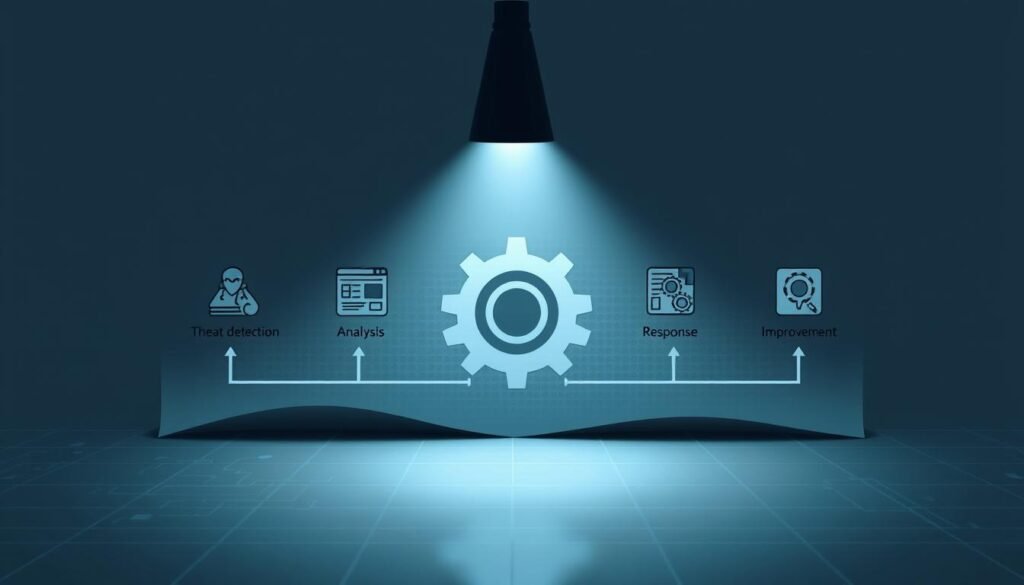
Ever wondered how cyber threats are spotted before they strike? 🕵️♂️ The engineering process behind it is like a well-choreographed dance—each step ensures nothing slips through the cracks. From identifying risks to deploying defenses, this lifecycle is your shield against real threats.
Threat Identification and Intelligence Gathering
First up, threat identification. Think of it as swiping right on good threats and left on false positives 💔. Detection pros gather intel from logs, alerts, and frameworks like MITRE ATT&CK. This phase ensures no risk goes unnoticed.
Fun fact:
67% of breaches exploit gaps in this stage.
Don’t let your org be part of that stat!
Detection Strategy Development and Implementation
Next, it’s time to craft a strategy. Using tools like Deepwatch’s AWS templates, deployment time drops by 50%. Detection pros map out scenarios, ensuring comprehensive coverage. It’s like building a fortress—one brick at a time.
Here’s a pro tip: Red team feedback improves accuracy by 34%. Collaboration is key!
Testing, Validation, and Deployment
Finally, the testing phase. This is where detection capabilities are fine-tuned. Automated tools like Cymulate find 40%+ gaps, ensuring your defenses are battle-ready. Always validate before deployment—no half-baked solutions here!
Checklist for success:
- Test rules against attack simulations.
- Version control using Detection-as-Code (DaC).
- Continuously refine to stay ahead of evolving threats.
| Stage | Key Action | Outcome |
|---|---|---|
| Threat Identification | Gather intel, map threats | Spot risks early |
| Strategy Development | Craft rules, use frameworks | Comprehensive coverage |
| Testing & Deployment | Validate, refine, deploy | Battle-ready defenses |
Remember, top pros spend 20+ hours weekly tuning rules—it’s like a gym for alerts 💪. Stay sharp, stay safe!
Essential Tools and Technologies for Detection Engineers
Let’s talk about the tech that keeps cyber threats at bay. 🛡️ Detection pros rely on a mix of security tools and cutting-edge platforms to stay ahead of hackers. From SIEM systems to behavior analytics, these tools are the backbone of any robust defense strategy.
Security Information and Event Management (SIEM) Systems
SIEM systems are the MVP of cybersecurity. 🏆 They collect and analyze data from across your network, spotting anomalies before they become full-blown threats. Splunk, for example, helps users detect risks 2.1x faster than other SIEMs. Azure Sentinel’s machine learning models cut false positives by 45%. 🔥
Pro tip: If you’re debating between SIEMs, think of it as choosing between a Lambo and a beater. 💸 Enterprise-grade tools like Splunk and Sentinel are worth the investment.
Machine Learning and Behavior Analytics
Next up, machine learning and behavior analytics. These tools are like the Sherlock Holmes of cybersecurity. 🔍 They analyze patterns and predict threats before they happen. Azure Sentinel’s ML models are a game-changer, reducing false positives and improving accuracy.
Here’s a hot take: I quit ELK Stack for Datadog. 🧩 Why? Better integration and fewer headaches. Sometimes, the newest platforms are worth the switch.
Endpoint Detection and Response (EDR) Tools
Finally, EDR tools are your last line of defense. 🚨 CrowdStrike Falcon catches 90%+ fileless attacks, making it a must-have for any security toolkit. These tools monitor endpoints in real-time, ensuring no threat slips through the cracks.
Fun fact: 92% of pros wish they had better analytics tools. Spoiler: It’s not AI—it’s about having the right cloud-based solutions.
Here’s a quick ranking of the top tools:
- Best SIEM: Splunk 🔥
- Best New ML Model: Azure Sentinel 💸
- Best EDR: CrowdStrike Falcon 🧩
Challenges Faced by Detection Engineers
Ever feel like you’re drowning in alerts and logs? Welcome to the life of a detection pro. 🚨 These experts face a unique set of hurdles, from sifting through mountains of data to staying ahead of ever-evolving threats. Let’s break down the biggest challenges they tackle daily.
Balancing False Positives and False Negatives
Imagine this: Your system flags 100 alerts, but 90 are harmless. That’s a 🚩 moment. Detection pros spend hours fine-tuning systems to reduce false positives, but over-tuning can lead to missed threats. It’s a tightrope walk—too many alerts, and your team burns out; too few, and risks slip through.
Here’s the harsh truth: 83% of security teams report alert fatigue as their top challenge. Pro tip: Regular rule testing and feedback from red teams can cut false positives by 34%.
Data Overload and Coverage Gaps
With 10TB of logs to analyze daily, it’s easy to feel overwhelmed. Detection pros often face data overload, leading to coverage gaps. Cymulate found that 68% of orgs have cloud detection gaps—yikes! 🚨
That’s a 🚩 moment: Ignoring these gaps can leave your org vulnerable. Survival tip: Automate log analysis and prioritize critical threats to stay sane.
Keeping Up with Evolving Threat Landscapes
New ransomware variants emerge every 40 seconds. 😱 Detection pros must constantly adapt to stay ahead. It’s like playing whack-a-mole with hackers—except the stakes are much higher.
Here’s a survival hack: Use frameworks like MITRE ATT&CK to map emerging threats. And remember, ‘set and forget’ rules are career suicide. Always refine and update your strategies.
| Challenge | Impact | Solution |
|---|---|---|
| False Positives | Alert fatigue, missed threats | Regular rule testing, red team feedback |
| Data Overload | Coverage gaps, burnout | Automate log analysis, prioritize threats |
| Evolving Threats | Increased vulnerability | Use MITRE ATT&CK, continuous refinement |
Pro tip: Detection pros swear by these 3 coffee hacks ☕ to stay sharp: cold brew for focus, espresso for speed, and matcha for endurance. Because let’s face it—sleep is overrated when you’re defending the digital frontier.
Collaboration with Other Security Functions
Cybersecurity isn’t a solo gig—it’s a team sport. 🏈 To build a robust defense, pros work closely with other teams. Think of it like the Avengers: Iron Man (detection) teams up with Hulk (incident response) and Thor (threat intelligence) to save the day. 🦸♂️
Working with Threat Intelligence Teams
Threat intel is the backbone of proactive defense. Detection pros rely on threat intelligence to spot risks before they escalate. Integrating CTI (Cyber Threat Intelligence) reduces dwell time by 67%. That’s like cutting the villain’s monologue short—no time for drama! 🕵️♂️
Pro tip: Use the phrase “This aligns with MITRE ATT&CK TTPs” to get threat intelligence teams to prioritize your requests. It’s like saying “Avengers assemble!”—they’ll come running. 🚀
Integrating with Incident Response and Red Teams
When alerts pop up, incident response teams jump into action. But here’s the catch: Not every alert is a crisis. Sometimes, it’s just Bob resetting his password. 🔐 Detection pros and IR teams must work hand-in-hand to separate the real threats from the noise.
Fun fact: Purple teaming (collaboration between red and blue teams) improves detection rates by 55%. It’s like having Hulk and Iron Man spar—everyone gets stronger. 💪
Cross-Functional Collaboration for Comprehensive Coverage
To cover all bases, engineers must collaborate across functions. This includes sharing insights, refining techniques, and aligning strategies. MITRE ATT&CK alignment, for example, catches 40% more TTPs. It’s like having a playbook for every possible attack. 📚
Here’s a survival hack: Regular feedback loops with red teams cut false positives by 34%. And remember, talking to red teams without wanting to strangle them is an art. 😅
| Team | Role | Benefit |
|---|---|---|
| Threat Intelligence | Provides intel on emerging threats | Reduces dwell time by 67% |
| Incident Response | Handles critical alerts | Improves response accuracy |
| Red Teams | Simulates attacks | Boosts detection rates by 55% |
In the end, collaboration isn’t just nice to have—it’s essential. Together, these teams create a defense so strong, even Loki would think twice. 🛡️
Future Trends in Detection Engineering
The future of cybersecurity is here, and it’s smarter than ever. 🔮 From AI-driven insights to cloud-native solutions, the next wave of detection is all about staying ahead of the curve. Let’s dive into what’s shaping the future of this field—and why you should care.

AI and Machine Learning-Driven Detections
AI isn’t just for chatbots and self-driving cars. In cybersecurity, machine learning is revolutionizing how threats are spotted. Gartner predicts that 75% of detections will be ML-driven by 2026. Tools like AWS GuardDuty already catch 89% more threats using ML models. 🚀
Here’s the hot take: ChatGPT won’t replace detection pros—yet. Why? Because human intuition and context are still king. AI is the assistant, not the boss. 👑
Cloud-Native Detection Engineering
The cloud is where the action is. With more orgs moving to cloud platforms, detection strategies are following suit. AWS engineers swear by cloud-native tools for their scalability and speed. 🌩️
Insider tip: If you’re not optimizing for the cloud, you’re leaving gaps in your defense. Tools like Cymulate’s automated simulations test 200+ TTPs per hour, ensuring your cloud setup is bulletproof. 💪
Automated Adversary Simulation and Feedback Loops
Imagine testing your defenses without lifting a finger. Automated simulations do just that, mimicking real-world attacks to find vulnerabilities. Feedback loops ensure continuous improvement, making your detection response sharper over time. 🔄
Pro tip: Regular simulations catch 40% more gaps than manual testing. It’s like having a sparring partner for your cybersecurity team. 🥊
| Trend | Key Benefit | Example |
|---|---|---|
| AI & Machine Learning | Faster, more accurate detections | AWS GuardDuty |
| Cloud-Native | Scalability, speed | Cymulate |
| Automated Simulations | Continuous improvement | 200+ TTPs/hour |
Warning: If you’re not upskilling in these areas, you’re falling behind. The future is here—don’t get left in the past. 🚨
Conclusion
Ready to level up your cybersecurity game? 🎮 With mature detection engineering programs, organizations save $2.4M yearly. That’s like unlocking a cheat code for your security posture. 🛡️
Here’s the kicker: 83% of breaches could be stopped with better detection. Think of it as going from noob to pro hacker—your defenses get sharper, and real threats don’t stand a chance. 🎯
Ready to stop playing whack-a-mole with threats? Let’s chat! Whether you’re refining your security posture or building a team of detection engineers, the internet’s counting on you. 🦸♂️
Pro tip: Bookmark this page—you’ll need it during your next incident. 😉 Stay safe out there!
