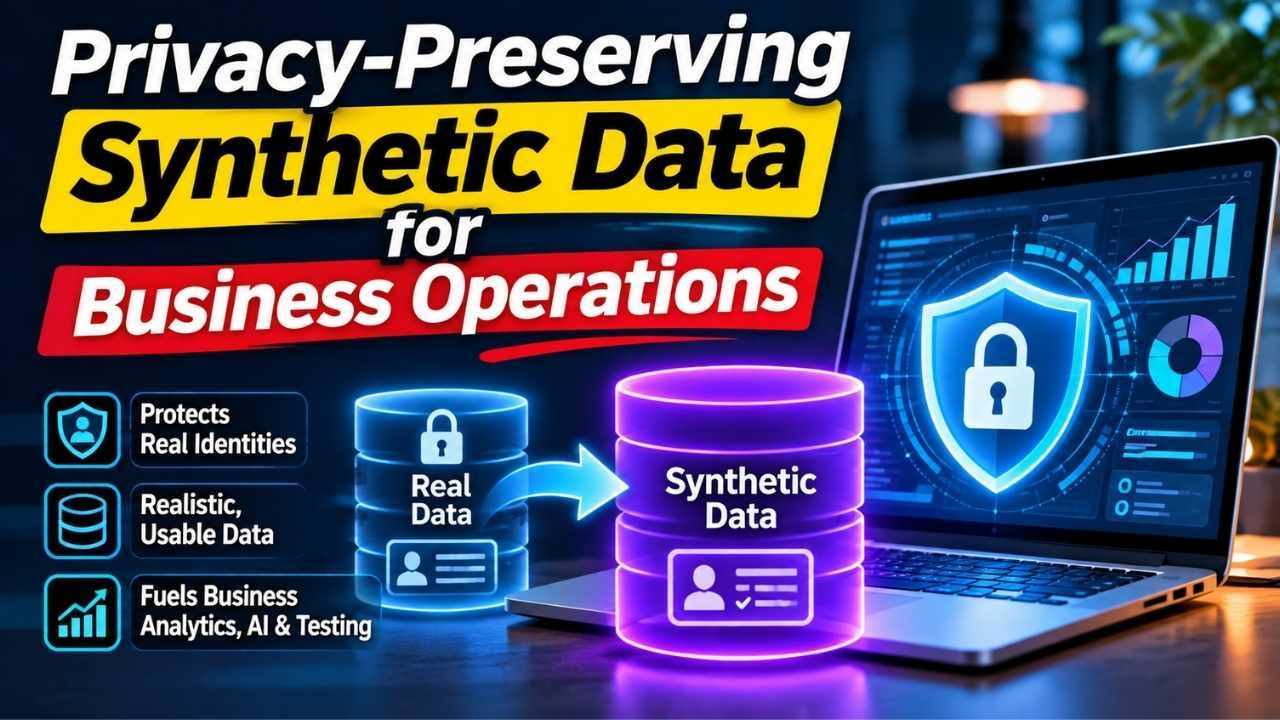
Businesses collect enormous amounts of information, from customer purchases and payment records to employee details and website activity. That information can improve decisions, but using it creates a serious challenge: how do you learn from sensitive data without exposing the people behind it?
Privacy-preserving synthetic data offers a practical way to reduce that risk. Instead of giving every analyst, developer, or outside partner access to real customer records, a company can create artificial information that reflects useful patterns in its original data. Teams can then test software, explore business trends, and develop AI systems with less direct exposure to sensitive records.
There is one important catch. Synthetic data is not automatically private, accurate, or suitable for every business decision. Its real value comes from choosing the right generation method, testing the results, and maintaining strong data controls. Here’s how businesses can make that approach work.

Key Takeaways
- Privacy-preserving synthetic data can reduce exposure to sensitive information while supporting software testing, analytics, research, and AI development.
- Synthetic does not automatically mean anonymous. Poorly designed generators can reproduce unusual records or reveal information about the original dataset.
- Differential privacy offers a stronger, measurable approach when properly applied during synthetic data generation, although it introduces accuracy trade-offs.
- Business value depends on the intended use. A dataset that works well for testing an application may be unsuitable for forecasting sales or training a decision-making model.
- Successful adoption requires privacy testing, quality checks, clear ownership, and ongoing monitoring rather than simply purchasing a data generation tool.
What Is Privacy-Preserving Synthetic Data?
Privacy-preserving synthetic data is artificially generated information designed to support useful tasks while limiting the disclosure of sensitive details from the original data. It may resemble real records in structure, statistical patterns, or relationships, but it should not simply copy identifiable people or transactions.
Imagine an online retailer with thousands of customer orders. Its developers need realistic information to test a new checkout system. Using actual customer names, addresses, and payment records would create unnecessary exposure.
Instead, the retailer could generate fictional customers, orders, delivery locations, and purchase amounts. The dataset could preserve important patterns, such as higher weekend sales or the relationship between order size and shipping costs, without directly reproducing the original records.
The National Institute of Standards and Technology (NIST) explains that synthetic datasets can retain the structure and statistical relationships of real data. However, it also warns that many synthetic data generation methods provide no formal privacy guarantee.
How Is Synthetic Data Generated?
Businesses generally create synthetic information using several approaches:
- Rule-based generation: Developers define acceptable values and relationships, such as delivery dates occurring after order dates. This works well for predictable application testing without using real customer records.
- Statistical generation: Software learns selected patterns from an existing dataset and generates new observations that resemble its distributions and relationships.
- Machine learning generation: Models learn more complex patterns and produce artificial records. These methods may capture relationships that simple rules miss, but they also require careful testing for memorization and privacy leakage.
- Differentially private generation: A generation process uses a formal privacy framework to limit how much the inclusion of any one person’s information can affect the released output.
There are also fully synthetic datasets, where all record values are generated, and partially synthetic datasets, where only selected fields are replaced. Partially synthetic information may still contain genuine personal data, so it needs appropriate protection.
Why Does Synthetic Data Matter for Business Operations?
Most organizations face two competing needs. Employees need access to useful information, while the business must restrict unnecessary access to sensitive records.
Privacy-preserving synthetic data can help separate those needs. When properly generated and approved for a particular purpose, it lets more work happen without repeatedly exposing the original database.
1. Faster Software Development and Testing
Software teams frequently need realistic data to test applications. A banking application, for example, must handle failed transactions, different account balances, missing information, and unusual payment activity.
Synthetic records can provide these scenarios without copying actual customer accounts into development environments. Teams can also generate unusual situations that rarely occur in production, such as unusually large orders or simultaneous payment failures.
This can make testing easier to organize and repeat. It does not replace final validation against approved production-like conditions, especially when complex real-world behavior matters.

2. Safer Data Sharing Between Teams
A marketing team might need purchase patterns, while a software team needs transaction formats. Neither team necessarily needs every original customer record.
Purpose-built synthetic datasets can give each department information suited to its work. Organizations may also use carefully assessed synthetic data when collaborating with researchers, software vendors, or outside development partners.
The benefit is reduced exposure, not unrestricted sharing. Privacy testing and approval are still needed before releasing information outside the business.
3. Better Support for AI and Machine Learning
Artificial intelligence systems often need training and testing examples. Synthetic data can supplement limited datasets, support model development, and help teams evaluate unusual scenarios.
For example, an insurance company might generate fictional claim records to test a document-processing workflow. A retailer could create artificial demand patterns to evaluate a forecasting pipeline.
However, adding synthetic examples does not automatically improve model accuracy. If generated records contain incorrect patterns, the model may learn those mistakes. Important decisions still require testing against reliable, representative real-world evidence under suitable controls.
4. More Flexible Business Planning
Businesses often want to explore what might happen if demand changes, deliveries are delayed, or purchasing habits shift.
Synthetic scenarios can help operations teams test planning systems against a wider range of possible conditions. This is particularly useful for stress testing, where the objective is to see how a process responds rather than to predict exactly what customers will do.
For instance, a logistics company could generate fictional shipment schedules to check whether its scheduling software handles sudden demand increases. Such simulations should be treated as planning exercises, not evidence that the simulated events will occur.
How Does Synthetic Data Compare With Traditional Data Protection Methods?
Removing names or replacing customer IDs may seem sufficient. Unfortunately, combinations of details such as location, age, purchase history, and unusual behavior can sometimes identify a person even when direct identifiers are missing.
Different techniques solve different problems, so choosing the right approach matters.
| Method | How It Works | Main Limitation |
|---|---|---|
| Data masking | Hides or replaces selected sensitive values. | Other fields may still reveal identity. |
| Pseudonymization | Replaces identifying details with codes or pseudonyms. | Records may remain linkable to individuals. |
| Rule-based synthetic data | Creates fictional records using predefined rules. | May not capture real statistical patterns. |
| Model-generated synthetic data | Learns patterns from source data and generates new records. | May memorize sensitive information or distort patterns. |
| Differentially private synthetic data | Uses a formally private generation process to limit information exposure. | Privacy protections may reduce accuracy and increase implementation complexity. |
The best method depends on the job. Rule-based records may be enough to test a website form, while realistic customer behavior analysis may require statistical modeling and stronger privacy controls.
The UK’s Information Commissioner’s Office (ICO) emphasizes that anonymization depends on whether people remain identifiable, including through information from other sources. Simply labeling a dataset as synthetic or anonymous does not settle that question.
What Makes Synthetic Data Truly Privacy-Preserving?
Artificial data is not automatically safe because it lacks real names. Privacy depends on what the generator learned, what it reproduces, and what someone could discover by examining its output.
Understanding Differential Privacy
Differential privacy is a mathematical framework for limiting the influence of an individual’s data on a released result. It helps quantify the additional privacy risk associated with including that person in the input dataset.
In synthetic data generation, a properly designed differentially private process can produce artificial records while providing a formal bound on individual information disclosure.
These systems commonly use parameters such as epsilon, often written as ε, to describe privacy loss. Broadly speaking, a lower epsilon means a stronger privacy bound when other assumptions are comparable. But epsilon alone is not enough to judge an implementation.
In its Guidelines for Evaluating Differential Privacy Guarantees, NIST SP 800-226, published in March 2025, NIST explains why organizations must assess implementation details and privacy hazards rather than accepting mathematical claims at face value.
What Privacy Risks Still Exist?
Businesses should evaluate several possible weaknesses before treating generated information as safe to share:
- Memorization: A generator may reproduce unusual source records or sensitive details too closely.
- Membership inference: An attacker may try to determine whether a particular person’s information was included in the training dataset.
- Attribute inference: Patterns in released information may help reveal previously unknown characteristics about a person.
- Re-identification: External information may be combined with generated records to infer someone’s identity.
- Bias preservation: Unfair or incomplete patterns in the original information may appear again in synthetic data.
Stronger privacy protection sometimes comes at the expense of detail. This creates a trade-off: a dataset that closely reproduces rare behaviors may offer better analytical accuracy while introducing greater disclosure risk.
The UK Financial Conduct Authority’s research on synthetic data validation discusses three important evaluation areas: privacy, utility, and fidelity. Businesses need to consider all three rather than selecting a dataset solely because it looks realistic.
How Can Businesses Implement Synthetic Data Successfully?
A successful synthetic data program begins with a specific operational problem. Generating millions of artificial records without a clear purpose can waste resources and introduce risks without improving the business.
The following process provides a practical starting point.
Step 1: Choose One Clear Business Use Case
Start with a task that currently depends on access to sensitive information. Examples include creating a safe development database, testing an order-management application, or sharing sample records with an approved software contractor.
Describe what the synthetic dataset must accomplish. A checkout test may need correct field formats and transaction relationships, while demand forecasting requires realistic time-based patterns.
Step 2: Identify and Minimize Source Data
Review the original dataset and identify personal information, sensitive fields, and business-confidential details. Remove fields that are unnecessary for the intended task before using data to train a generator.
Protect the original information with appropriate access controls, encryption, retention limits, and approved processing environments. Synthetic data generation itself may involve processing protected information.
Step 3: Select an Appropriate Generation Method
Choose the simplest approach that meets the business need. Use invented rule-based records when realistic statistics are unnecessary. Consider statistical or machine learning methods when important relationships must be preserved.
For sensitive source datasets or wider releases, assess whether a properly implemented differentially private method is needed. Define the privacy requirements and acceptable data accuracy before selecting a system.
Step 4: Test Whether the Data Is Useful
Check the generated dataset against the task it must perform. Useful tests include:
- Comparing key distributions, such as order values and purchase frequencies.
- Checking relationships between fields, including valid dates and totals.
- Measuring whether expected business reports produce reasonably similar aggregate results.
- Testing whether applications handle missing values, unusual inputs, and errors.
- Comparing model performance on approved real-world validation data when synthetic records are used for AI.
A dataset may pass basic statistical checks while still being poor for a specific decision. Testing must reflect the actual work employees will perform.

Step 5: Perform Privacy and Security Assessments
Before broader distribution, examine whether generated records match source records too closely and whether unusual combinations could disclose sensitive information.
Where appropriate, carry out membership-inference, attribute-inference, and other disclosure-risk assessments. For differentially private generation, review the claimed guarantees, privacy parameters, assumptions, and implementation.
Risk assessments should reflect the intended audience. Publicly releasing a dataset generally demands greater scrutiny than providing it to a small, authorized internal team.
Step 6: Approve, Document, and Control Access
Assign responsibility for approving generated datasets. Document how each dataset was created, its intended uses, known limitations, privacy evaluation, and conditions for sharing.
The UK Office for National Statistics’ synthetic data policy recommends documenting production methods and suitable uses. It also calls for disclosure checks when synthetic data will be shared more widely than its source information.
Keep access restrictions when needed. Synthetic datasets, generation models, and related files should not automatically become public assets.
Step 7: Monitor Results and Update the Process
Business conditions change. New customer behavior, additional data fields, or updated software may make an older synthetic dataset less useful.
Review data quality, privacy risks, operational performance, and access permissions when the dataset or its intended use changes. Reassess whether the original privacy approval still applies before using the information for a substantially different purpose.
What Would Synthetic Data Look Like in a Real Business Workflow?
Consider a fictional online store preparing to replace its order-management system. Its developers need thousands of orders to test refunds, discounts, shipping charges, and inventory updates.
Rather than copying production records into a testing server, the company creates a synthetic database containing fictional customers and transactions. It uses artificial contact details, valid product relationships, and realistic order patterns.
The workflow could look like this:
- The operations team identifies which processes the new system must support.
- The data team reviews an approved source dataset and removes unnecessary fields.
- A generator creates fictional orders while preserving required relationships.
- Developers test checkout, refunds, reporting, and inventory adjustments.
- Privacy reviewers evaluate whether the generated records expose source information.
- The company performs final checks against approved real-world behavior before deployment.
This example is illustrative, not a documented company case study. Its main advantage is that routine testing can be separated from direct access to customer information.
But the synthetic dataset may not reproduce every unusual transaction or operational failure. Teams still need controlled final testing and safeguards before moving the system into production.
How Do You Measure the Business Value of Synthetic Data?
Buying a synthetic data platform does not automatically increase productivity or reduce risk. The business should measure whether its selected use case delivers useful results.
Track a small group of practical indicators before and after introducing synthetic data:
| Business Goal | Useful Measurement |
|---|---|
| Speed up development | Time needed to prepare and approve test datasets. |
| Reduce sensitive-data exposure | Number of workflows requiring access to real personal records. |
| Improve software testing | Required test scenarios covered and defects identified. |
| Support data analysis | Differences between approved real-data results and synthetic-data results. |
| Manage operational costs | Generation, computing, validation, review, and maintenance expenses. |
Consider the full cost of ownership, including training, privacy evaluations, specialist staff, and ongoing monitoring. A free generation library may be inexpensive to obtain but still require significant technical effort to operate safely.
Businesses should also identify what the dataset cannot do. If generated information is unsuitable for an important decision, using restricted real data under appropriate controls may remain necessary.

What Common Mistakes Should Businesses Avoid?
Synthetic data projects are most likely to disappoint when organizations focus on generating large datasets rather than checking their usefulness and safety.
- Assuming all synthetic data is anonymous: Artificial records can still disclose information about their source. Assess privacy before sharing.
- Choosing a tool before defining a purpose: Start with the problem, required accuracy, and exposure risk rather than a vendor’s feature list.
- Ignoring rare cases: Generators may miss unusual but important events, including operational failures or uncommon fraud patterns.
- Confusing realistic data with accurate predictions: A dataset can resemble the past without reliably representing future behavior.
- Reusing datasets without review: Information approved for application testing may not be safe or accurate enough for wider sharing or AI training.
- Neglecting the original information: Source records and trained generation models may still need strong protection, even after synthetic datasets are produced.
Businesses should also avoid treating synthetic data as a shortcut around privacy laws. In the United States, applicable requirements can depend on the data, industry, state, and specific processing activity. Legal or privacy teams should determine which obligations apply and whether the generated information meets any relevant de-identification standard.
Frequently Asked Questions
Is Privacy-Preserving Synthetic Data Completely Safe?
No. Synthetic data can reduce exposure to real records, but privacy risks depend on the generation method, source information, and how the output is shared. Even formally protected methods need correct implementation and realistic risk assessment.
Can Small Businesses Benefit From Synthetic Data?
Yes. A small business may use rule-based synthetic records to test a website, develop an application, or demonstrate software without exposing customer details. It does not always need an expensive AI-based generation platform.
More advanced statistical or privacy-preserving projects may require specialized expertise, so the expected benefit should justify the added complexity.
Can Synthetic Data Replace Real Data Entirely?
Usually not. Synthetic data is useful for many testing, development, and exploratory tasks, but it may miss important details or introduce misleading patterns. Some high-stakes analyses and final system validations still require carefully controlled access to real information.
Does Using Synthetic Data Automatically Make a Business Compliant With Privacy Laws?
No. Generating synthetic information from personal data can itself be regulated, and some generated outputs may remain identifiable. Organizations still need appropriate legal grounds, data governance, security controls, and an assessment of whether the output meets applicable privacy requirements.
Conclusion: Make Business Data More Useful Without Unnecessary Exposure
Privacy-preserving synthetic data offers businesses an opportunity to work with useful information while reducing dependence on real customer and employee records. It can support software development, operational planning, collaboration, and AI projects when implemented for the right purposes.
The secret is not generating more artificial data. It is generating information that is useful enough for the job, protecting the people represented in the source data, and knowing where the results fall short.
Start with one clear operational problem. Choose a suitable method, verify privacy and accuracy, measure the practical benefit, and expand only when the results justify it. That approach turns synthetic data from a promising technology into a dependable part of business operations.
