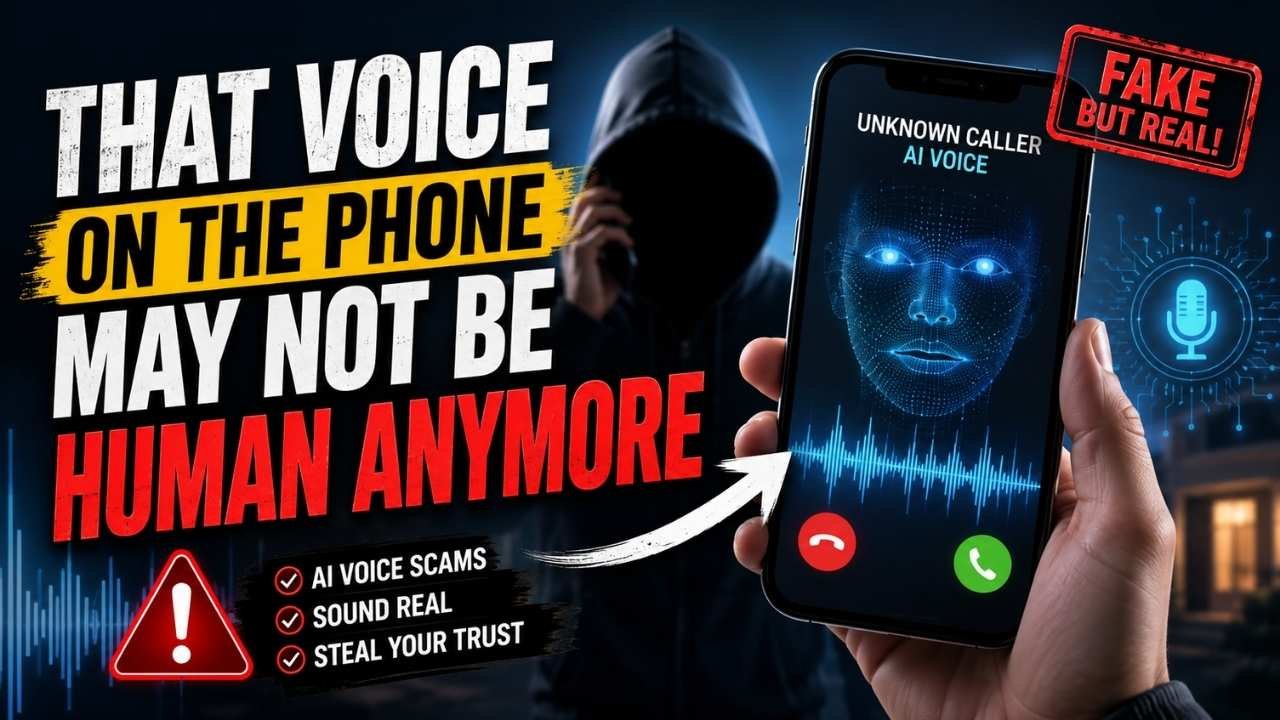
Back in March 2023, WIRED argued that AI-generated voice deepfakes were impressive but not yet consistently convincing enough to justify some of the more extreme fears surrounding them.
At the time, that was a fair reality check. Voice cloning existed, but producing a convincing and flexible imitation of a specific person was not always as simple as pressing a button.
By 2026, however, the word “yet” deserves more attention.
Synthetic speech sounds more natural, cloning tools are easier to access, and real-time voice conversion has improved. That does not mean every generated voice is flawless. It does mean the security question has changed.
A fake voice does not need to hold up for a 30-minute conversation to cause trouble. It may only need to sound convincing for a few urgent sentences.
Quick Answer: Are AI Voice Deepfakes Still “Not Scary Good”?
Not in quite the same way as they were in 2023.
AI-generated speech has improved substantially, and some current systems can produce highly convincing synthetic voices. The FBI has warned that AI-generated content, including voice messages used for impersonation, can be difficult to identify.
That does not mean every clone perfectly reproduces a person’s voice. Results still depend on the model, the reference recording, pronunciation, emotion, language, recording quality and what the generated speaker is being asked to say.
The more useful distinction is between perfect imitation and scam-effective imitation.
A clone may start to fall apart during a long, unpredictable conversation and still be convincing enough for a short call in which someone sounds injured, frightened, stressed or desperate for help.
Where the “Aren’t Scary Good Yet” Claim Came From
The phrase comes from WIRED’s March 2023 look at AI voice deepfakes. The article pushed back against the idea that criminals could simply generate a flawless imitation of anyone in any situation.
There were real limitations. Consistency could vary, high-quality reference audio mattered, and generating believable speech across longer or less predictable conversations was difficult.
Consumer-facing voice tools could also sound excellent for one sentence and noticeably less convincing for the next. Prosody, emotion, unusual words and conversational timing often exposed weaknesses.
The problem is treating that 2023 assessment as a permanent description of the technology.
Voice generation has continued to improve, while research published in 2026 describes synthetic speech as realistic enough to create increasingly difficult detection problems. Detection performance can also vary depending on which generation system produced the audio.
What Has Changed in AI Voice Cloning?
Shorter Reference Recordings Can Be Enough to Attempt a Clone
Older voice-cloning workflows often benefited from larger amounts of clean recorded speech. Newer systems can sometimes work with much less.
There is no universal number of seconds that guarantees a convincing clone. Claims such as “three seconds can perfectly clone anyone” make the technology sound more predictable than it really is.
The broader risk is still real. A relatively short recording can sometimes provide enough speaker information for a system to attempt a recognizable imitation.
The FTC has warned that scammers may take short audio clips from material posted online and use them in voice-cloning scams.
Generated Speech Sounds More Natural
Better voice cloning is not simply a matter of cleaner audio.
Current systems are more capable of producing pacing, pronunciation, rhythm and sentence-level expression that sound like normal speech rather than an old-fashioned text-to-speech engine reading a script.
That makes a big difference in impersonation. Matching the sound of someone’s voice is only part of the job. The generated speech also has to behave enough like natural conversation that the listener does not immediately become suspicious.
Speaker Identity Can Be Preserved More Convincingly
Modern voice-cloning and voice-conversion systems are designed to retain recognizable speaker characteristics while changing the words being spoken.
That is different from choosing a generic synthetic voice. The goal may be to preserve enough of the target person’s vocal traits that someone listening thinks they recognize the speaker.
Generation Is Faster and Easier to Access
One of the biggest changes is not purely about audio quality. It is about access.
Sophisticated synthetic speech no longer has to stay inside research labs or professional production environments. The FBI’s 2025 Internet Crime Complaint Center report noted that wider access to AI tools has made high-quality synthetic content easier to create and harder to identify. Voice cloning was specifically mentioned as one technology that can appear in fraud schemes.
Real-Time and Prerecorded Cloning Are Different Problems
Prerecorded audio gives an attacker room to retry.
A poor sentence can be discarded, regenerated or edited before it is ever sent to the target.
Real-time voice conversion is harder. The system has to respond quickly while preserving the speaker’s identity, maintaining intelligibility and keeping the conversation moving naturally.
That remains a more demanding technical task, but it is not just a theoretical capability. Recent research has demonstrated low-latency streaming voice-conversion systems designed for real-time use.
How Good Does a Deepfake Actually Need to Be?
This is where the discussion often becomes too focused on technical perfection.
Consider two situations.
In one, you sit in a quiet room and listen carefully to several minutes of audio while actively looking for signs that it was generated.
In the other, your phone rings unexpectedly and a distressed voice that sounds like your child says there has been an accident and money is needed immediately.
Those are very different tests.
A scammer does not necessarily need studio-quality deception. The voice only needs to be believable enough that you stop questioning the story.
Social-engineering attacks already rely on fear, urgency, secrecy and authority. CISA describes voice phishing as a technique in which attackers may pose as trusted people and deliberately create a sense of alarm or immediate pressure.
Voice cloning simply gives that familiar playbook another tool.
Telephone audio can also work in the attacker’s favor. Compression, background noise, poor connections and speakerphone playback already change the way real voices sound. A slightly unnatural synthetic voice may be dismissed as stress, a bad microphone or a weak connection.
Where AI Voices Can Still Give Themselves Away
Voice generation has improved, but convincing does not mean flawless in every situation.
Unnatural Timing or Pauses
Generated speech may pause in odd places, respond with unusual timing or maintain a rhythm that feels less natural than spontaneous conversation.
Emotional Inconsistencies
A system may reproduce someone’s vocal identity more successfully than their emotional behavior.
Crying, laughing, hesitation, interruption, stress and sudden changes in emotion can all be more difficult to reproduce consistently.
Pronunciation and Unusual Names
Names, abbreviations, local expressions, multilingual phrases and unusual pronunciations can still trip up some systems.
Longer Spontaneous Conversations
A prepared sentence is easier to fake than an unpredictable conversation.
Follow-up questions force the speaker to answer immediately, maintain context and react in ways that fit the situation. That gives a synthetic impersonation more chances to expose inconsistencies.
These clues can be useful, but they should not be treated as reliable authentication tests. The FBI’s advice is more practical: verify the person independently instead of assuming you will always hear the difference.
Why Voice-Cloning Scams Are a Real Security Problem
Family-Emergency Impersonation
A familiar voice saying “I’ve been in an accident” or “I need money right now” creates exactly the kind of situation in which careful analysis becomes difficult.
The FTC has warned consumers about AI voice cloning in fake-emergency scams and advises people not to trust the voice alone, even when it sounds like a relative or friend.
Executive and Employee Impersonation
The same technique can be used inside a company.
A synthetic voice may support an attempt to impersonate a manager, executive, supplier or coworker while asking for sensitive information, account access or a financial transaction.
The FBI has warned about criminals using AI-generated voice and video to impersonate trusted individuals in fraud attempts.
Authentication Risks
Voice biometrics still have legitimate uses, but security systems now have to account for replayed and synthetic audio.
That does not mean every form of voice authentication is broken. Stronger systems may include anti-spoofing controls, liveness checks, additional risk signals and other authentication steps.
The safer conclusion is more limited: a familiar-sounding voice should not settle a high-risk identity question by itself.
Personal Information Makes the Impersonation Stronger
The audio is only one part of the attack.
Public posts can reveal names of relatives, employers, travel plans, schools, job titles and personal relationships. Combined with synthetic speech, those details can make a false story sound much more believable.
Why “I Know Their Voice” Is No Longer Enough
People naturally use familiar voices as identity signals. For most of the history of the telephone, that was reasonably useful.
Generative audio weakens that assumption.
You do not have to distrust every phone call. You do need to separate recognition from verification.
Recognizing your daughter’s voice tells you who the caller appears to be. It does not prove who created the audio.
That distinction matters most when someone is asking for money, passwords, account access, confidential information or anything else unusual.
What to Do When a Suspicious Voice Call Sounds Real
The most dependable defense is not learning to become an audio-forensics expert. It is changing how you verify unusual requests.
- Slow down when urgency appears. Pressure to act immediately is a reason to become more cautious, not less.
- End the original call if needed. You do not have to resolve the situation while staying connected to the person who contacted you.
- Call the person yourself. Use a phone number you already know rather than one supplied during the suspicious interaction.
- Check through another channel. A text message, video call, second family member or normal workplace process can provide another layer of verification.
- Verify financial requests separately. Unexpected bank transfers, gift cards, cryptocurrency payments or account changes should always get an independent check.
- Do not let a familiar voice overrule other warning signs. Caller ID, personal details and audio can all be manipulated or used as part of an impersonation attempt.
The FTC recommends the same basic approach for family-emergency scams: do not trust the voice by itself. Contact the supposed caller independently and confirm the story.
AI Voice Deepfake Detection Is Not a Perfect Safety Net
Deepfake detectors can be useful, but there is no reason to assume a single tool can reliably settle every suspicious call.
Generation systems change, and detection systems have to keep adapting to new methods and artifacts.
Research published in 2026 found that detector performance can vary significantly across synthetic-speech models. A method that works well against one generation architecture may perform less reliably against another.
The FTC has also approached voice-cloning defense as a layered problem involving prevention, authentication, real-time detection and post-use evaluation rather than treating one detector as a complete solution.
For ordinary users, listening for odd audio can still be useful. Independent verification is safer than betting on your ears.
What Most People Get Wrong About Voice Deepfakes
1. “It Has to Sound Perfect to Fool Someone”
No. A short impersonation attempt has a much lower bar than a sustained conversation. Fear, urgency and context can make an imperfect clone more believable.
2. “Every Strange Impersonation Call Must Be AI”
No. Emergency scams and phone impersonation existed long before modern generative AI.
Unless investigators or reliable technical evidence confirm AI involvement, it is better to describe a case as reported or suspected rather than automatically calling it a voice-cloning attack.
3. “All Voice Clones Are Equally Convincing”
They are not. The model, reference recording, language, emotional range and target sentence can all change the quality of the result.
4. “I’ll Hear the Difference”
You might. That still is not a strong security policy.
Some synthetic voices are easier to recognize than others, and real scams are often designed to prevent calm, careful listening in the first place.
5. “Better AI Is the Entire Problem”
The technology is only part of the risk.
A technically excellent voice clone paired with an unbelievable story may fail. A merely adequate clone backed by real personal information and an urgent story may work.
The bigger threat is synthetic media combined with social engineering.
Final Verdict: The “Yet” Matters More Than Ever
The 2023 claim that AI-generated voice deepfakes were not “scary good yet” described an important stage in the development of generative audio.
Voice cloning could already be impressive, but consistency, flexibility and real-world usability still created meaningful limits.
By 2026, that framing needs more qualification.
AI-generated voices can now be convincing enough that U.S. agencies including the FTC and FBI explicitly warn about voice-cloning impersonation and fraud. The FBI’s 2025 IC3 report also identified voice cloning as one tool appearing in AI-related fraud scenarios.
That still does not justify claiming that AI can perfectly clone anyone or that synthetic speech is impossible to detect. Voice quality varies by system and situation, and longer interactive conversations can expose weaknesses that short recorded messages do not.
The practical lesson is more useful than trying to judge every voice on technical quality alone.
Stop asking whether a voice sounds real enough. Ask whether the request has been independently verified.
That works whether the caller is using a state-of-the-art voice model, a rough imitation or no AI at all.
FAQ
How realistic are AI-generated voice deepfakes in 2026?
Some systems can produce highly convincing synthetic speech, but realism varies by model, reference audio, language, emotion and situation. It would be inaccurate to say every AI-generated voice is indistinguishable from a real person.
How much audio is needed to clone someone’s voice?
There is no universal minimum. Some systems may produce recognizable results from relatively short recordings, while better or more flexible cloning may benefit from more suitable reference audio. Claims that a fixed number of seconds guarantees a perfect clone should be treated cautiously.
Can you tell whether a phone call uses an AI-generated voice?
Sometimes. Unusual pauses, pronunciation, tone or conversational behavior may raise suspicion, but none of those clues is a guaranteed test. For important requests, contact the person independently instead of relying on your ability to spot synthetic audio.
Can AI voice clones imitate emotion and speaking style?
Modern systems can reproduce parts of a person’s speaking style and expressive delivery, but consistency varies. Complex emotional changes, spontaneous reactions and unusual speaking situations can still be difficult depending on the system.
Are AI voice clones actually being used in scams?
Yes. U.S. agencies have warned about AI-generated audio being used in impersonation and fraud involving relatives, executives and public officials. That does not mean every reported voice-impersonation scam has been technically confirmed as AI-generated.
Can voice cloning bypass voice authentication?
Synthetic speech creates a spoofing risk that voice-authentication systems need to address, but implementations differ. Stronger systems may use anti-spoofing controls, liveness checks and additional authentication factors. Voice biometrics should not be treated as universally broken.
What should I do if a family member calls urgently asking for money?
Pause, end the original call if necessary and contact the person using a number or channel you already trust. If you cannot reach them, verify the situation through another relative or trusted person before sending money or sharing sensitive information. The FTC recommends this type of independent verification.
Is voice recognition still safe for identity verification?
Recognizing someone’s voice can still provide context, but familiarity alone should not be treated as strong authentication for high-risk actions. Payments, account changes and requests for sensitive information should be verified through another trusted method.
