Imagine your digital systems as a house. 🏠 The front door is locked, but a skilled intruder knows how to pick it. That’s exactly how initial access works in the cyber kill chain. It’s the moment attackers find their way into your network, and once they’re in, the real trouble begins.
This phase is critical because 90% of breaches start here. Yet, many organizations focus on flashy threats like ransomware instead of securing their digital front door. Think of it as hackers casing your digital joint before robbing it blind. 💻🔓
Take the SolarWinds breach, for example. Attackers exploited a vulnerability to gain entry, causing widespread damage. Even Microsoft paid $200k for a single Hyper-V vulnerability—proof of how much this stage matters. Whether it’s phishing, software exploits, or even a rogue USB stick, hackers have countless ways to sneak in.
Key Takeaways
- Initial access is the attacker’s entry point into your network.
- 90% of breaches begin at this stage, making it a critical focus.
- Phishing, software exploits, and USB devices are common methods.
- Securing this phase can prevent major security incidents.
- Understanding the cyber kill chain helps you stay one step ahead of threats.
Understanding Initial Access in the Cyber Kill Chain
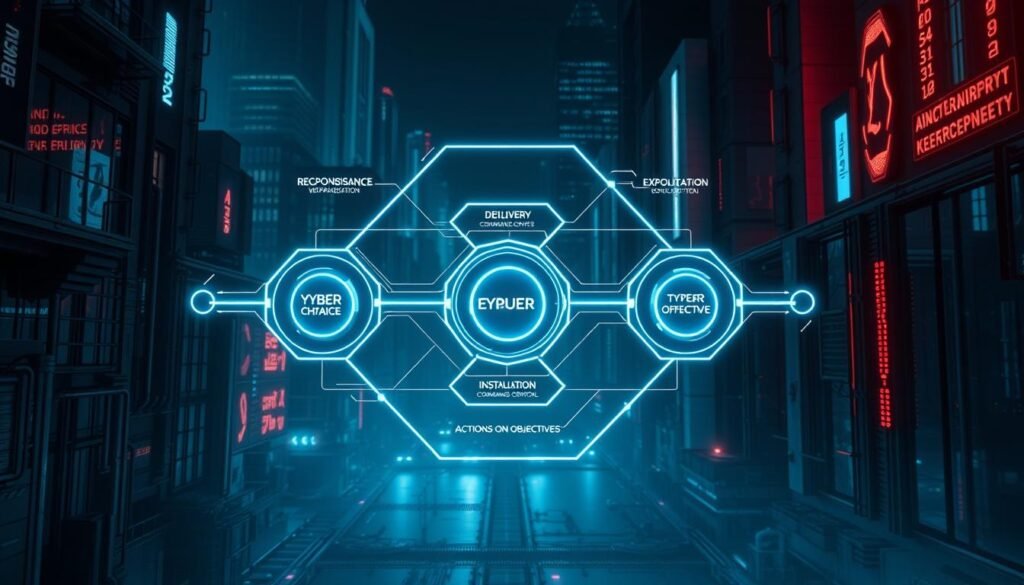
Think of your digital defenses as a fortress—every weak spot is a potential entry. 🏰 This is where attackers begin their mission, following a 7-step playbook known as the kill chain. Developed by Lockheed Martin, this model breaks down how breaches happen, starting with that first critical step: getting inside your network.
It’s not magic; it’s methodical. Hackers are like cat burglars, checking every window and door for an opening. And guess what? 63% of breaches start with RDP or VPN logins, according to Huntress. 🕵️♂️ Your remote workers? They’re hacker candy. 🍬
But it’s not just about passwords. Ever heard of MFA fatigue? That’s when attackers bombard users with authentication requests until they cave. Uber fell victim to this in 2022. 🚨
Here’s the kicker: Zero Trust isn’t just a buzzword. It’s about treating every login like a potential intruder. 🛡️ By securing your system at this stage, you can stop breaches before they escalate into full-blown disasters.
- Hackers follow a 7-step playbook—the kill chain—to breach your network.
- 63% of breaches start with RDP or VPN logins (Huntress data).
- MFA fatigue can leave your system vulnerable—Uber learned this the hard way.
- Zero Trust ensures every login is treated as a potential threat.
Why Initial Access Is Critical in Cybersecurity
Your digital perimeter is like a high-security vault—breaches start with a single crack. 🚨 This phase is where attackers plant their flag, and once they’re in, the dominoes start falling. It’s not just about getting inside; it’s about what they can do once they’re there.
The Foundation of Cyberattacks
No entry, no attack. It’s that simple. 🛑 Think of it as stopping a bank robber at the vault door. Most organizations focus on the aftermath, but the real battle is at the gate. According to Huntress, 70% of companies miss early warning signs—like ignoring a 3am text. 📱
Hackers exploit vulnerabilities to gain a foothold. Whether it’s a weak password or an unpatched system, they’ll find a way. That’s why this stage is the foundation of every cyberattack. 🏗️
Early Detection Saves Time and Money
Here’s the kicker: catching hackers early saves big bucks. 💰 IBM reports that early detection can save organizations over $3M per breach. Compare that to the cost of cleaning up after they’ve ransacked your data. 🕵️♂️

Early detection isn’t just about saving money—it’s about minimizing damage. The longer hackers stay inside, the more they can steal or destroy. 🚨
Integral to Defense-in-Depth and Zero Trust Strategies
Zero Trust isn’t paranoia—it’s smart. 🧠 Assume every login is a potential breach and verify every access attempt. This approach, combined with defense-in-depth, creates multiple layers of security. Think of it as lasagna—firewalls, MFA, patching—layer it up! 🍝
By focusing on this stage, you can stop breaches before they escalate. It’s not just about fixing vulnerabilities; it’s about building a fortress that’s tough to crack. 🏰
Common Methods Used to Gain Initial Access
Picture this: attackers are like digital locksmiths, always hunting for the right key. 🗝️ They use a variety of tactics to sneak into your network, and once they’re in, the damage begins. Let’s break down the most common ways they do it.
Phishing and Spear Phishing
Phishing isn’t just about fake emails anymore. Hackers have leveled up, using DocuSign clones and fake IT alerts that could fool your grandma. 🎣 Even tech giants like Stanford.edu have fallen victim to spoofing attacks. These scams trick users into handing over credentials, giving attackers a free pass into your system.

Exploiting Public-Facing Applications
Public apps are like hacker playgrounds. Remember Log4j? That vulnerability exposed millions of systems worldwide. 🎮 Attackers scan for unpatched software, exploiting weaknesses to gain entry. Patching isn’t optional—it’s your first line of defense.
Supply Chain Compromise
Third-party risk is real. The SolarWinds attack showed how poisoned software updates can infect 18,000 organizations. 🚨 Even Uber got hit via a contractor’s compromised device. Hackers target the weakest link in your supply chain, so vet your partners carefully.
- Phishing 2.0: Hackers use advanced tricks like fake IT alerts and DocuSign clones.
- Public apps are hacker magnets—patch regularly to avoid exploitation.
- Third-party risk: SolarWinds and Uber show how supply chain attacks work.
- Pro tip: Disable USB autorun—that “Confidential” flash drive? Probably malware.
How to Detect Initial Access Attempts
Detecting hackers before they wreak havoc is like catching a burglar mid-break-in—timing is everything. 🕵️♂️ The sooner you spot their activity, the better your chances of stopping them. Here’s how to stay ahead of the game.

Endpoint Detection & Response (EDR)
Think of EDR as your digital security cameras. 🎥 These tools monitor every move on your endpoints, flagging anything suspicious. Huntress, for example, caught 1,091 vulnerabilities in 2023 alone. That’s like having a guard dog that never sleeps. 🐕
EDR doesn’t just detect; it responds. If a hacker tries to sneak in, it can isolate the threat before it spreads. It’s your first line of defense against threats.
Email Filters and Behavioral Analytics
Email filters aren’t just spam catchers—they’re phishing shields. 🛡️ When configured right, they block 99% of phishing attempts. But hackers are sneaky, so you need more than just filters.
Behavioral analytics spots sketchy logins, like your CFO accessing files at 3am from Russia. 🕒🇷🇺 It’s like having a detective who knows when something’s off. Combine this with EDR, and you’ve got a solid detection system.
MITRE ATT&CK T1190
Ever stalked your ex’s social media? 🕵️♀️ That’s how closely you should track public app exploits. MITRE ATT&CK’s T1190 technique focuses on these vulnerabilities. By monitoring this, you can catch hackers before they exploit your tools.
Real Talk: Monitor MFA Push Spam
Uber’s breach started with 100+ MFA push requests. 🚨 Hackers bombarded an employee until they caved. Monitoring MFA spam is crucial—don’t let fatigue be your downfall.
| Tool | Function | Example |
|---|---|---|
| EDR | Monitors endpoint activity | Huntress caught 1,091 vulnerabilities |
| Email Filters | Blocks phishing attempts | 99% success rate |
| Behavioral Analytics | Spots unusual logins | CFO logging in from Russia at 3am |
| MITRE ATT&CK T1190 | Tracks public app exploits | Log4j vulnerability |
By using these tools, you can detect threats early and stop breaches in their tracks. For more tips on detecting initial access attempts, check out this guide. 🛡️
Mitigation Strategies to Prevent Initial Access
Stopping hackers before they breach your system is like building a moat around your castle—essential and non-negotiable. 🏰 The key is to focus on proactive measures that make it harder for attackers to get in. Here’s how you can fortify your defenses.
Employee Training and Awareness
Your employees are your first line of defense. Train them like they’re CIA agents. 🕵️♂️ Stanford’s phishing test dropped click rates by 60%—proof that awareness works. Regular training sessions can turn your team into a human firewall.
Pro tip: Huntress offers free security awareness training—no credit card needed. 🛡️
Patch Management and Network Segmentation
Patch faster than TikTok trends go viral. 🚀 Microsoft paid $13.7M for vulnerability reports in 2023—showing how serious this is. CISA’s patch management guidelines are a great starting point.
Network segmentation is like creating digital quarantine zones. 🚧 If one device gets infected, it won’t spread. Think of it as containing the outbreak before it becomes a pandemic.
Implementing Multi-Factor Authentication (MFA)
MFA or GTFO. Even stolen passwords need that second auth factor. 🔒 It’s a simple yet effective way to block unauthorized access. Uber’s breach could’ve been avoided with better MFA monitoring.

| Strategy | Benefit | Example |
|---|---|---|
| Employee Training | Reduces phishing success rates | Stanford’s 60% drop in click rates |
| Patch Management | Prevents exploitation of vulnerabilities | Microsoft’s $13.7M bug bounty program |
| Network Segmentation | Contains breaches | Digital quarantine zones |
| MFA | Blocks unauthorized access | Uber’s MFA fatigue attack |
By combining these strategies, you can build a robust cybersecurity framework. The MITRE ATT&CK framework is a game-changer for identifying vulnerabilities. 🛡️ Remember, prevention is always better than cure.
Real-World Examples of Initial Access Attacks
Hackers don’t just knock on your digital door—they break it down. 🚪💥 Real-world breaches show how creative attackers can be when gaining access. Let’s dive into some infamous cases that highlight the importance of staying vigilant.
SolarWinds Supply Chain Attack
In 2020, hackers pulled off one of the most sophisticated breaches in history. They hid malicious code in SolarWinds’ software updates, infecting over 18,000 organizations. 🕵️♂️ It’s like bedbugs in a mattress—you don’t know they’re there until it’s too late.
This attack underscores the importance of monitoring third-party access. As one expert put it:
“Supply chain attacks are the ultimate Trojan horse—trusted tools turned into weapons.”
Phishing Campaigns and Credential Theft
Phishing has evolved from fake emails to full-blown social engineering. In 2022, Uber fell victim to an MFA fatigue attack. Hackers bombarded an employee with 100+ MFA requests until they caved. 🚨 Then, they posed as IT support on WhatsApp to gain access.
Colonial Pipeline learned the hard way that one leaked password can cost $4.4M in ransom. 💸 Password managers aren’t optional—they’re essential.

| Attack | Method | Impact |
|---|---|---|
| SolarWinds | Supply chain compromise | |
| Uber | MFA fatigue + social engineering | Full system access gained |
| Colonial Pipeline | Credential theft | $4.4M ransom paid |
Pro tip: Stay ahead of attackers by using threat intelligence tools like SOC Prime’s Cyber Threats Search Engine. 🛡️ It’s like having a crystal ball for live attack patterns.
Conclusion
Securing your network is like locking every door in a mansion—hackers only need one to slip in. 🏰 While defending against access attempts might not seem glamorous, it’s the backbone of robust cybersecurity. A single weak spot can cost millions, but the right mix of tools and training can save the day.
Combine solutions like Huntress EDR with employee awareness to create a human firewall backed by machine learning. 💻 Remember, attackers need just one opening, but you need to shut them all. 🚪
Want to sleep better at night? Try SentinelOne’s free demo—their AI predicts threats before they strike. 🛡️ Stay ahead of the kill chain by updating your software, training your team, and always assuming you’re already breached. Paranoid? Maybe. Safe? Definitely.
