
Can a single provider really protect your privacy, stream Netflix and Amazon Prime reliably, and still keep speeds fast? That question drove our hands-on retesting across platforms.
We tested 20 services to find the five that pass a strict litmus test for privacy, speed, and streaming services. Our focus is U.S. users who need strong privacy security, dependable internet access, and consistent unblocking for major streaming libraries.
What passed the test combines audited infrastructure, RAM-only servers, and consistent unblocking with minimal slowdowns. ExpressVPN stands out for broad audits and fast servers. NordVPN led on raw speed. Surfshark won for unlimited device connections. Proton VPN impressed with stealth and streaming reach. Mullvad is the privacy purist with simple pricing.
Key Takeaways
- Our vpn review used hands-on retesting to evaluate privacy, speed, and streaming performance.
- ExpressVPN, NordVPN, Surfshark, Proton VPN, and Mullvad met strict trust and performance criteria.
- All five offer kill switches and split tunneling for safer, flexible connections.
- U.S. server coverage—some with servers in all 50 states—helps bypass regional sports blackouts.
- We report clear pricing and renewal rates so you avoid billing surprises.
Search intent decoded: who this Product Roundup of best vpn apps is for right now
Different users want different trade-offs: speed, streaming access, or airtight privacy.This section helps you match needs to features so you pick a provider that fits real life, not marketing.

Who benefits most: U.S.-based streamers who want regional libraries, privacy-conscious users focused on online privacy, gamers needing low latency, and remote workers who are using vpn daily for secure logins.
If you are new to use vpn, pick intuitive apps with strong defaults and an automatic kill switch. That lowers the chance of leaks due to misconfiguration.
- Travelers: choose wide server coverage to avoid captive-portal issues.
- Small businesses: prefer audited platforms with clear logging language.
- Tinkerers: seek multi-hop and obfuscation plus Linux GUI support.
Why avoid free vpns: tests show many leak IPs or metadata, and ads or data harvesting often fund “free” services.
| User group | Top concern | Must-have feature |
|---|---|---|
| Streamers | Geo-access to libraries | Reliable streaming servers |
| Privacy-focused users | Data minimization | Independent audits & RAM-only servers |
| Remote workers | Consistent secure logins | Kill switch & clear logging policy |
Our VPN litmus test methodology and criteria
We designed a repeatable test suite to judge privacy, speed, streaming access, and edge-case reliability. The goal: expose real-world gaps in claims and show which providers hold up under pressure.

How we set the privacy bar
We required a documented strict no-logs policy, independent audits, and RAM-only (diskless) servers that wipe on reboot. Providers without audited claims failed the privacy threshold.
Integrity checks included forced disconnects to validate kill switches and multiple DNS tests to detect any dns leak.
Performance and consistency
Tests measured download and upload speeds, latency, and sustained throughput across regions and times. We recorded average speed loss: Express 18%, Nord 3%, Surfshark 21%, Proton 16%, Mullvad 24%.
Consistency and low latency mattered as much as peak numbers for gaming and remote work.
Streaming and geo-unblocking
We verified unblocking for Netflix, Amazon Prime Video, Disney+, BBC iPlayer, Max, and regional U.S. catalogs. Each provider was judged on reliable access from U.S. endpoints during multiple sessions.
Security features and protocol review
We inspected the security stack: available vpn protocol options (WireGuard/NordLynx, Lightway, OpenVPN), cipher choices, split tunneling behavior across OSes, and DNS leak protection. Post-quantum measures were flagged where present.
Value, transparency, and refund terms
Pricing checks compared per-month cost, intro vs. renewal rates, and money-back guarantees. Most providers offer 30-day refunds; Mullvad offers 14 days. We also noted aggressive auto-renewal rates like Nord’s $140/year on certain plans.
- Privacy bar: audited no-logs + RAM-only servers
- Integrity: dns leak checks and kill switch verification
- Speed: multi-region baselines and latency tests
- Streaming: verified access to major services
- Transparency: audits, clear jurisdiction, and refund windows
At-a-glance winners: the five VPNs that passed in the present market
Here’s a quick snapshot of the five services that consistently met our privacy, speed, and streaming checks. Each entry is concise so you can match priorities to features fast.
Best overall: ExpressVPN — privacy leadership with excellent streaming
ExpressVPN balances independent audits (23+), polished apps, and a broad server network, including servers in all 50 U.S. states. It unblocks major streaming services reliably and preserves privacy with RAM-only infrastructure.
Fastest for streaming and gaming: NordVPN — outstanding internet speed
NordVPN posted ~3% average speed loss in our tests, making it ideal for 4K streaming and low-latency games. It pairs speed with advanced features and a note on renewal pricing ($140/yr on some plans).
Best value on a budget: Surfshark — unlimited simultaneous connections
Surfshark offers unlimited device connections plus FastTrack and Dynamic MultiHop. Long-term renewal sits near $79/year, which keeps long-run costs competitive.
Most versatile and privacy-forward: Proton VPN — obfuscation and strong features
Proton VPN excels at stealth and unblocking regional streaming content (we saw access to Netflix Egypt). Listed pricing: about $10/month with typical renewals around $80/year.
Most private pricing model: Mullvad — flat monthly rate and minimal data required
Mullvad charges ~5 EUR (~$6) per month, requires no email, and supports open-source clients. Its minimal sign-up model and transparent billing appeal to users who want anonymity and predictable cost.
- Streaming reliability: all five maintained access to major streaming content with simple server swaps.
- Pick one best based on whether you value audit pedigree, raw speed, device coverage, stealth, or anonymous billing.
ExpressVPN: why it leads for privacy, usability, and streaming services
ExpressVPN pairs rigorous independent audits with fast, simple connections so privacy works without a steep learning curve. It also unblocks major streaming service catalogs and keeps speeds usable for 4K playback.
ExpressVPN runs on TrustedServer RAM-only architecture and has completed 23 independent audits since 2018. Post-quantum protections (ML‑KEM) are present for forward-looking key exchange. The kill switch is enabled by default and Shuffle IP rotates addresses to reduce tracking.
Privacy & audits
Proven privacy: TrustedServer (diskless) plus repeated audits validate logging claims. Controls are clear and verifiable, which helps when you compare expressvpn nordvpn options.
Streaming power
Reliable unblocking: ExpressVPN consistently accesses Netflix, Disney+, Hulu, Max, and Amazon Prime Video. Its 50-state server network also helps with U.S. regional sports and other geo-restricted content.
Pricing snapshot
Plans start near $13 per month, with discounts for longer terms ($75 first year, $98 first two years). Renewals run near $100 per year. A 30-day money-back guarantee and 10 simultaneous connections simplify trial and household use.
- Speed: Lightway Turbo and Data Channel Offload cut overhead; measured download speed impact averaged ~18%.
- Platform reach: native clients across major OSes, router support, and Smart DNS for TVs and consoles.
- When to pick: a great choice if you want audited privacy, strong streaming reach, and easy setup.
NordVPN: speed champion with advanced security features
When connection speeds matter most, NordVPN’s engineering keeps downloads and streams feeling native. The service combines a lean protocol stack and layered privacy tools to deliver low latency and consistent throughput across regions.

Speed results: lab tests showed ~3% average download speed loss, the smallest hit among top contenders. That level of performance keeps 4K playback, large file transfers, and cloud backups smooth.
What powers the performance?
Efficient vpn protocol: NordLynx (a WireGuard-based variant) reduces handshake overhead and improves stability. OpenVPN remains available for legacy networks or stricter firewall rules.
Advanced privacy stack
Double VPN chains two servers for extra unlinkability. Onion over VPN combines Tor and the tunnel for harder tracing. Post-quantum protections are active across clients to guard future key-exchange threats.
Practical notes and value caveats
The built-in kill switch performed reliably in failure tests, and upload speeds showed minimal impact for calls and live streams. Apps cover Windows, macOS, Linux (GUI), iOS, Android (with scam call protection), Apple TV, Android TV, and Fire TV.
Pricing runs about $13 per month at standard rates, with first-year and two-year offers ($60 and $83) and a steep renewal near $140/year on longer plans. A 30-day money-back guarantee and 10 simultaneous connections help offset the renewal risk.
- Unmatched speed: ~3% download impact keeps real-world use fluid.
- Protocol flexibility: toggle NordLynx or OpenVPN to solve network issues.
- When to pick: choose Nord if low latency and steady connection speeds are your priority alongside layered privacy features.
Surfshark: great choice for features and unlimited devices
Surfshark packs advanced tools and unlimited device support into one accessible package. It targets households and power users who want many simultaneous logins and flexible privacy controls.
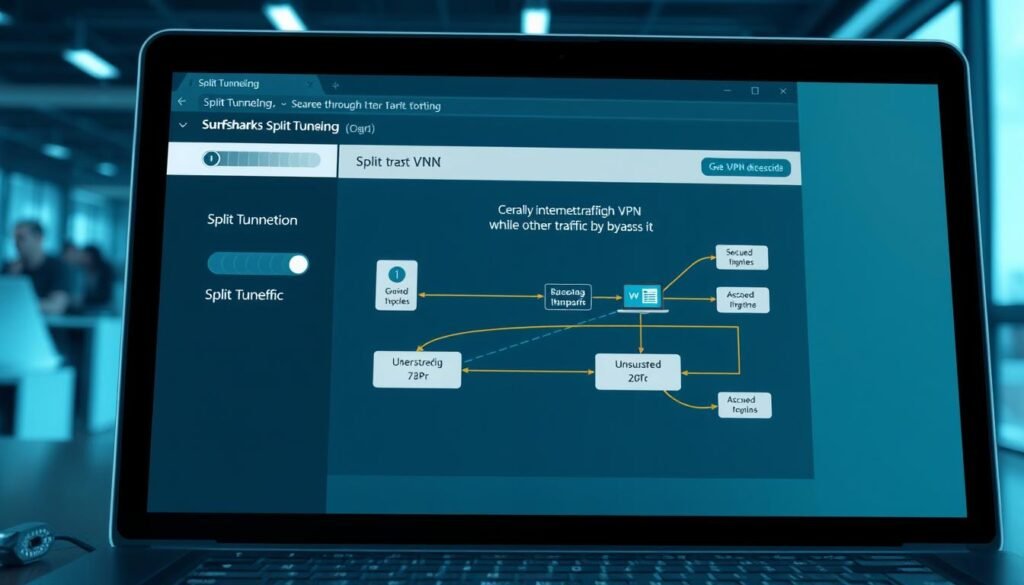
The platform offers unlimited simultaneous connections, Dynamic MultiHop for added anonymity, and split tunneling on macOS for selective routing.
Standout tools and performance
FastTrack uses Nexus routing to improve internet speed in many routes. Our lab runs measured ~21% average speed loss overall, but FastTrack reduced that on key paths.
“Unlimited device support makes Surfshark a practical pick for families and students.”
| Feature | Detail | Impact |
|---|---|---|
| Servers | 3,200+ across 100 countries | Better nearby options and lower congestion |
| Privacy | Dynamic MultiHop + audited diskless servers | Stronger unlinkability |
| Pricing | $15.45 per month; $48 first 15 months; renew $79/year | High monthly rate but solid long-term value |
- Household hero: covers every device without juggling logins.
- Reliability: kill switch held during forced drops in our tests.
- Use case: a great choice for multi-device homes that need features and steady streaming.
Proton VPN: versatile virtual private network for privacy and streaming
Proton blends stealthy connection modes with reliable streaming reach for users who need both privacy and entertainment access. It targets restrictive networks without forcing heavy trade-offs in speed or usability.
For users who travel or face restrictive networks, Proton VPN offers protocol options that hide VPN traffic as ordinary web requests.
Obfuscation & stealth: protocol options that mask VPN usage
Stealth strength: Proton includes an obfuscation-focused vpn protocol option that disguises traffic as regular HTTPS. That helps slip past deep packet inspection and strict firewalls.
Safety net: The built-in kill switch worked in our stress tests, blocking leaks during abrupt disconnects.
Global streaming reach: unblocking regional catalogs reliably
Streaming scope: Proton consistently managed to access geo-restricted content, including tough markets like Netflix Egypt during our checks.
Pricing is clear: about $10 per month with sensible renewals and a 30-day money-back option. Five simultaneous connections cover most households and travel kits.
- Performance: mid-teens average speed loss, good for 4K and secure sync.
- Apps: polished clients across platforms and quiet Android icons for privacy.
- Support: thorough docs and responsive help when a region resists unblocking.
Mullvad: the privacy purist’s pick with flat pricing
Mullvad keeps account details to a bare minimum so your identity stays separate from your subscription. Its model favors predictability and anonymity over bells and whistles, which appeals to security-minded users in the U.S.
Minimal data model: no email required, cash payments, open-source apps
Sign-up minimalism means you can create an account without an email address and pay with cash to reduce linkability.
Code transparency is another core promise: Mullvad ships open-source clients so researchers can audit the software directly.
Transparent pricing: about $6 per month with no hikes
Pricing simplicity: a flat 5 EUR (~$6) per month applies to every term, with no intro deals or sudden renewal spikes.
The service runs 724 servers across 49 countries, offers a strict no-logs policy, and keeps the commercial model deliberately small.
- Privacy posture: no-logs policy and minimal data reduce attack surface.
- Practical trade-offs: may not unblock as many streaming catalogs; choose Mullvad when anonymity matters more than entertainment.
- Refund window: 14 days—shorter than some peers but consistent with a lean business model.
“Flat pricing and open code make Mullvad a clear option for researchers and journalists seeking a private network, without the usual marketing noise.”
Head-to-head comparison essentials: server network, protocols, and platforms
The right balance of global servers, modern protocols, and native clients often decides real-world performance. This section breaks down the technical edges that separate leading providers so you can match features to use cases quickly.
Server coverage: broader footprints ease congestion and stabilize connection speeds. NordVPN and Proton list ~126 countries, ExpressVPN ~105, Surfshark ~100, and Mullvad 49. A wider server network across 100 countries increases the odds of a nearby node and lower latency.
Protocol choices: Lightway (ExpressVPN) and NordLynx (WireGuard) prioritize speed. OpenVPN still wins on compatibility. Proton adds obfuscation for restrictive networks. Pick WireGuard variants for fast transfers, OpenVPN TCP for stubborn firewalls, or obfuscation where filtering blocks tunnels.
Device breadth and features: native clients appear across Windows, macOS, Linux, iOS, Android, Apple TV, Fire TV, and routers. All five support split tunneling and kill switches. Simultaneous connections vary: Surfshark offers unlimited, ExpressVPN and NordVPN offer 10, and Proton commonly allows 5. That number affects household coverage and streaming on living-room devices like Amazon Prime on Fire TV.
Practical takeaway: test your likely devices and routes. A polished UI and stable defaults from a vpn provider matter as much as raw specs. For deeper comparisons, see our curated roundup at Wirecutter’s review.
Pricing and value in the US: per month costs, renewals, and money-back policies
Look beyond monthly snapshots: renewal rates and refunds shape long-term cost. Compare per month labels, introductory deals, and actual renewal bills before you commit.
Intro vs. renewal pricing: avoiding surprises over the long term
Headline rates can mislead. ExpressVPN lists about $13 per month with a $75 first-year option and renewals near $100/year. Nord shows similar monthly pricing but renews around $140/year.
Surfshark promotes low intro terms ($48 for the first 15 months) and renews at about $79/year. Proton runs near $10 per month with renewals around $80/year.
Mullvad is the outlier: a flat ~€5 (~$6) every month with no surprise hikes. Refund windows vary: most offer 30 days; Mullvad gives 14 days.
Willing to pay vs. best free: why “best free vpn” often isn’t the best value
Decide what you are willing pay for. Unlimited device support, obfuscation, or audited no-logs policy may justify a higher annual bill.
Best free options and many free vpns limit data, inject ads, or trade privacy. Trust independent audits and avoid trusting rankings from promotional vpn companies.
- Quick rule: shortlist 2–3 candidates and use refund periods to confirm streaming, speed, and fit.
- Cost lens: annual plans usually lower the per month figure but raise renewal exposure at year two.
Streaming focus: how these VPNs unlock geo-restricted content
Streaming catalogs change fast; pick services that offer multiple working endpoints and quick support to stay ahead of blocks. This section explains how top providers restore access to shows and sports across devices.
U.S. streaming: Netflix, Max, Disney+, Amazon Prime Video, and sports
Top providers reliably unlock Netflix, Max, Disney+, and Amazon Prime Video from U.S. endpoints. In-state servers can bypass regional sports blackouts by appearing local to the event.
If a vpn connection fails, switch to another server in the same state or contact 24/7 live chat for known working endpoints. That usually fixes playback fast.
International catalogs: BBC iPlayer, CBC and multi-region Netflix
Rotating to servers in specific cities helps access BBC iPlayer, CBC, and alternate Netflix regions. Providers with presence in 100 countries give more fallback routes when one node is blocked.
Smart DNS and streaming devices
Smart DNS (MediaStreamer-style) tools let TVs and consoles stream without native support for tunnels. Polished vpn apps on Apple TV and Fire TV reduce friction and keep playback smooth.
| Use case | Action | Why it works |
|---|---|---|
| Blocked catalog | Switch server city or ask live chat | Providers track working endpoints and rotate IPs |
| TV/console | Enable Smart DNS / MediaStreamer | Bypasses device VPN limits while preserving region |
| Traveling | Use providers with broad country coverage | More routes reduce chance of a dead endpoint |
- Avoid relying on free options: even the best free choices often fail to maintain reliable unblocking and can throttle throughput.
- Test before you commit: use trial or refund periods and confirm streaming services work on your devices; see a curated guide for streaming-focused picks at best VPNs for streaming.
Speed findings: download speed, upload speeds, and real-world stability
Real-world speed matters more than peak lab numbers when you stream, game, or upload large files. This section summarizes measured loss, what’s acceptable, and simple steps to restore performance when your connection lags.
Average internet speed loss benchmarks — what’s acceptable?
Acceptable baseline: an average internet speed loss under ~25% usually supports 4K streaming and group video calls without trouble.
- Provider spread: NordVPN ~3% (leader), Proton ~16%, ExpressVPN ~18% with Lightway Turbo and Data Channel Offload, Surfshark ~21%, Mullvad ~24%.
- Upload speeds: steady upload speeds matter for live streaming and backups; top providers preserved low jitter in our tests.
When to switch servers: congestion, distance, and routing optimizations
Switch servers when you see high ping, variable throughput, or evening slowdown. Distance and congested nodes are common culprits.
Protocol tuning: try Lightway or NordLynx before falling back to OpenVPN; they often boost connection speeds without losing stability.
- Routing smarts: features like FastTrack can improve paths — test with and without to measure impact.
- Resilience: confirm auto-reconnect and kill-switch behavior to avoid mid-session exposure.
- Time-of-day: bookmark nearby alternates for peak evening hours when ISPs and servers are busiest.
- Quick test: run an A/B speed test after connecting and swap servers if performance dips below your needs.
For deeper technical reads and updated speed benchmarks, see a focused roundup on fastest connections and protocols.
Privacy and security deep dive: strict no-logs policy, audits, and DNS leak tests
Good privacy starts with verifiable claims, not promises you can’t check. Independent audits, diskless servers, and routine leak checks are the practical tests that separate marketing from real protection.
Why independent audits and RAM-only servers matter
Audit proof: third-party audits validate a provider’s no-logs policy and confirm RAM-only operations that wipe data on reboot. ExpressVPN has completed 23 audits and runs TrustedServer diskless tech.
Architecture edge: diskless servers reduce persistence. That strengthens a private network posture when servers are seized or inspected.
Essential protections: kill switch, split tunneling, and leak prevention
Leak checks: repeated dns leak tests are essential. We ran DNS and IP leak checks under normal use and during forced disconnects to verify that internet traffic stayed inside the tunnel.
Essential controls: every leading provider ships a kill switch and split tunneling. These features must be reliable and easy to configure so users do not trade convenience for exposure.
Protocol and logging considerations
Protocol confidence: modern ciphers and forward-looking features such as post-quantum key exchange help protect traffic against evolving threats. NordVPN adds double VPN and Onion-over-VPN for extra layers.
Logging clarity: avoid vague statements. Look for explicit language on activity, timestamps, and diagnostics. Audits carry more weight than jurisdiction claims alone.
- App defaults: safe-by-default settings cut accidental exposure during network changes.
- Telemetry transparency: acceptable when anonymized and optional; audit reports should state scope.
- Outcome: choose providers with repeated reputable audits and repeatable lab results, not just marketing verbiage.
| Protection | Why it matters | Example from leaders |
|---|---|---|
| Independent audits | Validates no-logs policy and controls | ExpressVPN: 23 audits; NordVPN: annual audits |
| RAM-only (diskless) | Wipes data on reboot, lowers persistence | TrustedServer / RAM-only deployments |
| Leak testing | Ensures DNS/IP stay inside the tunnel | Repeated dns leak checks in lab runs |
| Kill switch & split tunneling | Prevents accidental exposure and supports selective routing | All five providers offer these controls and passed our tests |
Feature checklist for power users: multi-hop, dedicated IPs, and more
This concise checklist helps power users match advanced tools to real needs. Use it to pick the right set of extras without overpaying for features you won’t use.
Advanced extras: double VPN, Shuffle IP, Threat Protection, port forwarding
Privacy layering: double VPN (multi-hop) is available on NordVPN and Surfshark. It adds redundancy for sensitive sessions but slows throughput. Enable it selectively when you need extra unlinkability.
Address hygiene: ExpressVPN’s Shuffle IP rotates your public IP per site. Choose this when you want reduced correlation without manual switching.
Threat controls: built-in blockers like Nord’s Threat Protection reduce ads and malware exposure. Still run endpoint antivirus as a second line of defense.
Port forwarding: offered by some providers and useful for P2P or self-hosting. Configure carefully to avoid exposing services to the open internet.
Simultaneous connections and household coverage
Household math: ExpressVPN and NordVPN allow 10 simultaneous connections, Proton permits 5, and Surfshark supports unlimited. Match counts to your device pool to avoid juggling logins.
- Split tunneling: route trusted apps outside the tunnel while keeping sensitive traffic protected.
- VPN connection management: prefer auto-connect on untrusted Wi‑Fi and fast protocol switching to reduce interruptions.
- Dedicated IPs: useful for banking and allowlists—ask for token-based issuance to retain anonymity.
- Automation: set rules for networks and app exceptions to keep daily use seamless.
- Provider choice: advanced security features vary widely—verify your must-haves before you commit.
| Feature | Typical providers | When to use |
|---|---|---|
| Multi-hop / Double VPN | NordVPN, Surfshark | High-sensitivity browsing |
| Dedicated IP / Shuffle IP | ExpressVPN (add-on) | Banking, remote allowlists |
| Simultaneous connections | Surfshark (unlimited), Express/Nord (10) | Household and travel kits |
United States use cases: travel, regional sports, and 50-state access
Road trips and business travel require quick, reliable access to the same services you use at home. Choose providers with broad U.S. reach so streaming, banking, and ticketing continue to work when you move between states.
Servers across all 50 states and beating blackout restrictions
ExpressVPN and some rivals offer endpoints that span all 50 U.S. states. That coverage helps you sidestep regional sports blackouts and keeps localized internet access intact for state-based services.
Practical tips:
- Travel convenience: pick a nearby state server to lower latency on the road.
- Sports access: in-market or out-of-market servers can unblock feeds tied to a specific state.
- Safety in transit: keep the kill switch enabled to avoid exposure on flaky hotel or public Wi‑Fi.
- Work continuity: bookmark several nearby servers as a backup if one is congested.
- Streaming on the go: use Smart DNS or TV-friendly clients to watch on hotel devices.
Want a deeper read on U.S. coverage or how to pick the right endpoint? See the U.S. coverage guide and a primer on optimal server placement.
best vpn apps: how to choose the right VPN provider for your needs
Pick a winner for how you actually use the service, not the headline features list. Match your top priority—privacy security, streaming, or speed—and you’ll eliminate most options quickly.
Match your priorities: privacy security vs. streaming vs. speed
If privacy security leads, favor providers with independent audits and RAM-only (diskless) servers. These reduce data persistence and raise the bar for real-world protection.
If streaming is the priority, pick services that demonstrate consistent unblocking and fast DNS response on living-room devices.
For gaming or large uploads, prefer providers using Lightway or NordLynx for lower latency and steady throughput. Test protocols on your network before committing.
Assess transparency: audits, jurisdiction, and logging language
Read audit reports and the logging policy. Avoid vague terms and missing jurisdiction details. Clear language beats marketing every time.
- Core safeguards: insist on a reliable kill switch and split tunneling that works on your OS.
- Practical checks: compare renewal totals, refund windows (most offer 30 days), and 24/7 support for streaming fixes.
- Try before you commit: trial 2–3 contenders during the refund window and keep the one that fits daily use.
| Decision factor | What to check | Why it matters |
|---|---|---|
| Privacy security | Independent audits, RAM-only servers | Limits stored data and validates claims |
| Streaming | Proven unblocking, Smart DNS, device support | Keeps catalogs working on TVs and consoles |
| Speed & stability | Lightweight protocols, nearby servers | Lower latency for gaming and uploads |
| Cost & refunds | Renewal pricing, 30-day trial | Prevents surprise bills and lets you test |
Why free vpns fall short on privacy and performance
A no-cost service can be tempting, but many free offerings introduce real risks. Use this section to weigh leaks, slowdowns, and hidden costs before you rely on a free connection for sensitive tasks.
Leak risks and data trade-offs vs. paid vpn services
Almost 90% of popular free providers we tested showed serious security gaps, including IP exposure in real checks. Over half of paid Android clients still had minor leaks in our scans.
Key failures include:
- Many free vpns fail basic dns leak and IP checks, exposing browsing and approximate location.
- “Best free vpn” offers often monetize by injecting ads or sharing analytics, putting your internet traffic data at risk.
- Bandwidth caps, slow nodes, and queue systems undermine streaming and conference calls.
Sensible path: if you are using vpn for anything sensitive, treat it as a security tool and budget accordingly. Trial a paid plan with a 30‑day money-back guarantee to validate speed, privacy, and unblocking before you commit.
| Issue | How common | Why paid helps |
|---|---|---|
| IP/DNS leaks | ~90% in free tests | Paid providers run audited, diskless servers and pass leak tests |
| Data monetization | Frequent in free tiers | Paid services fund operations from subscriptions, not ads |
| Performance limits | Bandwidth caps and slow nodes | Paid plans provide higher throughput and priority routing |
| Support & reliability | Often absent or slow | Paid support restores access and rotates working endpoints |
Conclusion
Balance clear privacy guarantees with steady download speed and stable clients to get protection that fits real life. Shortlist two or three providers, test them during the refund window, and confirm per month and renewal costs match what you’re willing pay.
Clear front-runners: ExpressVPN for audited privacy and 50‑state reach; NordVPN for top download speed; Surfshark for unlimited devices and value; Proton for stealth and reach; Mullvad for flat‑fee anonymity.
Prioritize providers with repeated audits, RAM‑only servers, and transparent ownership from credible vpn companies. For a quick comparison and further reading, see a curated roundup of the best VPN.
