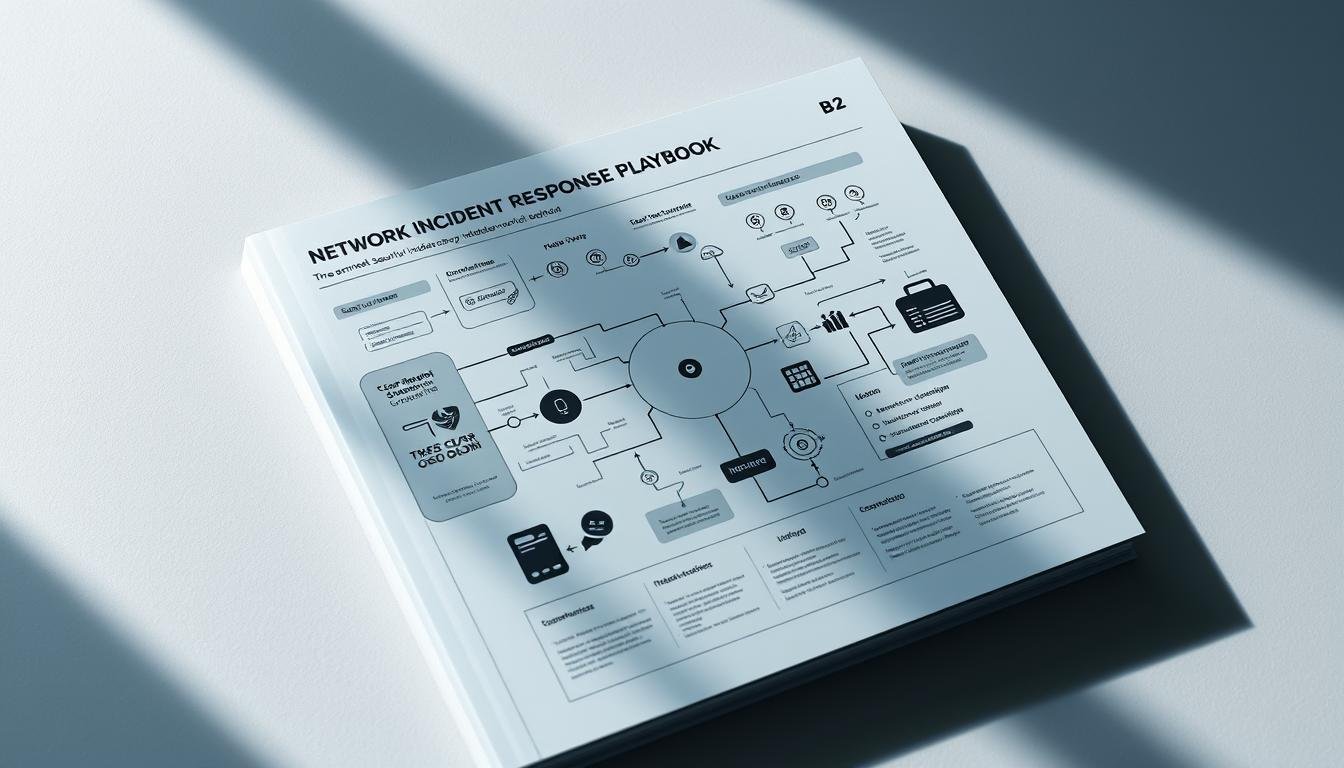
Can your team act fast enough when every second counts? This guide lays out a practical, blue team-focused a step-by-step blue team incident response playbook that moves from first alert to verified recovery.
Think of this plan as a living document. It defines how to detect threats, contain harm, and restore services while keeping roles clear and communications tight.
Grounded in NIST phases—Preparation; Detection and Analysis; Containment, Eradication, and Recovery; Post-Incident Activity—this resource maps tools like SIEM and SOAR into the process.
Outcome-focused design reduces dwell time, protects data, and helps maintain business trust during a breach. Clear ownership, concise checklists, and frequent exercises keep teams fluent when pressure rises.
Key Takeaways
- Use a living plan that defines roles and priorities for speedy execution.
- Follow NIST phases to create consistent, repeatable actions.
- Integrate SIEM, SOAR, and evidence collection into the process.
- Train often so handoffs and communications stay sharp under stress.
- Focus on outcomes: shorter dwell time, faster recovery, preserved trust.
Why Incident Response Matters Now: Impact, risk, and business continuity in the present threat landscape
Modern cyberattacks impose hard financial and reputational tolls that leaders can no longer ignore. Ransomware caused more than $30 billion in global losses in 2024, and the 2025 average cost of a data breach hit $4.56 million. Those numbers show how fast a single security incident can create direct costs for forensics, legal work, and recovery.

Rising costs and the real price of impact
Direct expenses are only part of the story. Indirect losses from downtime, lost customers, and brand damage often exceed initial bills.
A documented CSIRP reduces financial and reputational risk and helps organizations meet compliance requirements such as CMMC 2.0, NIST SP 800-171, HIPAA, and PCI DSS v4.0.
From reactive firefighting to resilient operations
Reactive firefighting leaves teams exhausted and metrics poor. Proactive management builds detection, containment, and recovery muscle memory through repeatable processes.
Clear reporting, ready evidence handling, and executive-funded readiness narrow time to contain incidents and limit data loss. That readiness also lowers regulatory exposure and speeds better outcomes in litigation or audits.
- Compounding effects: multiple incidents in short order can overwhelm staff and inflate impact.
- Leadership matters: executives must approve, fund, and track metrics that show shrinking MTTD and MTTR.
- Human factor: concise instructions and training reduce panic and prevent costly errors.
Treat incident response as core risk management that complements insurance, disaster recovery, and broader continuity plans. Preparing for minor anomalies and full-scale disruptions is how resilient organizations survive frequent attacks and recover faster.
Plan vs. Playbook: How incident response plans, playbooks, and the broader process fit together
A strong plan sets the frame; targeted playbooks fill in exact actions. The CSIRP anchors governance and defines triggers and roles. Playbooks supply precise sequences for specific initiating conditions.

CSIRP and lifecycle alignment
The policy layer assigns ownership and triggers. The plan documents the overall process from detection through recovery.
Ongoing risk management keeps both current through testing and audits. This alignment makes each part of the management lifecycle clear and repeatable.
When to use a plan, a playbook, or both
Use the plan to coordinate across the organization and satisfy governance needs. Use playbooks to execute exact actions during urgent events.
“Standardized playbooks reduce variation and protect compliance under pressure.”
Design tips:
- Centralize common components (evidence handling) in the plan and reference them in multiple playbooks.
- Map which roles own policy, plan, and playbooks to avoid confusion.
- Review cadence: after major incidents, audits, or tech changes.
| Artifact | Primary Owner | Purpose |
|---|---|---|
| Policy | Security leadership | Define roles and triggers |
| Plan | Incident management | Coordinate cross-organization process |
| Playbooks | SOC / Practitioners | Execute tactical sequences for specific incidents |
Preparation Essentials: People, systems, and scope before an incident strikes
Start by mapping what matters most inside your network and business operations. This short inventory sets priorities and keeps leadership ready to act.

Define scope, assets, and stakeholders
Inventory the environment: document systems, data flows, dependencies, and business-critical services the plan protects.
Name stakeholders: assign roles across IT, security, legal, HR, communications, and vendors. Secure executive sponsorship with clear authority to make fast decisions.
Set recovery targets and compliance expectations
Recovery targets: record RTOs (maximum downtime) and RPOs (maximum data loss) for each key system. Make SLAs explicit so teams know required timelines under pressure.
Align with rules: map notification and preservation requirements for GDPR (72-hour breach notification), HIPAA documentation, and CMMC/DFARS reporting timelines.
- Communication: pre-approved contact trees, secure channels, and message templates for rapid updates.
- Tooling access: ensure SIEM, endpoint controls, ticketing, and legal templates remain reachable if primary systems fail.
- Evidence handling: standardize logging, timestamps, and artifact retention for forensics and audits.
- Readiness: run tabletop exercises to validate assumptions and train every team on handoffs.
Calibrate severity tiers and triage rules so triggers map to clear actions and escalation paths. That clarity shortens decision time and protects data when threats appear.
Building a step-by-step blue team incident response playbook
Designing tactical guides begins with precise triggers and ends with measurable closure criteria. This section shows how to turn alerts into clear actions and verified outcomes.

Identify triggers and incident types
List initiating conditions for common types: user-reported phishing, SIEM alerts, unusual outbound traffic, ransomware, malware, DDoS, or insider threats. Each trigger links to a named entry point in the playbooks.
Map actions, dependencies, and flow
Capture required actions for immediate containment and optional actions for deeper analysis. Map dependencies so each action shows its prerequisites and expected owner.
Define end states, handoffs, and governance
Specify clear end states: resolved, mitigated and monitored, or escalated. Document who owns each transition—SOC, engineers, legal, communications, leadership—and tie steps to reporting and regulatory requirements like GDPR timelines.
| Component | Required | Owner |
|---|---|---|
| Initiating condition | Yes | SOC |
| Containment actions | Yes | Endpoint ops |
| Forensic enrichment | No | Forensics |
| Escalation & reporting | Yes | Legal / Exec |
Validate playbooks in exercises, refine steps, and standardize artifacts so the process performs under pressure.
NIST-Aligned Phases in Action: Detection, containment, eradication, and recovery
Detection must turn data into clear priorities, and every follow-up action should reduce uncertainty. This section shows how to move through analysis, containment, eradication, and recovery while preserving evidence and improving defenses.

How to centralize detection and analysis
Centralize logs in a SIEM and train analysts on indicators of compromise (IOCs). Triage each alert with context from endpoints, network flows, cloud logs, and application traces.
Confirm scope quickly: verify affected hosts, user accounts, and data to shape which actions come next.
Contain with intent
Apply short-term isolation to stop spread, then plan long-term hardening: patching, segmentation, and credential resets. Containment must protect business-critical systems while enabling forensics.
Eradicate, verify, then recover
Remove persistence, backdoors, and malicious code. Rescan systems and review recent changes before restoring services from known-good backups.
Validate integrity: stage reintroduction to production and monitor for regression or recurrence.
Post-incident activity and continuous improvement
Preserve timestamps, logs, and actions taken so investigators can reconstruct events. Run a lessons-learned session, assign owners for fixes, and update detection rules and tools.
| Phase | Primary focus | Key outputs | Owner |
|---|---|---|---|
| Detection & Analysis | Logging, SIEM, IOCs | Confirmed scope, enriched alerts | SOC |
| Containment | Isolation, segmentation | Stopped spread, hardening plan | Endpoint ops |
| Eradication & Verification | Remove access, rescans | Clean systems, verification report | Forensics |
| Recovery & Post | Restore, lessons | Validated services, updated processes | Incident response |
Communications and Reporting: Clear protocols for internal, external, and regulatory audiences
Clear, timely communication preserves trust and keeps technical teams focused when a security event unfolds. Designate ownership, use secure channels, and pre-write adaptable messages so the organization meets legal windows without confusion.

Assign one communications lead to centralize message creation and approvals. That role keeps statements consistent, reduces leak risk, and coordinates with legal before public release.
Who owns messages and which channels to use
Appoint a single authorizer and backup. Use encrypted chat, dedicated hotlines, and isolated email lists for sensitive updates.
Templates for customers, partners, and media
Keep short, factual templates ready. Each template should state known impact, next steps, and when the next update will arrive.
Regulatory timelines and audit-ready reporting
Embed GDPR 72-hour notification, HIPAA documentation needs, and CMMC/DFARS 72-hour reporting into the plan. Log every communication with timestamps and recipients for audits and post-event review.
- Coordinate with legal: review claims and protect privileged data.
- Update leadership: provide time-based summaries focused on business impact.
- Track what you say: keep written records to support any later report or litigation.
- Avoid speculation: publish facts and committed next steps only.
- Sync with technical teams: ensure public messages match containment and forensics actions so security work is not hindered.
Roles, Responsibilities, and Escalation: Who leads, who executes, and when to escalate
Who can declare a security emergency matters more than many teams realize. Clear decision rights and published escalation thresholds keep action timely and lawful.
Start by naming who may declare an incident and who will act as Incident Commander. That person—often the CISO or an authorized senior security lead—has authority to assign tasks, approve containment, and brief executives.

Who does what?
Execution roles should be explicit. SOC analysts triage alerts and gather scope. Engineers isolate affected systems and restore services. Legal advises on notifications. Communications manages external messages.
When to escalate to DRP or BCP?
Set measurable thresholds that trigger Disaster Recovery Plan (DRP) or Business Continuity Plan (BCP) activation. Examples: service outage beyond RTO, confirmed data exfiltration, or multi-site impact. Publish the criteria so every team knows when to escalate.
“Assign authority early and document alternates; speed without clarity risks mistakes.”
- Name decision-makers: who declares and who commands.
- Build redundancy: alternates for critical roles and live contact trees.
- Standardize handoffs: short status reports when ownership shifts.
- Include vendors: third-party escalation paths for dependent systems.
| Role | Main duty | Authority & alternate |
|---|---|---|
| Incident Commander | Overall direction, approvals | CISO; Deputy CISO |
| SOC | Triage, scope, IOCs | SOC Lead; Senior Analyst |
| Engineering | Contain, restore systems | Head of Ops; On-call Engineer |
| Legal & Comms | Notifications, public messaging | General Counsel; PR Lead |
Keep role documents current, accessible off-network, and reviewed after every event. That practice turns authority into reliable action and closes gaps in management across the organization and plan.
Automation and SOAR: Accelerating response while reducing analyst burnout
Orchestration can turn noisy alerts into swift, repeatable actions that stop threats faster. Automation saves minutes per alert, scales capacity, and reduces burnout for security staff.
Automatable tasks include threat-enrichment, log gathering, ticket updates, alert routing, and metric collection. These tasks cut manual overhead and improve reporting quality.
Which tasks to automate?
- Enrichment & correlation: pull threat intelligence and related logs automatically.
- Triage & ticketing: open or update tickets based on verified signals.
- Alerts & notifications: send time-stamped emails and chat alerts to on-call staff.
- Metrics capture: record MTTD and MTTR inputs for downstream reporting.
How to keep humans in the loop
Design workflows that require approval for high-impact containment actions. That preserves oversight while letting tools handle routine work.
Safety checks must verify scope before isolating hosts or resetting credentials. Log every automated action so investigators can trace decisions.
Example: phishing playbook with automated containment
A common sequence: enrich sender and URL, block malicious IPs in perimeter controls, isolate affected endpoints, and update tickets with artifacts. The system notifies security teams and records each step for reporting.
| Task | Automated Action | Human Approval |
|---|---|---|
| Threat enrichment | Pull TI, domain reputation, related logs | No |
| Containment | Block IPs, isolate endpoint | Yes (for critical assets) |
| Ticketing | Open/update ticket with context | No |
| Reporting | Capture metrics, attach logs | No |
Start small: focus on high-volume use cases like phishing and malware triage. Train the team on tool actions, build rollback paths, and iterate as trust grows.
Testing, Metrics, and Continuous Improvement: From tabletop to real incidents
Regular testing turns assumptions into proven capabilities under pressure. Run exercises often and measure outcomes so the plan improves with each run.
Quarterly tabletop drills and annual red/blue evaluations
Run tabletop scenarios every quarter to validate decision-making, communications, and technical coordination across incidents.
Annual red/blue evaluations stress detection, controls, and recovery under realistic conditions. Use these tests to confirm whether protections meet operational needs.
Forensic readiness, documentation updates, and MTTD/MTTR tracking
Standardize evidence collection so teams analyze data fast without harming legal defensibility. Keep chains of custody and logs accessible off-network.
Track Mean Time to Detect (MTTD) and Mean Time to Recover/Respond (MTTR) to show whether tools and processes reduce exposure and shorten recovery time.
Iterating from lessons learned and threat intelligence
Convert post-event findings and threat information into concrete changes for detections, controls, and playbooks. Write a short report after each exercise or real event that states what worked, what didn’t, and who owns fixes.
Budget for simulations, tooling, and training. Revisit improvements in the next exercise to confirm gaps were closed, not just recorded.
| Practice | Cadence | Primary Output | Owner |
|---|---|---|---|
| Tabletop drills | Quarterly | Decision validation, comms test | Incident management |
| Red/blue evaluations | Annual | Control effectiveness, detection gaps | Security operations |
| Forensic readiness | Continuous | Audit-ready evidence, playbook updates | Forensics |
| Metrics & reports | After each event | MTTD/MTTR trends, follow-up tasks | Security leadership |
Conclusion
Clear roles, rehearsed protocols, and measured tools move chaos into control.Train, test, and update your plan so detection, containment, and recovery work together.
Finish strong: disciplined incident response anchored by a defined plan and precise playbooks helps an organization contain threats, limit impact, and restore systems faster.
When teams rehearse authority, communication, and recovery across on‑prem and cloud, response time shrinks and detection improves. Apply lessons from real events, update playbooks, and keep cross‑functional ownership for legal, comms, and ops. Invest in metrics, automation, and exercises this quarter so cybersecurity maturity produces measurable results and better outcomes for customers, partners, and operations.
