
Could one ordinary email really trigger losses that ripple through vendors and partners until totals reach the nine-figure mark?
This section unpacks a single, well-timed business email compromise and the chain of events that turned a routine request into massive fraud.
The FBI’s IC3 documented over 21,000 complaints in 2023, with adjusted losses near $2.9 billion. IBM found that this breach type ranks among the costliest, averaging millions per incident.
We will define the threat in plain terms, trace impersonation, thread insertion, and altered invoices, and show why approval cycles and vendor changes are common targets.
Expect clear detection cues, practical process controls, and incident steps you can use today. Whether you manage IT, finance, or run a small business, this primer will make the risk visible and the response practical.
Key Takeaways
- Business email compromise can move large sums with minimal friction.
- Routine approvals and vendor changes are frequent entry points.
- Real cases show simple emails led to massive aggregate losses.
- Early detection cues and process controls shrink attacker advantage.
- Actionable response steps cut recovery time and damage.
From one email to billions: why business email compromise is America’s costliest social engineering threat
A single convincing email often opens a quiet conduit for large-scale financial fraud. That one message exploits trust inside routine workflows and can reroute payments, change vendor details, or seed false approvals.
Business email compromise relies on tight social engineering: attackers impersonate executives, vendors, or partners to create urgency and legitimacy. Employees facing a familiar sender and a pressing request often skip extra checks.
The scale is real. The FBI IC3 logged 21,489 BEC complaints in 2023 with $2.9 billion reported losses. By 2024 BEC accounted for roughly 73% of reported cyber incidents, and activity rose another 30% into 2025.
Invoice approvals, vendor onboarding, and bank-detail changes are high-risk moments. Attackers keep a low technical footprint, sending crafted emails that yield outsized returns.
- Defenses: strong authentication, verified callbacks, and dual approval.
- Governance: executives must treat this as enterprise risk—finance, IT, legal aligned.

How BEC attacks work: the anatomy behind the inbox
A convincing message often starts with careful reconnaissance of people, processes, and payment rhythms. Attackers chain that intelligence into email pretexts that look routine and urgent.
Impersonation and pretexting
Variants include vendor impersonation to change bank details, CEO fraud that pressures for immediate transfers, and attorney pretexts that demand secrecy. Email account compromise (EAC) is especially dangerous because a real mailbox lends instant credibility.
Account takeover vs. spoofing
- Spoofing: lookalike domains and display-name tricks that fool quick reviewers.
- Account takeover: stolen credentials let attackers reply inside live threads and alter invoices.
Reconnaissance and timing
Adversaries watch month-end close, travel, and due dates to tighten decision windows. Red flags include mismatched domains, new bank details, secrecy directives, and out-of-hours requests.

- Map the kill chain: research, craft pretext, deliver, steer approvals, cash out.
- Document vendor contacts and approval steps so anomalies stand out to employees.
- Protect accounts with unique passwords and multi-factor access to limit EAC risk.
By the numbers: BEC costs, volumes, and timelines in the United States
Data from law enforcement and industry studies reveal clear trends: volume, loss, and long detection timelines. These figures translate into material exposure for finance teams and leadership.
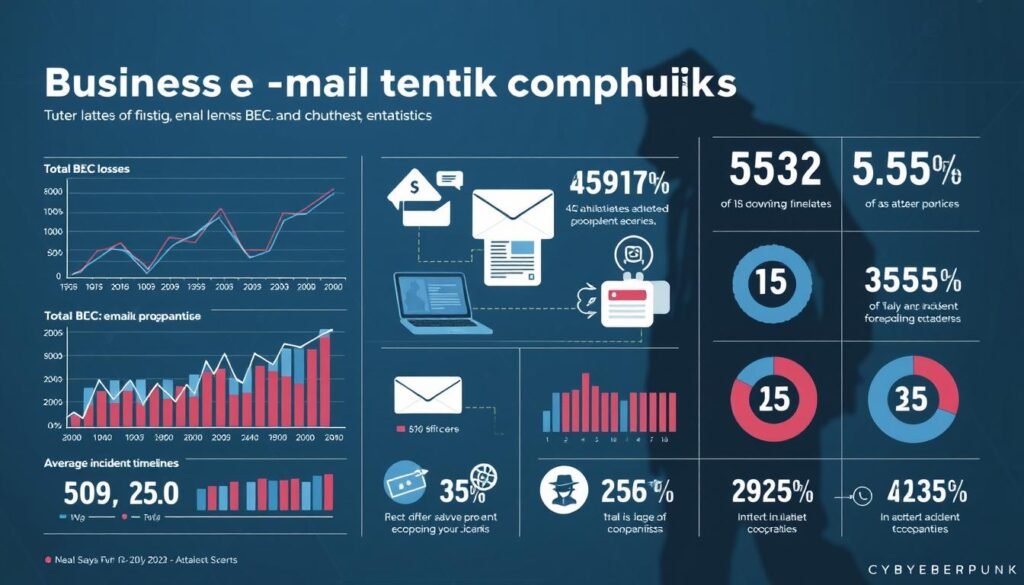
FBI IC3 findings
The FBI’s Internet Crime Complaint Center logged 21,489 complaints in 2023, with reported losses near $2.9 billion. The average reported loss per incident was about $137,132.
Incident economics from IBM
IBM’s breach study places this type of breach among the most expensive, with average total impact near $4.89M. Investigation, recovery, legal fees, and disruption drive that figure well above simple wire totals.
Detection lag and cash‑out trends
Average time to identify and contain these schemes is roughly 308 days. Low malware use and believable context let threats dwell unseen.
- Cash-out evolution: custodial crypto accounts and third‑party processors speed laundering and shrink recovery windows.
- Staff exposure: finance and HR inboxes concentrate risk, so focused controls deliver outsized benefit.
- Detection implications: proactive monitoring, reconciliation checks, and verified callbacks reduce dwell time.
Fast reporting matters. Quick notifications to banks and the FBI’s financial fraud kill chain improve chances of freezing moving funds; see the financial fraud kill chain report for more detail.
how a bec attack cost a company a billion dollars
One manipulated inbox can trigger payment redirections that ripple through suppliers and partners. Small, repeated diversions turn into very large aggregate loss when vendor masters and approval workflows accept changed accounts without verification.
Aggregate impact
Aggregate impact: compounding losses across sectors, vendors, and supply chains
A single successful business email compromise often starts modestly and then compounds. Attackers modify bank details for one vendor, then repeat the change across multiple vendors and customers.
Notable examples include the Quanta pretext used against Facebook and Google, FACC’s CEO fraud, and Orion’s $60M disclosure. These incidents show how one inbox can seed broad exposure.
The invoice diversion pipeline
The invoice diversion pipeline: from a single approval to systemic cash-out
Attackers gain access or spoof a trusted partner, alter payment instructions, and route future funds to mule accounts. Recurring payments and automated approvals let redirected accounts keep receiving payouts.
- Accounts updated: future transfers flow to layered mule networks.
- Supplier effect: one vendor compromise can expose many customers.
- Recovery reality: rapid reporting helps, but clawbacks and insurance limits often leave gaps.

Attacker tradecraft in 2024-2025: AI-polished lures, VEC, and multichannel pressure
Adversaries now blend synthetic text, voice, and timeline intelligence into single, persuasive campaigns. Defenders must assume messages are AI‑grade and pair technical controls with repeatable processes.
In mid‑2024 roughly 40% of phishing lures showed signs of generative sourcing. That has erased old telltales: tone, grammar, and format now mirror internal memos.

Generative AI and deepfakes
Near‑perfect language and synthetic voices amplify pressure. Deepfake calls or short videos can confirm fraudulent instructions and close the loop on social engineering.
Vendor Email Compromise (VEC)
VEC rose about 66% in early 2024 as criminals insert into real vendor threads to change payment details. Context from breached mailboxes makes pretexts harder to spot.
Cash‑out diversification
Gift cards made up nearly 38% of early‑2024 schemes, while advance‑fee variants were about 29%. Custodial crypto platforms and installment scams now shorten laundering timelines.
- Tools: crimeware services sell templates, personas, and calendar‑aware sends.
- Telemetry: monitor vendor bank changes, odd gift card buys, and out‑of‑region logins.
- Rehearse: run multichannel playbooks to test callbacks and dual approvals.
The human factor: psychology that powers BEC success
Human instincts—trust, obedience, and the need to avoid embarrassment—fuel many successful email cons. Attackers shape messages to trigger those instincts, then compress time to reduce checks.
Authority and secrecy
Authority and secrecy: CEO fraud and isolation tactics
Impersonation of leaders exploits authority bias: about 89% of schemes mimic executives. Urgent, private requests like “keep this confidential” discourage calls for verification.
Isolation works. When employees feel singled out, they skip peer checks and avoid escalation.
Urgency and fear
Urgency and fear: compressing decision windows to bypass controls
Roughly 75% of attacks demand action within 24–48 hours. Compressed timelines trigger stress responses. People trade caution for speed and may grant access or approve transfers without validation.
Trust and routine
Trust in familiar brands and partners: routine process exploitation
More than 60% target known vendors or partners. Familiar workflows create autopilot behavior that attackers mimic. New employees in their first two weeks are especially vulnerable.
For example, a 2019 deepfake CEO call in the energy sector convinced staff to transfer €220,000. That multichannel pressure sealed the compromise.
- Train with micro-simulations that recreate urgent, private requests.
- Watch for secrecy cues, odd tone, or deviations from templates.
- Empower employees to pause and verify with safe callbacks.

Who’s being targeted: industries, company sizes, and geographies
Attackers pick sectors where routine invoices and complex supply chains create believable pretexts. These operational patterns make impersonation and email compromise especially effective.
Sector hotspots
Manufacturing leads at 27%, followed by energy at 23%. Retail, utilities, and real estate round out the top five with 10%, 7%, and 6% respectively.
Why it matters: frequent vendor billing and layered suppliers let one fraudulent change affect many payees.
Size doesn’t save you
Large organizations face near 100% weekly likelihood of being targeted if they have 50,000+ staff. Firms over 1,000 show 83–97% weekly exposure. Small firms still see about 70% weekly odds.
That means continuous monitoring and playbook drills are necessary at every scale.
Geographic trends
The United States concentrates documented loss—roughly $2.9B in reported incidents with an average near $137K per report. Europe rose sharply in 2024; Australia saw modest increases.
Priorities for leaders: tighten vendor-change controls, verify bank details by callback, and benchmark incident rates against peers.
| Metric | Top Sectors | Weekly Exposure by Size | Regional Trend |
|---|---|---|---|
| Target share | Manufacturing 27%, Energy 23% | <1k: 70% | 1k+: 83–97% | 50k+: ~100% | U.S.: $2.9B reported |
| Secondary sectors | Retail 10%, Utilities 7%, Real Estate 6% | All sizes: regular targeting | Europe: +123.8% YoY (Apr 2024) |
| Operational driver | Complex supply chains, recurring invoices | Large orgs: broader surface; SMBs: fewer layers | Australia: +7% YoY |
Real-world cases: invoice fraud, CEO scams, and large-scale wire transfers
Several high‑profile frauds show a single invoice or urgent note can trigger cascading transfers across multiple banks and countries. These examples reveal the patterns that let criminals exploit routine workflows and trusted partners.
Facebook / Google and the Quanta pretext
Fraudsters sent forged vendor invoices that mirrored Quanta paperwork. That led to $98M and $23M in transfers to mule accounts. Most funds were recovered, but the episode shows how well‑crafted invoices pass routine checks.
FACC CEO fraud and Orion’s multi‑wire disclosure
The 2016 FACC case used executive impersonation to secure a $47M transfer. Authority and secrecy compressed verification time. In 2024 Orion disclosed $60M lost via repeated wires to third‑party accounts, underscoring how repeated small diversions evade reconciliation.
International and municipal examples
Zamora’s €19,952.90 diversion recovered €16,838.18 — a small case with clear lessons: fast reporting helps, but money that moves through layered accounts is hard to trace.
U.S. municipalities show vendor master gaps. Busy finance teams can miss subtle bank‑detail changes, letting funds reroute before teams detect anomalies.
- Vendor impersonation at scale: mimic invoices to exploit routine approvals.
- CEO fraud dynamics: authority plus secrecy defeats single‑step checks.
- Repeat wires: multiple transfers hide in normal volumes unless reconciled.
- Money movement: mule accounts and quick cash‑outs reduce recovery chances.
- Lessons: dual approval, verified callbacks, vendor audits, and shared post‑incident reports.
For more documented examples and playbook guidance see Business email compromise examples.
Defense in depth: controls that reduce BEC risk and losses
Layered defenses cut attacker options and make fraud recovery faster. Combine technical controls, hardened processes, identity protections, and focused training to reduce successful business email compromise.
A staged combination of policy, tech, and people reduces the chance that a single message reroutes funds.
Email authentication and security tools
Enforce DMARC, SPF, DKIM and move to reject policies for misaligned mail. Major providers and standards bodies now push these controls for high-volume senders.
Deploy Secure Email Gateways and API add-ons with AI detection to flag spoofed display names, risky request language, and malicious links.
Process hardening
Require dual approval for wires and vendor bank changes. Use trusted callbacks to verified contacts before releasing funds.
Alert on vendor-master edits, off-hours approvals, and geo-anomalous sign-ins to critical accounts.
Identity protection
Roll out phishing-resistant MFA, apply least privilege, and monitor sign-in risk to reduce account compromise. Limit admin access and log critical changes.
Awareness training and simulations
Run role-based security awareness training for finance, HR, and executives. Use recurring simulations that mirror urgent, private requests.
Track completion and tie training outcomes to system access when appropriate.
Response and recovery
Document playbooks: immediate bank contact, FBI IC3 referral, legal notification, and incident retainer contacts. Organizations that act fast often recover most stolen funds.
| Control | Primary Benefit | Example Tool or Practice | Expected Outcome |
|---|---|---|---|
| Email authentication | Reduce spoofing | DMARC/SPF/DKIM, reject policy | Fewer spoofed inbound messages |
| Layered security tools | Faster detection | SEG + AI detection, sandboxing | Higher catch rate for malicious requests |
| Process hardening | Stop fraudulent transfers | Dual approval, trusted callbacks | Fewer unauthorized fund releases |
| Identity controls | Limit account compromise | Phishing-resistant MFA, least privilege | Lower credential theft impact |
Conclusion
Even one trusted message can trigger cascading transfers that outpace controls and reporting windows. The core lesson is simple: social engineering and rapid money movement combine to make email compromise high‑impact, but preventable.
Practical path forward: enforce sender authentication, require out‑of‑band verification for payment changes, mandate dual approval, and monitor accounts for anomalies. Pair these controls with clear playbooks so teams act fast when minutes matter for funds recovery.
Make training realistic and empower employees to pause on suspicious emails without penalty. Elevate this threat to executive priorities, track detection and response metrics, and run tabletop drills each quarter. For IC3 findings and trends, see this IC3 report summary.
