
A single exploited gap can cost an organization millions within days.
The guide that follows maps a practical, ten-layer security framework to leading standards. A cybersecurity framework is a clear set of standards, controls, and practices that help teams and vendors manage risk. It turns scattered fixes into repeatable management.
NIST released Cybersecurity Framework 2.0 in 2024 and added Govern to lift cyber work into enterprise risk. ISO 27001 and 27002 prove mature programs but only show a point in time. PCI DSS 4.0 now mandates multi-factor authentication for many systems.
This piece is tactical. You will find steps to inventory digital assets, harden systems, monitor threats, and show evidence for audits. We map actions to ISO, CIS, CSA, SOC 2, PCI, HIPAA and other standards so your organization gains faster response and clearer risk visibility.
Key Takeaways
- A ten-layer blueprint links practical controls to major standards.
- Governance matters: NIST CSF 2.0 adds enterprise-level oversight.
- Certifications help but continuous monitoring is required.
- Immediate wins: asset inventory, hardening, monitoring, and response.
- Outcome-focused: reduced attack surface and audit-ready evidence.
Why 2025 Demands a Framework-Driven Security Strategy
Adopt a standards-led core and add continuous detection to close gaps between audits and active threats. NIST CSF 2.0 adds governance so cyber becomes part of enterprise risk, not an IT checklist.
Organizations manage faster, adaptive attacks by pairing formal standards with day-to-day controls. Point-in-time ratings—ISO certificates or annual audits—show discipline but miss live threats that move hourly.
The updated nist cybersecurity framework introduces a *Govern* function that embeds accountability and policy at executive and board levels. That shift improves budget alignment and drives faster incident response.
Frameworks provide a common language that helps nontechnical leaders weigh risk and compliance. They translate technical controls into business outcomes and make regulatory requirements easier to meet.
- Point-in-time vs continuous: audits validate maturity; continuous monitoring detects new threats.
- Regulatory alignment: mandates like PCI DSS MFA and GDPR breach windows reward standards-based approaches.
- Operational benefit: fewer duplicated efforts, clearer priorities, and faster response when seconds count.
| Aspect | Traditional Audit | Standards + Continuous |
|---|---|---|
| Timing | Periodic | Continuous |
| Focus | Maturity snapshot | Real-time risk management |
| Outcome | Compliance evidence | Faster detection & response |
Start with a nist cybersecurity framework-aligned core, then tailor to HIPAA, FISMA, or NERC-CIP as needed. This approach drives measurable improvements in cybersecurity maturity and lowers operational risk.
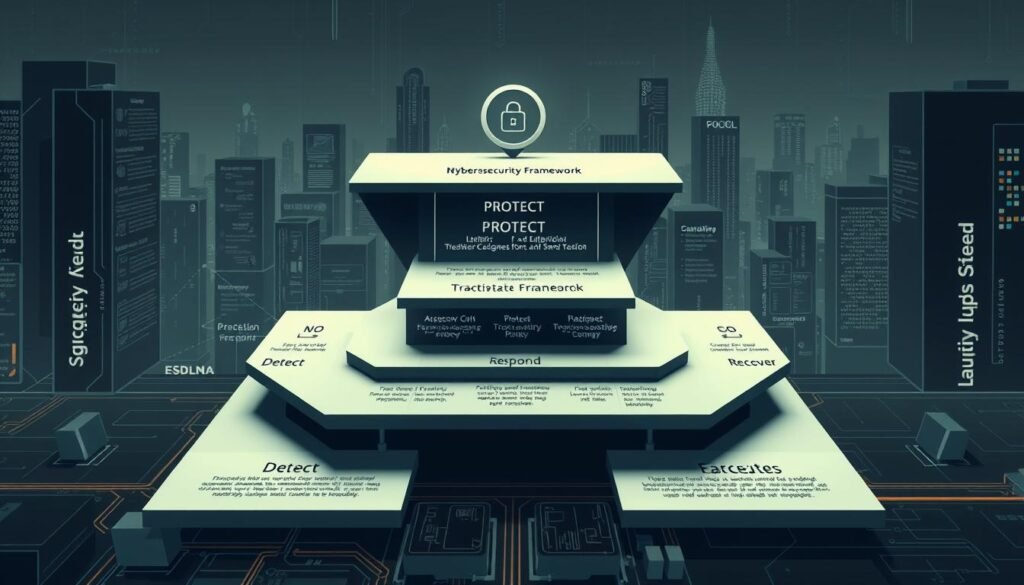
Web Security Framework 2025: How We Structure Defense for Real-World Risks
We map defensive functions directly to business goals so teams can prioritize work that protects revenue and uptime. This keeps technical work tied to measurable outcomes and reduces wasted effort.
The six NIST core functions become business levers:
- Identify: Maintain an asset inventory and run threat models to prioritize critical systems and data. Owners get clear risk ratings tied to revenue.
- Protect: Apply policy-backed baselines, least privilege, encryption, and hardened configs to lower outage likelihood while preserving productivity.
- Detect: Centralize logging, telemetry, and behavior baselines across endpoints, network, and cloud to spot anomalies early and shorten dwell time.

- Respond: Use decision trees, roles, and communications plans so incident response limits impact and speeds containment.
- Recover: Test backups, define recovery time objectives (RTOs), and tie post-incident lessons to management metrics.
- Govern: Align budgets, KPIs, and continuous improvement so the program lives in operations, not a binder.
“Turn the framework into a living program: measure, act, and improve every quarter.”
For practical guidance on implementing controls and best practices, read our secure applications guide. This helps organizations implement repeatable risk management and compliance steps.
The Ten Layers of Defense: Practical Controls Mapped to Leading Frameworks
Map each defensive layer to audit-ready controls so teams act quickly and prove compliance. This section ties each layer to standards and shows repeatable actions IT and leadership can follow.
Start with visibility, then harden, monitor, and verify.

Govern and Identify
Living asset inventories, threat models, and a risk register mapped to iso 27001 and NIST CSF help organizations implement clear ownership.
Access and Identity
Enforce zero trust, MFA per PCI DSS 4.0, and least privilege aligned to CIS and SOC 2 to block credential abuse.
Data Security
Classify data, encrypt in transit and at rest, and apply privacy controls per iso 27002, GDPR, and HIPAA timelines.
Hardening & Configuration
Use CIS Benchmarks and COBIT-driven baselines and scan for drift continuously.
Vulnerability & Patch Management
Continuous scans and NIST SP 800 guidance prioritize exploitable issues on internet-facing systems.
Network & Cloud
Segment workloads, limit east–west traffic, and map cloud controls to CSA CCM.
Detection & Monitoring
Centralize logs, deploy IDS/IPS, baseline behavior, and enable SOAR for repeatable triage.
Incident Response and Recovery
Document runbooks, test exercises, and align incident response to NIST Respond/Recover for audit evidence.
Third-Party Risk
Require SOC 2 reports, continuous vendor assessments, and map supply-chain risk to NIST and FISMA rules.
Compliance & Assurance
Maintain an ISO 27001 ISMS, build an evidence catalog, and map controls to CMMC where required.
For primary guidance on implementing governance and the Identify function see the NIST CSF guidance.
Aligning with Top Cybersecurity Frameworks Without the Noise
Start with a clear baseline and add only what maps to your risks and obligations. This keeps teams lean and focused on high-impact work. Use NIST CSF 2.0 for structure, then pick certification signals or controls that match your needs.

How should you choose and tailor standards?
Decision path: adopt NIST CSF 2.0 as the program backbone, add iso 27001/iso 27002 if certification matters, and apply CIS Controls to prioritize fast wins.
Map control objectives to your assets and regulatory requirements. Prioritize controls that cut real exposure, not neat checklists.
What about healthcare, federal, and critical infrastructure?
For health data, align safeguards with HIPAA and consider HITRUST for customer requirements. Federal contractors should follow FISMA and NIST SP 800 series and plan for CMMC. Power and utilities need NERC-CIP scoping and supply-chain assurance.
- Keep an ISMS to anchor policies, metrics, and audits.
- Reduce noise: consolidate duplicate controls, retire overlapping tools, and assign owners with evidence paths.
Result: a pragmatic, auditable program that fits small teams and large organizations while reducing wasted effort.
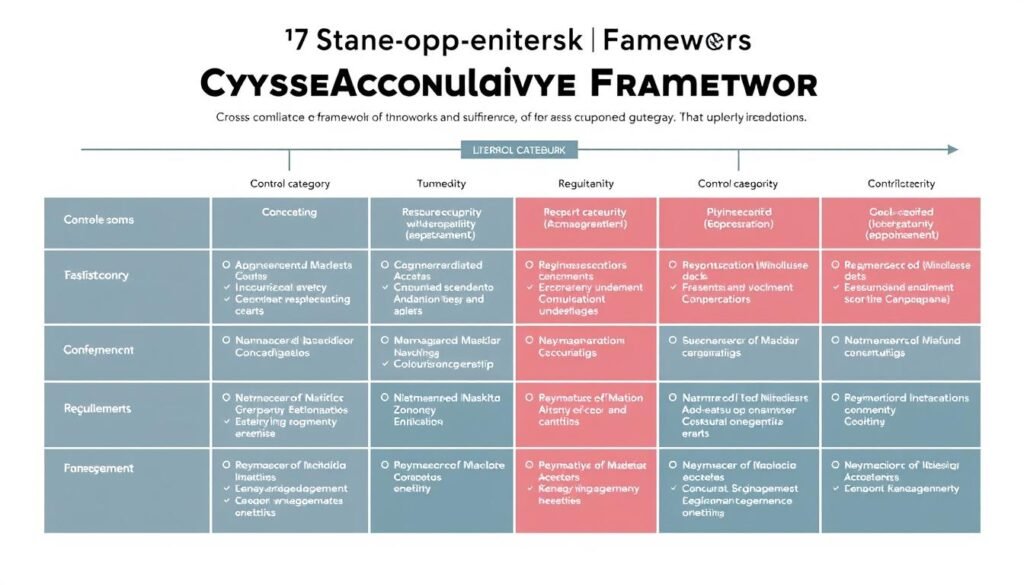
Cross-Compliance Mapping: One Control Set, Many Requirements
Map controls once and satisfy many audits. Use a shared control catalog to tag evidence, owners, assets, and frameworks so audits pull the right artifacts fast.
Treat controls as reusable assets: tag them to standards, owners, and evidence so audits run smoothly. A single, well-documented control can meet multiple audit asks and cut duplicate work.
How do you harmonize major standards?
Harmonizing NIST CSF with ISO 27001 and SOC 2
Use the NIST CSF for functional mapping, ISO 27001 for governance and the ISMS, and SOC 2 for customer-facing assurance.
- One control, many mappings: a centralized access review maps to ISO 27001 A.9, SOC 2 security criteria, and the nist cybersecurity framework Protect function.
- Link evidence: store logs, review records, and owner attestations in a single repository so auditors see the chain of custody.
Overlaying PCI DSS 4.0, GDPR, and HITRUST
Apply the same controls where they fit: IAM, logging, segmentation, and encryption often cover multiple rules.
- Map PCI DSS 4.0 MFA and segmentation to your IAM and network controls.
- Embed GDPR into data classification, encryption, and breach playbooks to prove timelines for breach notices.
- Use HITRUST to consolidate HIPAA-aligned safeguards for handling health information and payer requirements.
Practical tip: maintain a shared control repository. Tag each control to standards, owners, assets, and criticality so auditors pull evidence without rework.
For teams needing a structured start, our roadmap can help. Read the guide to start your cybersecurity journey and build a unified control set that cuts audit overhead.
Measuring Cybersecurity Maturity and Managing Risk Over Time
Measure what matters: baseline against recognized profiles, track a few high-value KPIs, and close gaps every quarter to reduce measurable risk.
Start with a baseline assessment against NIST CSF 2.0 profiles to set a target maturity level tied to your organization’s risk appetite.
Define clear metrics: pick indicators that map to incident response and daily operations. Use mean time to detect (MTTD), mean time to respond (MTTR), patch SLA for exploitable vulnerabilities, privileged access approvals, and backup recovery test success rates.
- Baseline and target: run an initial profile, then set quarterly targets tied to compliance and risk management.
- Continuous loops: run retros after incidents and audits, feed fixes into the backlog, and track closure rates.
- Detection tuning: use behavior baselines, threat intel, and purple-team exercises to cut false positives and improve fidelity.
Automate measurable gains: SOAR and detection baselining reduce response time and produce repeatable evidence. Document dashboards, logs, and change records so auditors and leaders trust the numbers.
For primary guidance on measuring and profiling, see the NIST Cybersecurity Framework.
Implementation Playbook for Organizations in the United States
Start with a focused, reproducible plan that delivers quick risk reduction and audit-ready evidence. Kick off a one-week assessment, then move into a 90-day roadmap and operational automation to sustain gains.
What should you do in week one?
Rapid assessment: enumerate critical assets, map data flows, and baseline existing controls against nist cybersecurity guidance to surface top gaps and owners.
How to build a 90-day roadmap?
Prioritize high-impact controls: enforce SSO and MFA, apply least privilege, set patch SLAs for internet-facing systems, and centralize logs for SOC 2 and compliance needs.
How do organizations operationalize response and evidence?
Stand up incident response: define roles, escalation paths, templates, and evidence capture. Run a short tabletop to validate the plan.
Automate with SOAR playbooks for triage, account disablement, IOC blocking, and ticket creation to speed response and reduce manual error.
- Make audits easier: build an evidence catalog of policies, diagrams, logs, tickets, and test records mapped to ISO 27001 and customer questionnaires.
- Iterate monthly: review KPIs, retest backups, and update the risk register so leadership sees measurable progress.
“Fast inventory, a focused 90-day plan, and automation are the best path from assessment to sustained control.”
Conclusion
A disciplined, standards-mapped approach turns ad hoc defense into predictable operations that protect business continuity.
strong, use this closing checklist to act now:
Reaffirm outcome: a clear cybersecurity framework and ten-layer model move teams from reactive fixes to steady management that supports business resilience.
Immediate steps: inventory critical systems and data, enable MFA, close high‑risk vulnerabilities, and validate incident response with a short tabletop.
Align once, prove many times: map controls to standards, keep evidence current, and let compliance streamline protection rather than distract from it.
Final note: when organizations adopt the ten layers, runbooks, and measured KPIs, they cut threats’ impact and meet requirements with confidence.
