
We faced that exact crisis. A client found credential theft that tried to siphon funds through finance workflows. Within minutes, our team moved from chaos to clear steps.
Credential-stealing malware can hijack sessions, grab logins, and change transactions in online finance portals. Without a playbook, confusion costs money, time, and trust.
This guide shows the lifecycle we follow: identify, contain, eradicate, recover, and learn. It names tools like SIEM, EDR/XDR, MDR, UEBA, WAF, and email protections such as DMARC, DKIM, and SPF. Every action aims to limit loss, protect credentials, and restore systems to a known-good state with validated restores.
We write for teams of all sizes. Small IT groups and enterprise security ops can run these steps. We bake evidence capture into each phase so legal and audit needs are met without slowing recovery.
Key Takeaways
- Act fast with a clear playbook to cut confusion and limit financial loss.
- Focus on credential protection, containment, and validated restores.
- Use SIEM, EDR/XDR, and MDR to detect and confirm malicious activity.
- Capture evidence during each phase to support legal and insurance needs.
- Run regular drills so any organization can reproduce these steps under pressure.
Understanding Banking Trojans and Why They’re Different
These threats combine social engineering and stealthy code to target finance workflows. They don’t just disrupt systems; they quietly harvest credentials and change transactions in real time.
The delivery chain is simple and effective: a crafted email or attachment convinces an employee to click, a downloader runs, persistence is installed, and command-and-control (C2) links open the door to theft.
How they infiltrate through phishing and vulnerable endpoints
Attackers use targeted phishing, fake update prompts, and malicious macros to trick staff into lowering defenses.
Unpatched browsers, legacy plugins, permissive Office macro settings, and missing application whitelisting make payload execution easier.
Credential theft, session hijacking, and financial fraud risks
- Credential harvesting: keyloggers and form grabbers steal logins and tokens.
- Session hijack: injected code can steal cookies and perform transactions without re-entry of passwords.
- Business impact: fraudulent wires, altered payroll, and changed vendor banking details.

| Stage | What happens | Mitigation |
|---|---|---|
| Phishing delivery | Malicious link or attachment solicits action | DMARC, DKIM, SPF, and sandboxing |
| Execution | Downloader runs and installs persistence | App whitelisting, macro restrictions, patching |
| Data theft | Credentials and session tokens exfiltrated | MFA, UEBA, XDR monitoring |
Combine training, email controls, and MDR/XDR monitoring so teams spot odd logins and anomalous transactions faster. For deeper technical details on common techniques, see techniques and tradecraft.
Early Warning Signs and Rapid Detection in the Present Threat Landscape
Watch for subtle behavior changes on endpoints; they often arrive before visible fraud. Quick, accurate detection saves time and limits damage to systems and accounts.
Behavioral indicators include impossible-travel logins, sudden session resets, and unusual payment patterns. Monitor finance user sign-ins from new countries and off-hours access closely.
Desktop clues matter too: unexpected pop-ups, slow performance, or dwindling disk space can point to resident malware trying to harvest credentials.

How SIEM, UEBA, and EDR/XDR improve signal-to-noise
Feed authentication, endpoint, and network logs into a Security Information and Event Management (SIEM) system to correlate events. Custom rules help match risky combinations instead of alerting on single noisy signals.
User and Entity Behavior Analytics (UEBA) builds a baseline of normal activity, then flags off-hour finance access, mass exports, or sudden inbox rule changes. Endpoint Detection and Response (EDR) and Extended Detection and Response (XDR) reveal browser injections, credential dumps, and scripting abuse.
Managed Detection and Response (MDR) shortens mean time to detect by pairing 24/7 analysts with automation. That blend reduces false positives and starts containment faster than internal teams alone.
Fast-check checklist
- Behavioral red flags: impossible travel, new-country sign-ins, odd transaction patterns.
- Desktop signs: pop-ups, slow systems, sudden storage loss.
- Instrumentation: SIEM + UEBA + EDR/XDR + financial app logs for high-fidelity alerts.
- Operational steps: tier-1 playbooks, tuned alerts, and MDR coverage to cut time-to-action.
| Signal | Likely cause | Action |
|---|---|---|
| Off-hours finance login | Credential misuse or session hijack | Trigger MFA challenge, validate geolocation, alert SOC |
| Unexpected pop-ups & slow systems | Resident malware activity | Isolate host, collect memory image, run EDR scan |
| Mass spreadsheet export | Data exfiltration or insider misuse | Block export, review UEBA alerts, escalate to analysts |
| PowerShell/script anomalies | Automation abuse or loader activity | Harden scripting policy, block process, capture artifacts |
Immediate Containment Actions Our Team Took
We moved fast to cut off malicious channels while keeping evidence intact. Every action aimed to stop credential loss, protect systems, and preserve forensic artifacts.
Isolating infected endpoints and disabling compromised accounts
Isolate first, power down later. We removed affected hosts from the network segment and Wi‑Fi to stop command-and-control and credential exfiltration. Teams did not power systems off so memory and running processes stayed available for analysis.
We suspended suspect user accounts, forced password resets, and required MFA re-enrollment where activity looked abnormal.
Blocking malicious IPs/domains and geolocation controls
Firewalls and DNS lists were updated with malicious IPs and domains. We applied geoblocking to limit traffic to approved regions and tightened Web Application Firewall (WAF) rules to reduce exposure.
Preserving volatile data without powering systems down
EDR captured memory images, process lists, and timeline telemetry. Cloud audit logs from identity providers and finance tools were exported to lock evidence windows.
- Quarantine email and remove suspicious mail across mailboxes.
- Pause non-urgent payments and verify vendor banking changes.
- Use out-of-band channels for coordination and document every action with timestamps.

When containment needs extra muscle, we engaged MDR/EDR teams to sustain isolation while internal staff prepared eradication tasks. For a deeper containment checklist, see our containment playbook.
incident response for a banking trojan attack: The Step-by-Step Playbook
A clear, repeatable playbook keeps teams coordinated from triage through full recovery. It sets roles, actions, and checkpoints so technical staff, legal, and communications move together.
Identify: Confirm the trojan family and scope of compromise
Use EDR telemetry, hash reputation, and C2 patterns to fingerprint the malware and map affected endpoints. Tally impacted users, credentials, and finance systems. Capture memory images and logs before remediation starts.
Contain: Network segmentation, quarantine, and access revocation
Segment infected VLANs and quarantine hosts via EDR. Revoke risky sessions and enforce credential resets with MFA. Keep forensic integrity while cutting exfil channels.
Eradicate: Malware removal, patching, and hardening
Remove payloads and purge persistence (scheduled tasks, registry run keys, browser hooks). Patch OS and browsers, disable risky macros, and tighten execution policies.
Recover: Clean rebuilds, validated restores, and functional testing
Prioritize clean builds for finance workstations and restore from known-good backups. Run end-to-end tests on payment flows and MFA. Validate app integrity before returning systems to production.
Learn: Post-incident review and plan updates
Hold a post-mortem within two weeks. Document root cause, dwell time, gaps, and prioritized fixes. Update the incident response plan, assign owners, and schedule tabletop drills.

| Phase | Core actions | Outcome |
|---|---|---|
| Identify | EDR analysis, hashes, C2 mapping, log capture | Scope and evidence established |
| Contain | Quarantine hosts, revoke sessions, segment network | Exfiltration stopped, access limited |
| Eradicate | Remove malware, patch, remove persistence | Threat removed, gaps closed |
| Recover | Rebuild, restore, validate transactions | Systems returned to trusted state |
| Learn | Post-mortem, plan updates, drills | Improved readiness and fewer repeat failures |
Secure Communications and Stakeholder Management
Fast, precise guidance reduces confusion and helps staff take the right steps under stress. Clear channels and consistent messages protect employees and preserve trust with customers and partners.
Fast, secure coordination matters during any major incident. Use an approved out-of-band tool to avoid adversary eavesdropping and ensure auditability.

Internal guidance to employees during an active event
Tell staff what to stop and what to start doing. Ask employees to avoid password reuse, halt vendor banking changes, and report anomalies immediately. Provide concise talking points so managers share consistent, vetted information.
Customer and partner notifications to preserve trust
If customer information might be affected, notify those impacted with clear, factual updates. Pre-draft external statements and FAQs and run them by legal and compliance before release.
- Establish a secure channel: approved out-of-band messaging for coordination.
- Freeze bank detail edits: finance and vendor teams verify changes by callback.
- Log every message: timestamp internal and external communications for a defensible record.
- Monitor news and public chatter to correct misinformation quickly.
Align statements with counsel, empower help desk and HR with escalation paths, and balance speed with accuracy. For a deeper guide to stakeholder coordination, see our stakeholder communication playbook.
Forensics, Evidence Preservation, and Legal Considerations
Preserving evidence and a clear timeline keeps investigations focused and defensible. Document who collected what, when, and how so legal teams can trust findings and technical teams can act quickly.

How to build and protect a defensible chain of custody
Start a formal log at first discovery. Record actions, tools used, artifacts collected, and personnel involved. Label disk images, memory captures, and logs with collector identity, date/time, and checksums.
Which logs and exports to preserve
Export SIEM events, EDR/XDR telemetry, email audit logs, identity provider events, and bank portal access records. Keep original files intact and capture cryptographic hashes to prove integrity.
“Document everything with timestamps; that record becomes the backbone of legal and technical follow-up.”
- Scope exposure: identify payment card details, personal data, or financial records that may trigger regulatory notification.
- Engage counsel early: align notification timing with state, federal, and sector rules so public filings stay accurate.
- Consider law enforcement: notify when fraud attempts or confirmed theft occur, coordinating to avoid disrupting containment.
| Task | Why it matters | Who owns it |
|---|---|---|
| Timeline capture | Enables audit trail and legal defensibility | Lead analyst |
| Evidence labeling | Preserves chain of custody and integrity | Forensic team |
| Log exports | Supports scope, root cause, and compliance | SOC and IT |
| Secure storage | Protects sensitive information during retention | Compliance |
Store evidence encrypted and limit access. Track third-party involvement, mirror privacy policy transparency when sharing collected data, and use forensic findings to refine policy and control baselines so future investigations run faster and cleaner.
Tooling That Made a Difference: MDR, XDR, and Email Security
MDR paired 24/7 analysts with advanced tools to hunt, alert, and contain issues quickly. XDR unified telemetry across endpoints, network, identity, and cloud so complex paths became visible.
The right mix helped our team spot credential theft and browser injection attempts before fraud moved funds.
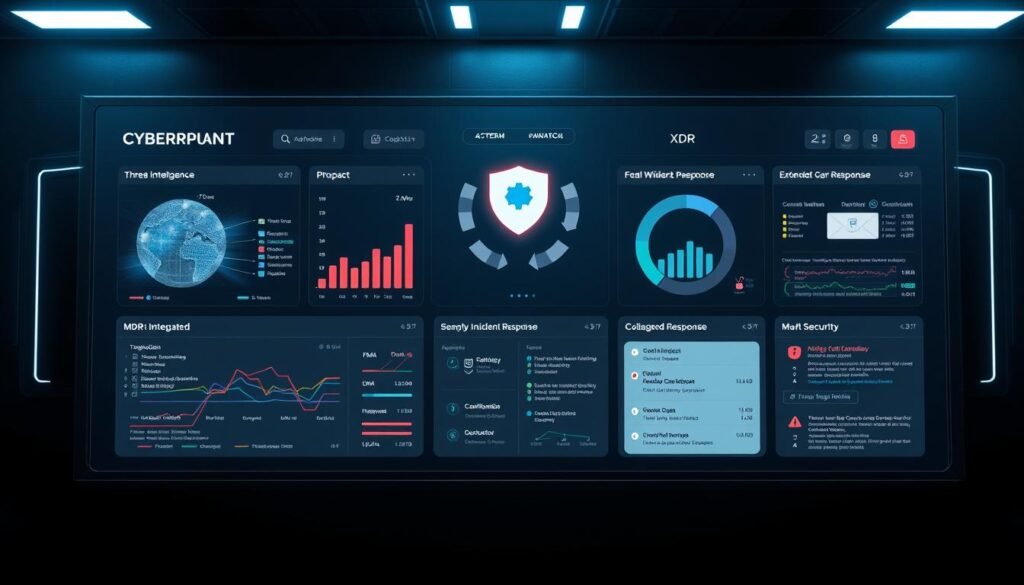
MDR/XDR for continuous monitoring and rapid action
Managed detection and response (MDR) gives round-the-clock analysts who triage alerts, hunt threats, and reduce dwell time. Small groups can offload triage and containment to extend limited resources.
Extended detection and response (XDR) consolidates signals so automated isolation can quarantine compromised hosts on malicious process sighting, then hand tasks to humans for validation.
DMARC, DKIM, SPF, and sandboxing to reduce phishing-led malware
Harden email with DMARC, DKIM, and SPF to stop spoofing. Route risky attachments through sandboxing to detonate content safely. Feed identity logs into SIEM and UEBA and enforce MFA to boost detection quality.
| Capability | What it does | Impact | Example vendor |
|---|---|---|---|
| MDR | 24/7 human triage & hunting | Faster containment, fewer false positives | Managed SOC |
| XDR | Cross-domain telemetry fusion | Detects complex lateral paths | AI-driven platforms |
| Email defenses | DMARC/DKIM/SPF + sandbox | Reduces phishing success | Gateway sandboxes |
| Identity integration | MFA + SIEM feed | High-fidelity alerts on finance logins | Identity providers |
Hardening the Environment to Prevent Reinfection
Hardening closes the windows attackers used and forces them to change tactics. This is about raising the cost of follow-up attempts through identity, host, and network controls. Make these changes part of the ongoing security plan so gains persist.
MFA, least privilege, and admin account hygiene
Enforce multi-factor authentication (MFA) for everyone, especially privileged users. Use phishing-resistant methods like number-matching or hardware tokens on high-value finance apps to counter MFA fatigue and credential theft.
Apply least privilege across accounts. Narrow finance roles, remove legacy admin rights, and ban shared credentials in payment workflows.
Rename default admin accounts, separate daily-use and privileged sessions, and prohibit web browsing or email on admin consoles.
Network controls: WAF, geoblocking, and DMZ for internet-facing assets
Protect public-facing services with a Web Application Firewall (WAF) and place them in a segmented DMZ. Geoblock traffic from regions outside your operating footprint.
Segment and monitor so compromises cannot freely traverse internal systems and so alerts tie to meaningful context.
Application whitelisting and rigorous patch management
Use application whitelisting to allow only approved binaries and block unsigned executables that loaders and malware often use.
Patch urgently: prioritize browsers, plugins, Office suites, identity agents, and VPN clients. Track SLA adherence in your plan and remediate high-severity vulnerabilities quickly.
“Hardening is not finished when systems come back online. It must be measured, enforced, and validated regularly.”
- Harden email: keep DMARC, DKIM, and SPF on strict policy and review reports.
- Reduce attack surface: uninstall unused apps and disable legacy services and scripting where possible.
- Test hardening: run periodic red-team or penetration tests to validate controls against real threats.
- Embed in plans: bake these controls into the incident response plan and the broader response plan so improvements stick across the organization.
| Control | Why it matters | Expected outcome |
|---|---|---|
| MFA & phishing-resistant auth | Stops credential replay and session takeover | Reduced account compromise and fraud |
| Least privilege & admin hygiene | Lowers privileges attackers can abuse | Smaller blast radius if compromise occurs |
| WAF, DMZ, geoblocking | Shields internet-facing assets | Fewer external exploit windows |
| App whitelisting & patching | Blocks unknown loaders and fixes vulnerabilities | Lower chance of malware and ransomware reinfection |
Sector-Specific Risks: Financial Services and Beyond
Different sectors face unique threat profiles; your safeguards must match those risks. Financial firms hold direct monetary assets and sensitive records, so they must prioritize transaction monitoring and fast account lockdowns.
What financial firms should prioritize
Monitor anomalous payments and lock suspect accounts immediately. Require verbal callbacks before changing bank details and pre-approve takedown paths with partner banks.
MSPs can analyze access logs, isolate systems, enforce encryption, and run transparent communications with stakeholders.
Cross-industry lessons and practical steps
Ransomware taught us to keep off-site, immutable backups and run restore drills. Business email compromise appears in many industries; watch inbox rules, geo‑anomalous logins, and invoice edits.
- Healthcare: coordinate with compliance and patient-safety teams to limit care disruption.
- SMBs: use cloud WAF and DDoS mitigation to protect storefronts and revenue.
- All organizations: partner with managed service providers and define SLAs and roles clearly.
“Tailored planning beats one-size-fits-all playbooks; prioritize based on risk and regulatory need.”
| Sector | Priority | Quick action |
|---|---|---|
| Financial | Transaction monitoring, account locks | Verbal callback, pause payments |
| Healthcare | Care continuity, compliance | Isolate systems, notify safety teams |
| SMB / Retail | Availability, revenue protection | Enable cloud WAF, engage CDN/DDoS service |
Share threat intelligence with peers and ISACs and continuously tailor controls to your organization’s risk profile and regulations. For deeper reading on financial threats, see financial services threats.
Conclusion
Strong preparedness, clear playbooks, and practiced teams turn chaos into controlled recovery. Turn lessons into action by updating your incident response plan so gains become standard operations.
Keep the core approach simple: identify, contain, eradicate, recover, and learn. Document every step, capture evidence, and run cross-functional drills to cut time to action.
Protect data and people: validate backups, harden endpoints, and train employees to spot phishing. If 24/7 coverage is missing, partner with an MDR or MSP to extend capability.
Practical next step: schedule a tabletop drill within 30 days, close the top-three gaps, and align service providers so your team can execute the plan with confidence.
