
Can a single flaw in a router or phone really turn a whole network into a weapon? That question frames the danger here: small gaps lead to large results.
A botnet is a network of compromised computers and smart devices that link back to a command hub. From that hub, operators issue orders that let thousands act as one. These coordinated attacks can break services, steal data, click-fraud, or mine currency.
The infection path often begins with phishing, bad downloads, or weak firmware. Once enrolled, endpoints phone home with quiet beacons, await instructions, and try to hide from security tools. Modern families like Mirai and Zeus show scale and persistence.
For a clear primer and definitions, see this concise overview on what a botnet is. This guide focuses on detection, remediation, and defensive steps for both enterprises and small networks.
Key Takeaways
- Botnets turn many endpoints into one coordinated threat.
- Infection starts with simple vectors like phishing and vulnerable software.
- Command-and-control channels keep enrolled systems synchronized and stealthy.
- Famous families (Mirai, Zeus) show the business model behind attacks.
- Effective defense combines detection, device hygiene, and takedown coordination.
Botnets Explained: From Bots to Bot Herders
One compromised node can be the seed of a large, coordinated network. Operators use remote servers to issue tasks and update functionality without user notice.
What is a bot? A bot is a single compromised computer or IoT device running malicious software that awaits orders. It acts quietly, beacons out, and retrieves tasks from a remote server.
What is a botnet? A botnet is a coordinated collection of those bots. A single operator, often called a bot herder or botmaster, issues instructions and hides identity behind proxies or Tor to avoid attribution.
- C2 mechanics: bots call home, pull a command, and return results. This cadence is tuned to blend with normal traffic.
- Architectures: simple client–server models use central servers; peer-to-peer setups distribute relay roles across peers for resilience.
- Modular updates: herders push new code to add functions—DDoS modules, credential theft, spam, or mining tools.
“A resilient command layer and low-cost endpoints make modern networks attractive to operators.”

| Model | Strength | Weakness |
|---|---|---|
| Client–Server | Simple to manage; fast updates | Single point of failure at the server |
| Peer-to-Peer (P2P) | High resilience; harder to takedown | More complex coordination |
| Hybrid | Flexible failover; mixed benefits | Operational complexity for herder |
Typical endpoints include Windows and Linux systems, Android phones, home routers, and cameras. Low-power items become powerful when aggregated; thousands can overwhelm major targets.
This section sets up the next part, which maps the command loop to real attack scenarios and practical security steps.
Inside the Botnet Control Loop: Infection, C2, and Command Execution
Infection, silent enrollment, and large-scale execution form a tight loop that keeps a network threat alive. Each stage builds on the last: a successful compromise leads to registration with a remote hub, then to coordinated tasks.
Attackers seed networks by tricking users, exploiting unpatched software, or slipping loaders into web pages. Common vectors include phishing emails, drive‑by downloads, and exploit chains that install a small loader or backdoor.

Silent enrollment and command reach
Once a system hosts a loader it beacons to a C2 server or joins a peer mesh, registers a unique ID, and polls on randomized intervals. This low‑and‑slow cadence hides abnormal outbound traffic and delays detection.
Execution at scale and spread
Modular payloads then activate: coordinated ddos floods, bulk spam, data theft, cryptomining, or secondary drops of malicious software. Advanced families scan and move laterally, seeking weak credentials or exposed services to expand across the network.
“Persistence and obfuscation give attackers time to monetize access.”
Persistence comes from autoruns, scheduled tasks, bootloader hooks, and re‑infection routines. Encrypted channels, DGAs, and proxy layers further mask C2. Watch for odd DNS lookups, egress spikes, or disabled security — early signs an endpoint has enrolled.
For practical cleanup steps and a focused removal guide see persistent malware removal.
how does botnet malware control infected devices
Operators use efficient messaging patterns so thousands of nodes act on the same orders almost simultaneously. This section contrasts central command servers and peer meshes, then shows the masking and update methods that keep operations alive.

Centralized commands versus peer-to-peer coordination
Centralized setups make bots poll one or a few server endpoints for tasks and updates. That model is simple to run and fast to change.
By contrast, P2P swarms share tasks, lists, and code among peers. A mesh caches commands so operations survive partial takedowns.
Encryption, proxies, and anonymity layers
Herders encrypt command streams and chain proxies or Tor to hide origin and evade inspection. This thwarts simple packet checks and attribution.
Fallback patterns — multiple domains, domain-generation algorithms (DGA), and hardcoded IPs — give redundant retrieval paths for command retrieval.
Dynamic updates and signed modules
Operators deliver new modules and configuration files over existing channels to swap functions: spam, floods, info theft, or mining. Signed updates and code signing on endpoints are a key defense.
Attackers tune polling intervals and jitter to blend with normal traffic. Network teams can surface anomalies with TLS fingerprinting, odd SNI values, and strict egress filtering.
- Detection angle: combine host signing policies with network telemetry and threat intel to interrupt command paths.
- Resilience: P2P caching and DGAs keep operations running when parts of the infrastructure fail.
For practical detection tips and traffic analysis tools, see this brief guide on network traffic detection, and a technical overview of modern botnet architectures.
Botnet Architectures: Centralized, P2P, and Hybrid
Different topologies give operators distinct strengths: speed, anonymity, or resilience. Picking the right design shapes an attack’s scale and the defender’s response.
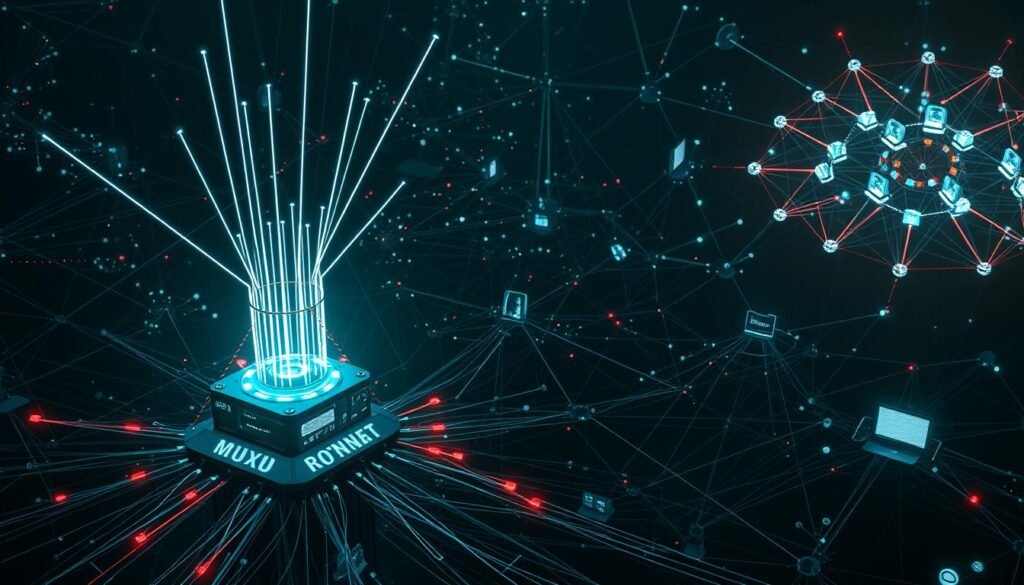
Client–server layouts range from a star with a single hub to multi‑server clusters and hierarchical tiers where upstream nodes issue orders to downstream systems. A star is simple and fast; multi‑server adds redundancy; hierarchical tiers delegate tasks to reduce load and speed growth.
Why peer meshes complicate takedowns
Peer‑to‑peer meshes remove single points of failure. Peers share command lists and updates, so mapping the swarm needs graph analysis and endpoint tracing.
Hybrid designs for speed and survival
Operators often seed with central servers for quick spread, then switch to a mesh for failover. This mix combines fast rollout with long‑term resilience.
Mobile and IoT ecosystems: the weak link
Phone and small internet‑connected gadgets thrive as amplifiers when they use default credentials or lag on firmware updates. Mirai showed how simple defaults yield massive DDoS scale.
“Segmentation, VLANs, and strict access policies cut the blast radius and make remediation faster.”
- Detection: centralized C2 can be blocked via IP/DNS; P2P needs peer correlation.
- Defense: segment IoT, enforce unique passwords, and speed firmware updates.
What Botnets Are Used For Today
Criminal operators convert scale into services: denial tactics, fraud, and covert monetization are the main outputs. These platforms switch roles fast—one day they send spam, the next they launch a distributed denial service.

Distributed denial and low-rate HTTP floods
Large pools launch volumetric floods and application-layer strikes. High-volume UDP or SYN floods saturate bandwidth. Low-rate HTTP floods mimic real user requests to exhaust server threads and evade simple thresholds.
In 2023, Q3 saw about 1.45 billion ddos attacks, a sharp jump that shows scale and accessibility.
Spam, phishing, and email abuse
Operators send bulk spam and targeted phishing to reuse compromised accounts. Those emails seed fresh infections and harvest credentials. Abuse of legitimate mailboxes increases delivery success and reduces blocks.
Credential theft and financial fraud
Keylogging and info‑stealers capture web logins and banking sessions. Harvested data fuels account takeover, wire fraud, and fraudulent transactions on corporate portals.
Click fraud, cryptomining, and secondary distribution
Click fraud rents out fake clicks to inflate ad revenue. Silent cryptomining converts spare CPU cycles into coins over long runs. Networks also drop ransomware or spyware as secondary payloads to expand revenue streams.
| Use Case | Primary Impact | Typical Defense |
|---|---|---|
| DDoS / HTTP floods | Service disruption; resource exhaustion | Rate limiting, WAF, CDN, anomaly detection |
| Spam / Phishing | Credential theft, brand abuse | Email authentication, filtering, user training |
| Info theft / Financial fraud | Monetary loss, account takeover | MFA, session monitoring, fraud detection |
| Click fraud / Cryptomining | Revenue loss, degraded performance | Behavioral baselining, process monitoring |
“Affordable DDoS services and automated toolkits mean even low-skill actors can launch disruptive attacks.”
Defensive takeaway: layered rate limits, behavioral baselines, and strong email controls cut exposure. Expect blended operations—an infection may pivot from phishing to a ddos attack as objectives change.
Why Botnets Persist: Economics, Evasion, and the Rent-a-Bot Market
Criminal marketplaces now offer on-demand disruption, turning compromised fleets into hourly commodities. Low upkeep and multiple revenue streams keep these operations profitable, and that economic reality sustains ongoing attacks.
Criminals advertise full-service packages for as little as $5 per hour and monthly plans near $38. Those rates reflect the low cost to maintain large IoT pools and the modest effort to replace lost nodes.

Pricing and operational drivers
Leasing capacity funds spam, DDoS, and fraud campaigns. Maintenance—scanning, re‑infection, and salt‑and‑pepper updates—influences price. Short bursts average about 390 seconds and let attackers probe defenses without long exposure.
Adaptation and evasion
Operators rotate code, shift command endpoints, and encrypt traffic to dodge signatures. Signed modules and rapid updates exploit new flaws and keep services usable.
- Why defenders lose ground: low hourly costs lower barriers and raise attack volume.
- Defense priorities: autoscaling, rate limits, playbooks, and shared indicators reduce risk and financial impact.
“Multiple revenue streams and rapid adaptation make takedowns costly and incomplete.”
Real-World Botnets and Attacks
Several notorious campaigns show how modest flaws and default settings can fuel global-scale disruptions. These cases teach defenders what to watch for and how adversaries adapt.
Mirai and IoT DDoS
Mirai marshaled over 600,000 units and produced a ~1 Tbps ddos peak in 2016. Its leaked source code created many variants that reused weak default credentials to amplify attacks.
Zeus and GameOver Zeus
Zeus infected more than 13 million computers, stealing banking data at scale. GameOver Zeus evolved into a P2P model, boosting resilience and causing over $100 million in losses.
Emotet and Dridex
Emotet remains polymorphic and serves as a delivery platform for other payloads. Dridex spreads via phishing macros and often supports ransomware drops.
Spam giants: Cutwail, Grum, Kraken
Cutwail once sent 74 billion spam messages daily. Grum handled roughly 20% of global spam at peak. Kraken reached nearly 500,000 bots with advanced evasion.
| Family | Primary Impact | Notable Trait |
|---|---|---|
| Mirai | Massive DDoS | IoT defaults, leaked source |
| Zeus / GOZ | Credential theft, fraud | P2P resilience |
| Emotet / Dridex | Distribution platform | Polymorphism, macro campaigns |
| Cutwail / Grum / Kraken | Industrial spam | High volume, evasion |
Lessons: leaked code speeds copycats, modular design enables rapid repurposing, and partial takedowns often let families resurface. Sustained telemetry sharing and coordinated sinkholing remain vital. For a case study on large-scale takedown efforts, see this write-up on the FBI’s disruption efforts: FBI dismantling the largest network.
How to Detect a Botnet Infection
Spotting a coordinated compromise starts with small, observable faults on hosts and across the network. Quick detection relies on simple monitoring: endpoint health, outbound patterns, and basic DNS logging.
A. Host-level signs: sudden slowdowns, high fan activity or heat while idle, frequent crashes, and unknown processes using CPU point to hidden activity.
B. Network indicators: watch for odd DNS queries, recurring beacon patterns to rare domains, and sustained egress to unfamiliar IP ranges. These anomalies often precede larger attacks.
C. UI clues: unexpected pop-ups, new browser extensions, or tools the administrator never installed can signal secondary payloads. Train each user to report these quickly.
D. Security tampering: antivirus or endpoint protection that is disabled, blocked from updating, or suddenly misbehaving usually means active interference.
- Monitor egress and baseline normal traffic so spikes stand out.
- Log DNS with alerts for domain-generation algorithm (DGA) patterns and newly registered domains.
- Correlate host telemetry with network events to confirm enrollment and tasking behavior.
| Indicator | What to watch | Action |
|---|---|---|
| Host performance | Sluggish apps, unknown processes, heat | Collect process dumps; isolate and scan |
| Outbound patterns | Beaconing, sustained egress, odd DNS | Block suspect IPs; enable egress filtering |
| Security posture | Disabled AV, blocked updates | Reinstate protection; audit logs |
“Early visibility beats late remediation — monitor endpoints and egress to stop small issues from becoming wide breaches.”
Document symptoms and timestamps to speed triage. Combine logs with threat intelligence to reduce false positives and cut alert fatigue. These steps make it far easier to contain and clean affected systems before data or services suffer.
How to Protect Against Botnets
Start by closing cheap entry points and making compromise costly for attackers. Focus on updates, robust access, and clear network separations to reduce risk across systems and users.
Patch and update OS, apps, and IoT firmware
Prioritize automatic updates for operating systems, software, and firmware. Set a regular patch cadence and track an asset inventory so nothing falls behind.
Stronger authentication and brute force resistance
Enforce multi-factor authentication (MFA) and block weak or reused passwords. Rate-limit login attempts to blunt brute force attacks and reduce unauthorized access.
Email and web hygiene
Train users to treat unexpected links and attachments with suspicion. Scan suspicious email in a sandbox and apply strong gateway filtering to stop delivery of risky content.
Segment networks and isolate IoT
Put IoT on separate VLANs and apply least-privilege access. Segment critical systems so a single compromised node cannot spread laterally.
Firewalls, egress filtering, and rate limiting
Configure firewalls to monitor outbound traffic, block known-bad endpoints, and apply rate limits at gateways to reduce impact from low-rate ddos style attacks.
“Routine hygiene and clear visibility raise the cost of operation and shrink an attacker’s window to act.”
| Measure | Primary benefit | Notes |
|---|---|---|
| Patch cadence | Close exploit paths | Automate updates; track assets |
| MFA & password policy | Reduce credential theft | Combine with rate limits for logins |
| Network segmentation | Limit lateral spread | Isolate IoT and guest systems |
How to Disable a Botnet
Disabling a large-scale infection starts with cutting the remote command paths and then cleaning every affected endpoint. Both legal takedowns and hands-on remediation are required to stop reconnection and future attacks.
Takedown strategies and cross-border work
Begin by mapping C2 infrastructure and identifying the key server endpoints. Teams then partner with law enforcement and providers to seize, sinkhole, or block those hosts.
Note: legal and jurisdictional hurdles mean takedowns often need multinational coordination to have lasting effect.
Stepwise device and system remediation
On hosts, run updated antivirus scans and targeted removers. If persistence remains, wipe and reimage the system or perform a full factory reset for constrained devices.
For IoT, reflash firmware, apply the latest updates, and change default credentials before returning a device to service.
Regain visibility and validate the cleanup
Use threat intelligence feeds, continuous monitoring, and audits to hunt for residual indicators. Audit startup items, scheduled tasks, and services to remove persistence hooks.
- Restore baseline security: patch, rotate passwords, and re-enable protections that the attack disabled.
- Harden execution: apply allowlists to block untrusted code and limit lateral access.
- Validate: run follow-up scans and monitor egress for a full cycle to ensure no reconnection.
“Document eradication steps and lessons learned; faster response lowers dwell time and reduces future risk.”
Tools and Techniques for Botnet Defense
Combine signature engines with behavioral analytics and machine learning to raise detection coverage. Layered tooling gives teams faster, more accurate signals and reduces noisy alerts.
Defenders win by combining signature checks with behavioral analytics and machine learning to catch novel tactics.
Signature plus behavioral and ML detection
Signatures quickly flag known code and indicators. Behavioral analytics spot deviations in process and traffic. ML models find subtle patterns across time that rules miss.
Command-path, IP reputation, and DNS monitoring
Instrument DNS and egress to flag DGAs, fast‑flux, and rare destinations. Add IP reputation feeds to triage alerts and block emerging C2 endpoints fast.
Honeypots, decoys, and UEBA
Deploy honeypots to capture attacker tactics, techniques, and procedures (TTPs) without risking production. Combine with user and entity behavior analytics (UEBA) to catch compromised accounts and odd access patterns.
Proxies, reverse proxies, and real-time visibility
Route web traffic through proxies to mask origin IPs when needed and to centralize policy enforcement. Real‑time monitoring and actionable alerts speed triage.
Bot management and WAAP features
Use bot management and Web Application and API Protection (WAAP) to apply challenge‑response, User‑Agent checks, rate limits, and anomaly detection. These services separate human users from scripted attacks while protecting availability.
“Pair signatures with behavioral analysis and threat intelligence to catch the novel campaigns that evade single-point detection.”
- Fast wins: tune allow/deny lists and use dynamic IP blocks.
- Continuous care: feed detections back into ML models and threat intelligence to cut false positives.
- Test: run red/blue exercises to measure efficacy and adjust policies.
Conclusion
Modern campaigns turn overlooked hardware into pooled resources that attackers call, update, and reuse for varied attacks. That loop — compromise, stealthy enrollment, and modular execution — explains why small flaws cascade into large outages, theft, or fraud.
Defend with depth: keep systems patched, segment networks, enforce strong authentication, and monitor DNS and egress traffic. Use behavioral analytics, bot management/WAAP, and rapid response to cut attacker return on investment.
Make user training and quick reporting standard. Build ties with law enforcement and industry peers for coordinated takedowns. Start with visibility: know your assets, baselines, and outbound paths today, then iterate toward measurable resilience.
