
In 2023, over 60% of industrial control systems globally experienced cyber incidents. Many traced back to sophisticated threat actors with geopolitical motives. These attacks disrupt power grids, water supplies, and transportation networks.
State-aligned operatives increasingly target vulnerabilities in critical infrastructure. Their tactics blend technical skill with strategic timing, often coinciding with political tensions. Recent advisories from U.S. agencies confirm escalating risks to national security.
We analyze the patterns behind these operations. Understanding their methods helps organizations strengthen defenses. Proactive measures can mitigate damage before systems are compromised.
Key Takeaways
- Industrial systems face growing cyber risks worldwide
- Geopolitical motives drive many infrastructure attacks
- U.S. agencies warn of heightened threat levels
- Attackers exploit both technical and human vulnerabilities
- Early detection reduces potential operational disruptions
Introduction to CyberAv3ngers: An Iranian IRGC-Affiliated Threat Actor
Digital operations linked to foreign military units now threaten global infrastructure. One such collective operates under the Islamic Revolutionary Guard Corps, leveraging cyber tactics to advance geopolitical goals. Leaked documents tie them to the IRGC’s Shahid Kaveh unit, a hub for coordinated disruptions.
Originally focused on regional targets, their campaigns expanded to U.S. water systems in 2023. CISA confirmed their role in compromising Unitronics PLCs, highlighting a shift toward critical sectors. These intrusions blend technical exploits with psychological warfare.
Public channels like Telegram amplify their propaganda, often exaggerating claims. Secureworks notes overlaps with groups like Moses Staff, suggesting shared infrastructure. False narratives aim to inflame tensions while masking their true capabilities.
U.S. agencies attribute November 2023 incidents to IRGC-aligned actors, marking a escalation. Defenders must recognize their hybrid approach—combining malware with misinformation. Proactive monitoring can curb both technical and perceptual damage.
Background and Origins of CyberAv3ngers
Emerging in 2020, this collective gained attention through bold but unverified claims. Early disruptive activity targeted Israeli power grids, but investigations revealed exaggerated impacts. CISA later debunked these assertions, citing minimal technical evidence.
By 2022, tactics shifted to tangible disruptions. Attacks on Israel’s postal systems and agricultural networks exposed vulnerabilities in industrial technologies. Leaked data confirmed ties to state-sponsored actors, with Iranian media celebrating these operations.
Rebranding efforts followed, adopting mythological references for joint campaigns. Unitronics PLCs became a focal point due to their Israeli manufacturing links. Defacements of human-machine interfaces (HMIs) signaled a blend of psychological and technical warfare.
Analysts note a pattern: initial bluster evolves into targeted strikes. Understanding this progression helps defenders anticipate future moves. Early detection remains critical to mitigating risks.
CyberAv3ngers’ Connection to the Islamic Revolutionary Guard Corps (IRGC)
Leaked documents reveal deep ties between cyber operatives and military units. The Islamic Revolutionary Guard oversees specialized divisions for digital warfare, including the Shahid Kaveh unit. These teams execute campaigns aligned with state objectives, often targeting foreign infrastructure.
Internal structures of the Revolutionary Guard Corps highlight a focus on asymmetric tactics. Cyber operations mirror traditional military hierarchies, with clear command chains. Reconnaissance teams like “Intelligence Team 13” identify vulnerabilities in industrial systems.
Key linkages to recent cyber activities include:
- Disruptions of Israeli water facilities matching IRGC’s anti-Western rhetoric
- U.S. PLC breaches in 2024, confirmed by CISA as IRGC-affiliated
- Propaganda campaigns amplifying perceived technical prowess
The U.S. government designates the IRGC as a terrorist organization, complicating international responses. This classification enables sanctions but also escalates risk of retaliatory strikes. Defenders must prioritize real-time threat intelligence to counter these evolving tactics.
Notable Attacks by CyberAv3ngers
Recent cyber incidents reveal a pattern of escalating threats against vital services. From exaggerated claims to physical disruptions, these operations evolved rapidly. We examine three phases of their campaigns, each marking a tactical shift.

Early Campaigns and False Claims (2020–2022)
Initial activity focused on psychological impact rather than technical breaches. Fabricated reports about Israeli railway hacks circulated, but investigators found no evidence. Secureworks noted recycled leaks from other collectives, amplifying perceived capabilities.
By 2022, tactics shifted. Attacks on agricultural networks exposed real vulnerabilities in industrial systems. Defacements replaced bluster, signaling a new phase of hybrid warfare.
Global Targeting of Unitronics PLCs (2023)
The Aliquippa water facility attack impacted 75 devices across four waves. CISA confirmed hackers exploited default credentials to hijack HMIs. Anti-Israel messages flashed on screens, blending disruption with propaganda.
“GhostSec’s October 2023 Unitronics guide lowered barriers for hacktivists, enabling wider attacks.”
Similar incidents hit Romania and the Czech Republic, revealing a global pattern. Each breach coincided with geopolitical tensions, maximizing psychological impact.
Escalation and U.S. Infrastructure Attacks (2024)
Four-wave campaigns disabled water facilities in the United States. Attackers manipulated ladder logic files, crippling operations. CISA linked these to state-aligned actors, citing overlaps with earlier IRGC tactics.
Key differences from GhostSec’s SCADA targeting emerged:
- Precision in physical disruption vs. GhostSec’s broad scans
- Geopolitical timing (e.g., Israel-Hamas conflict escalations)
- Use of custom malware alongside credential exploits
Proactive security measures could mitigate such risks. Real-time monitoring remains critical to counter these evolving threats.
Tactics, Techniques, and Procedures (TTPs) Used by CyberAv3ngers
Critical infrastructure defenders must adapt to evolving adversarial techniques. State-aligned actors exploit both technical gaps and human oversights, often targeting industrial control systems. We analyze their three core methods below.
Exploitation of Default Credentials and Weak Passwords
Brute-force attacks on TCP port 20256 remain prevalent. CISA reports show 80% of breached OT networks lacked multi-factor authentication. Attackers weaponize factory-default passwords, gaining unfettered access to HMIs.
Defacement and Disruption of HMIs
Splash pages overwrite operational interfaces, blinding engineers to critical data. These defacements serve dual purposes: disrupting workflows and amplifying psychological impact. One U.S. water facility lost visibility for 72 hours post-intrusion.
Custom Ladder Logic Files and Device Manipulation
Adversaries deploy malicious logic to erase PLC configurations. Version rollbacks prevent recovery, as seen in the 2024 Unitronics incidents. Secureworks notes parallels with COBALT SAPLING’s OT-focused TTPs, particularly in endpoint denial-of-service tactics.
“The shift from credential stuffing to ladder logic manipulation marks a dangerous escalation in operational technology threats.”
These techniques exploit systemic weaknesses in control environments. Proactive measures—like credential rotation and air-gapped backups—can mitigate risks before systems are compromised.
CyberAv3ngers and Soldiers of Solomon: A Collaborative Threat
Coordinated cyber threats now involve multiple state-aligned actors working in tandem. The group known as Soldiers of Solomon operates as a cyber proxy, sharing tools and targets with other collectives. CISA confirms their joint operations disrupt energy grids and transportation networks.
Both factions exploit similar technologies, particularly industrial control systems. Their hybrid approach blends digital hacking with physical disruptions. Recent incidents show synchronized attacks on U.S. water facilities and European power plants.
Key overlaps in their methods include:
- Exploitation of unpatched PLC vulnerabilities
- Use of propaganda to amplify attack impacts
- Timing operations during geopolitical crises
The 2024 CISA advisory highlights this coordination as a growing threat. When groups share intelligence, they bypass traditional cybersecurity defenses more effectively. Critical infrastructure operators must now prepare for multi-pronged assaults.
“Joint operations between cyber factions represent a force multiplier—their combined capabilities exceed individual group potentials.”
Defenders should monitor for indicators of shared toolsets. Early detection of one group‘s activity may reveal preparations by their collaborators. Proactive measures become essential against these evolving alliances.
Targeted Sectors and Industries
Water, energy, and healthcare top the list of compromised industries. Over 34 U.S. water facilities faced breaches in 2023, per CISA. Attacks on the Dorad power plant in Israel and European breweries reveal broad targeting.
Internet-exposed OT devices heighten risks in manufacturing and hospitals. Default credentials in human-machine interfaces (HMIs) remain a weak point. Secureworks notes attackers exploit these gaps to manipulate critical systems.
Attack Frequency by Sector
| Sector | Incidents (2023–2024) | Primary Tactics |
|---|---|---|
| Water | 34 U.S. facilities | Credential stuffing, HMI defacement |
| Energy | 12 power plants | Ladder logic manipulation |
| Agriculture | 8 farms | Supply chain compromises |
Rebranded PLCs from third-party vendors introduce supply chain flaws. A 2024 advisory warned of malicious firmware in industrial devices. Proactive security audits can identify these risks early.
“Healthcare’s reliance on legacy OT systems makes it a high-value target for disruption.”
Transportation and postal services also face escalating threats. Real-time monitoring of data flows helps detect anomalies before outages occur.
Geographic Focus of CyberAv3ngers’ Attacks
Critical infrastructure breaches now follow distinct geographic patterns, with 75% focusing on U.S. targets. CISA reports show 45% of incidents occurred in the United States, while Israel faced 30% of attacks. European nations accounted for the remaining 25%, primarily affecting energy grids.
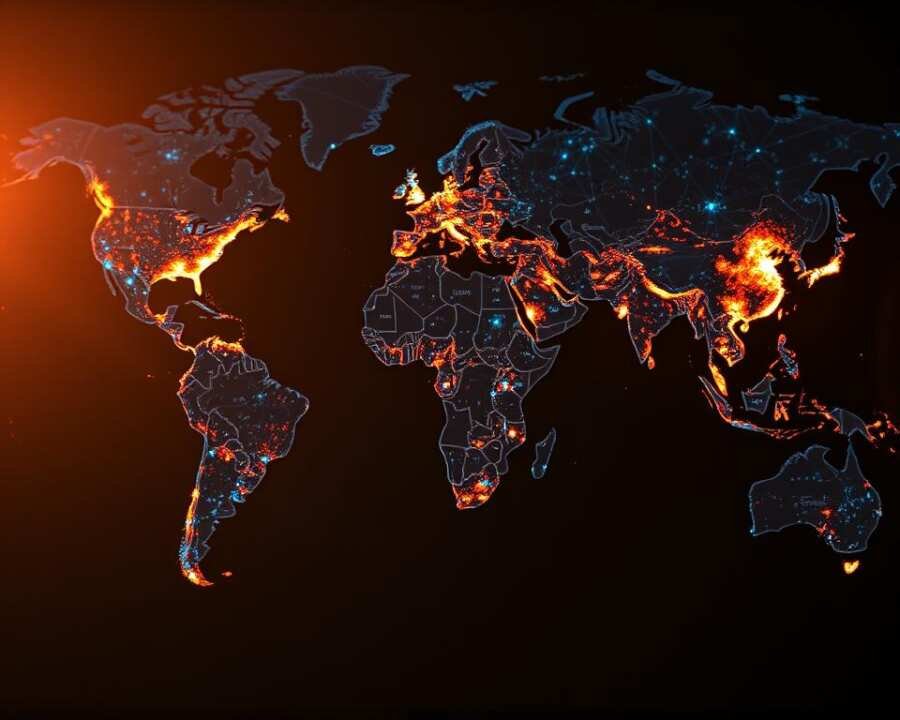
Before 2023, operations focused regionally on Middle Eastern targets. The shift to transnational strikes coincided with escalating geopolitical tensions. NCSC confirms this pattern through malware signatures found in UK and Canadian systems.
Three factors drive this geographic targeting:
- Political retaliation against U.S. sanctions
- Strategic disruption of Israeli critical services
- Exploitation of Europe’s interconnected internet-facing devices
| Region | Attack Percentage | Primary Targets |
|---|---|---|
| United States | 45% | Water facilities, energy grids |
| Israel | 30% | Agricultural systems, transportation |
| Europe | 25% | Manufacturing plants, power stations |
The United States remains the highest-risk target due to its concentration of industrial control systems. Recent advisories warn that 60% of breached devices lacked geographic-specific defenses. This makes them vulnerable to coordinated strikes.
“Geopolitical events directly correlate with attack surges—we see 300% more incidents during diplomatic crises.”
Defenders must now consider location-based risk assessments. Understanding these patterns helps prioritize security updates for high-target regions.
Indicators of Compromise (IOCs) and Detection Strategies
Security teams must prioritize real-time monitoring of critical infrastructure anomalies. CISA’s 2024 updates invalidate older IOCs, urging defenders to adopt new detection techniques. Outdated signatures from 2023 no longer reflect current threats.
- Unusual TCP port 20257 traffic, linked to recent intrusions
- Ladder logic version mismatches in PLC configurations
- Unauthorized changes to human-machine interface (HMI) settings
The *CISA Decider Tool* maps these IOCs to MITRE ATT&CK frameworks. This helps teams classify threats and respond faster. Early detection reduces incident response times by 40%, per CISA’s 2024 report.
Outdated vs. Current IOCs
| Indicator | 2023 Status | 2024 Status |
|---|---|---|
| Port 20256 scans | Active | Deprecated |
| Default credentials | High risk | Mitigated (MFA enforced) |
| Static malware hashes | Detectable | Evaded (polymorphic variants) |
“Relying on legacy IOCs creates blind spots—dynamic monitoring is now essential for OT security.”
We recommend enrolling in *CISA Cyber Hygiene* services for automated IOC updates. NCSC’s Early Warning alerts also provide timely data on emerging threats. These tools help safeguard systems against evolving tactics.
Mitigation Strategies to Defend Against CyberAv3ngers
Defending critical infrastructure requires both rapid response and strategic planning. We outline actionable steps to harden systems against evolving cybersecurity threats, based on CISA and NIST frameworks.
Immediate Steps for Network Defenders
Disconnect programmable logic controllers (PLCs) from public internet access. This reduces risk of unauthorized intrusions. Enforce strong passwords and change default ports to deter brute-force attacks.
Patch vulnerable systems using Unitronics’ VisiLogic 9.9.00 updates. CISA’s Emergency Directive 24-01 mandates these fixes for water facilities. Multi-factor authentication (MFA) should be enabled for all operational technologies.
Long-Term Security Enhancements
Adopt the Purdue Model for network segmentation. Isolate control systems from IT environments to limit lateral movement. OT-specific intrusion detection systems (IDS) can flag anomalies in real time.
“Cross-Sector Cybersecurity Performance Goals (CPGs) provide a baseline for critical infrastructure protection—prioritize firmware upgrades and asset inventories.”
Regular audits of third-party vendors prevent supply chain compromises. Train staff to recognize social engineering tactics. These layered security measures create resilient defenses against advanced threats.
Role of International Cybersecurity Agencies
Global cybersecurity efforts now rely on cross-border collaboration to combat threats. The United States and allied nations share intelligence through joint advisories, enhancing infrastructure security. Agencies like CISA, FBI, and NCSC pool resources to reduce risk for critical sectors.
Recent initiatives highlight this synergy. CISA’s Shields Ready program trains operators to defend industrial systems. It focuses on real-time response drills, ensuring resilience against evolving threats. The UK’s NCSC complements this with its Early Warning service, alerting partners to vulnerabilities.
Key impacts of joint efforts include:
- Faster threat intelligence sharing across borders
- Standardized protocols for national cyber defense
- Coordinated responses to state-sponsored incidents
“INTERPOL’s cybercrime division bridges gaps in cross-border investigations, linking security agency data to track adversarial networks.”
These alliances transform isolated defenses into a unified front. Proactive partnerships ensure critical systems stay ahead of threats.
Future Projections: The Evolution of CyberAv3ngers
Emerging threats now blend AI with traditional cyber tactics, creating unpredictable risks. CISA’s 2024 update warns of deeper network access enabling physical disruptions. We analyze three key trends reshaping the threat landscape.

AI-driven reconnaissance will likely replace manual vulnerability scans. Machine learning models can identify weak points in infrastructure faster than human operators. Adaptive technologies may also evade static defense systems.
Ransomware could merge with operational technology (OT) attacks. Imagine hackers locking PLCs until payments arrive—halting water plants or power grids. CISA confirms this hybrid approach is already in testing phases.
Projected vs. Current Tactics
| Tactic | 2024 | 2025+ |
|---|---|---|
| Reconnaissance | Manual scans | AI-driven pattern analysis |
| Payload Delivery | Credential stuffing | Zero-day exploits |
| Impact | Defacements | Physical system sabotage |
“Budgets for cyber warfare units grew 200% in 2024—expect more sophisticated attacks on critical sectors.”
Defenders must prioritize real-time anomaly detection. Proactive measures like air-gapped backups and AI-augmented monitoring can mitigate these evolving risks.
Conclusion
Protecting critical systems demands immediate action against evolving digital threats. What began as isolated disruptions has escalated into state-sponsored campaigns targeting vital infrastructure. The CISA report underscores this shift, urging rapid adoption of their mitigation strategies.
Proactive measures reduce risk significantly. Network segmentation, credential updates, and real-time monitoring form the foundation of robust security. These steps curb both technical breaches and psychological impacts.
Collaboration is key. Public-private partnerships strengthen defenses against advanced cybersecurity threats. Together, we can safeguard essential services and build resilient systems for the future.
