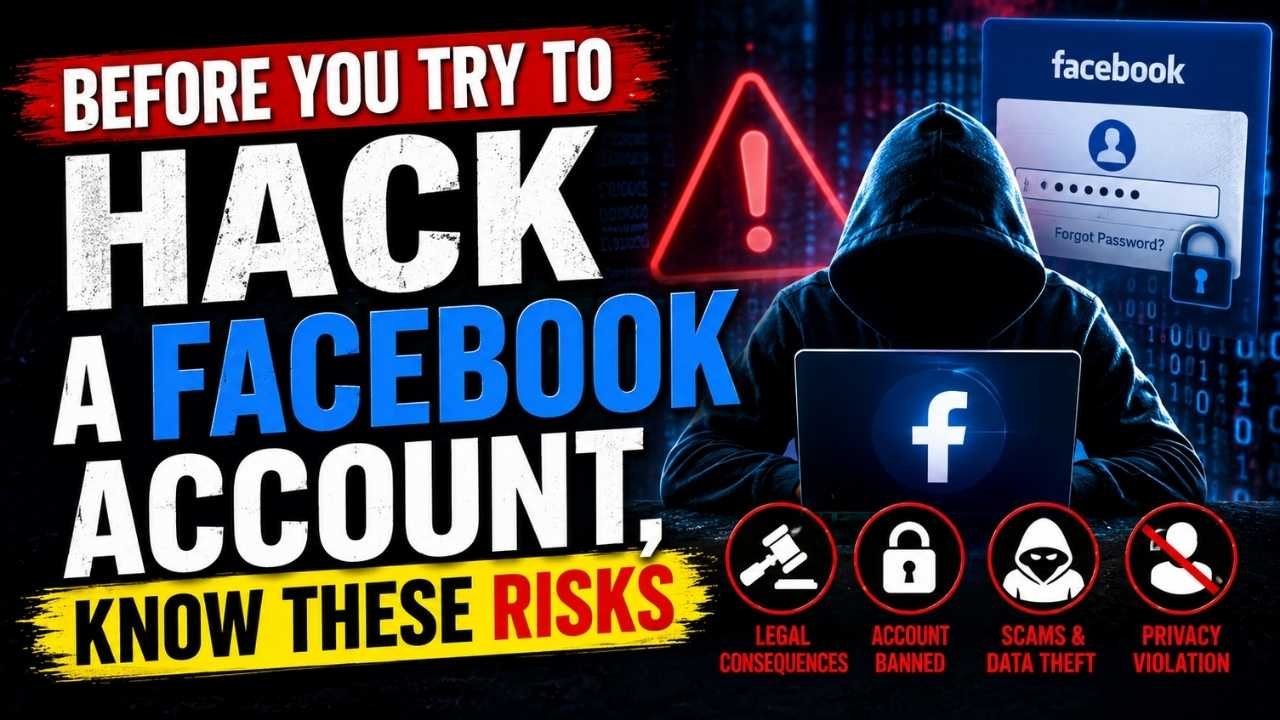
Claims that someone can reliably hack a Facebook account in five minutes deserve serious skepticism. There is no legitimate shortcut that guarantees access to another person’s account within a fixed amount of time.
In many cases, the bigger risk is the supposed hacking tool or service. Websites, downloads, paid services, and social-media posts that promise instant access may instead be trying to steal credentials, install malicious software, collect payments, or trick users into compromising their own accounts.
If you are locked out of your own Facebook account, use legitimate account recovery. If you want to study cybersecurity, practice in authorized labs or on systems where you have explicit permission to test.
Why “Hack a Facebook Account in 5 Minutes” Claims Are Misleading
The promise sounds appealing because it turns a complicated security problem into something that appears quick and predictable. Real account security is not that simple.
Accounts may be protected by passwords, additional authentication, security alerts, recognized devices, recovery controls, and other safeguards. Each situation is different. A claim that any Facebook account can be compromised within a specific number of minutes is therefore hard to take seriously.
A fixed-time hacking promise is usually a sales pitch, not a realistic description of how account security works.
There is also an important difference between recovering an account you own, testing a system with permission, and trying to enter someone else’s private account. Authorization is what separates legitimate security work from unauthorized access.
Unauthorized Access and Account Recovery Are Not the Same Thing
| Situation | Purpose | Appropriate Approach | Main Risk |
|---|---|---|---|
| Recovering your own account | Regaining legitimate access | Use official recovery and identity-verification procedures | Falling for fake recovery services |
| Protecting your account | Reducing the chance of compromise | Strengthen credentials and security settings | Weak or reused passwords and phishing |
| Ethical security testing | Finding security weaknesses responsibly | Work only in authorized systems and testing environments | Testing outside the agreed scope |
| Accessing another person’s account | Obtaining access without permission | Do not attempt it | Privacy, security, legal, and ethical consequences |
The dividing line is straightforward: authorization matters. Learning about cybersecurity does not give someone permission to target a real account.
Why You Should Avoid Quick Facebook Hacking Tools and Services
1. The Tool May Be Designed to Target You
A suspicious program advertised as a Facebook hacking tool may ask you to install software, disable security protections, enter account details, complete surveys, or hand over personal information.
That can quickly turn the person looking for a shortcut into the actual target. Instead of gaining access to another account, they may expose their own computer, browser, login credentials, or financial information.
2. Fake Services Can Take Your Money
A service that promises Facebook account access after an upfront payment gives you little reason to trust it. The operator may take the money, ask for additional payments, or simply disappear.
Progress bars, countdown timers, account scans, and success percentages are not proof that any real security process is happening behind the scenes.
3. You May Be Asked for Your Own Login Details
Some scams tell users they must sign in, verify their identity, or connect a social account before the promised tool will work.
Entering your credentials on an untrusted website can create the exact account-security problem you were trying to avoid.
4. Unauthorized Access Creates Real Privacy and Security Problems
A Facebook account may contain private messages, photographs, contact information, personal details, and connections to other services. Trying to enter someone else’s account without permission crosses a clear privacy and security boundary.
Curiosity does not make unauthorized access ethical hacking.
5. “Five Minutes” Is a Red Flag, Not a Guarantee
Security outcomes depend on the account, the protections in place, the circumstances, and, in legitimate testing, the authorized scope. A universal promise that a particular account can be hacked within minutes ignores all of that.
The more absolute the promise sounds, the more carefully you should question the person or service making it.
What Actually Matters for Facebook Account Security
Rather than looking for shortcuts into accounts, it is more useful to focus on what makes your own account harder to compromise.
- Strong, unique credentials: Do not reuse the same password across multiple services.
- Additional authentication: Use available security protections that require another verification step.
- Phishing awareness: Be cautious with unexpected login pages, urgent messages, and links asking you to verify your account.
- Account recovery readiness: Keep legitimate recovery information current so you have a safer way back into your account.
- Device security: Protect the computers and phones you use to access social accounts.
Account compromises are often less dramatic than people imagine. Stolen or reused passwords, phishing, deceptive login pages, and compromised devices can be more relevant than the idea of a mysterious tool instantly breaking into an account.
What People Often Get Wrong About Facebook Hacking Claims
They Assume a Professional-Looking Website Must Be Legitimate
A polished website does not prove that a service can do what it claims. A fake tool can show convincing animations, technical terms, progress indicators, and fabricated results without accessing anything at all.
They Confuse Ethical Hacking With Attacking Real Accounts
Ethical security work depends on permission and a defined scope. Practicing in an authorized lab is very different from trying to access a stranger’s, partner’s, employee’s, or acquaintance’s Facebook account.
They Think a Precise Time Makes the Claim More Credible
“In five minutes” makes the process sound easy and certain. In cybersecurity, that kind of precise guarantee should usually lead to more questions, not fewer.
They Download Software Before Checking the Source
Installing an unknown program because it promises access to an account can expose your own device and information to far greater risks than any supposed benefit.
They Search for Hacking Tools When They Actually Need Account Recovery
If the account belongs to you and you have lost access, you do not need a hacking service. You need a legitimate recovery process that can verify you are the rightful account holder.
Facebook Account Recovery: The Safer Path for Your Own Account
If you forgot your password, lost access to a recovery method, or believe your own account was compromised, start with Facebook’s legitimate recovery and security procedures rather than a third-party hacking website.
Depending on the problem, recovery may involve identifying the account, completing verification steps, reviewing recent activity, changing compromised credentials, and securing the account against further unauthorized access.
Be especially cautious with anyone who claims they can recover your account only after you provide payment, your password, a verification code, or remote access to your device.
Legitimate account recovery is about proving your right to access your own account, not bypassing someone else’s security.
Ethical Hacking and Authorized Security Testing
Learning how attacks work can be a legitimate part of cybersecurity education. The important part is where and how that learning takes place.
Suitable environments include systems you own, purpose-built cybersecurity labs, controlled practice platforms, and programs where the owner has explicitly authorized security testing.
A few rules keep that work on the right side of the line:
- Get explicit authorization before testing a system you do not own.
- Stay within the agreed testing scope.
- Use dedicated training environments for offensive-security practice.
- Study vulnerabilities so they can be understood, prevented, or fixed.
- Do not use cybersecurity education as an excuse to access private accounts.
You can build useful cybersecurity skills without targeting a real person’s Facebook account.
Warning Signs of a Facebook Account Hacking Scam
Be cautious when a website, app, download, social-media profile, or paid service makes claims such as:
- Guaranteed access to any Facebook account.
- Account hacking within a precise number of minutes.
- No technical knowledge required and no possibility of failure.
- A requirement to download unknown software before seeing results.
- A request for your own Facebook password or authentication code.
- Repeated payments to unlock additional stages.
- Instructions to disable security software before the tool will work.
- Pressure to act immediately before an offer or supposed hacking opportunity expires.
One warning sign alone does not prove that a service is malicious. Several appearing together, however, are a good reason to stop rather than continue.
How to Protect Your Own Facebook Account
Good account security comes down to reducing the easy opportunities available to attackers and scammers.
Use a Unique Password
Reusing a password across several websites creates more risk if one of those services is compromised. Your Facebook password should not be the same one you use for email, banking, shopping, or other important accounts.
Use Additional Authentication Protections
Where available, an additional verification step can make a stolen password less useful on its own.
Be Careful With Login Links
A page is not necessarily legitimate just because it looks like Facebook. Unexpected messages telling you to sign in, confirm a warning, or prevent an immediate account suspension deserve extra scrutiny.
Review Unexpected Account Activity
If something looks wrong with your account, deal with it early. Use legitimate channels to change compromised credentials and review available security information.
Protect Your Email Account Too
Your email may be used for password resets and account recovery. Securing Facebook while leaving the connected email account poorly protected can leave an important weakness in place.
How We Evaluated This Topic
This article treats the keyword as an informational cybersecurity and account-safety question rather than a shopping query.
No Amazon products were included because adding cybersecurity books, antivirus software, hardware security keys, or unrelated privacy accessories would not directly answer the reader’s main question. Including them only to create affiliate links would make the article less useful.
The focus instead stays on the distinction between unauthorized access, legitimate account recovery, scam awareness, defensive account security, and ethical security testing performed with permission.
Final Verdict
Do not trust a service simply because it promises to hack a Facebook account in five minutes. No universal method can guarantee that outcome, and the supposed tool or service may expose you to credential theft, malicious downloads, financial scams, or other security problems.
If you are locked out of your own account, use legitimate recovery channels. If you are worried about someone accessing your account, strengthen both your Facebook and connected email security. For cybersecurity training, stick to environments where testing is clearly authorized.
The useful lesson behind the “five-minute Facebook hack” claim is not how to break into an account. It is how to recognize a promise that may be exploiting curiosity, urgency, or confusion about the way real account security works.
FAQ
Can you really hack a Facebook account in five minutes?
There is no legitimate method that can universally guarantee access to any Facebook account within five minutes. Claims that make this promise should be treated with skepticism.
Are websites that promise instant Facebook hacking safe?
Be cautious. Sites making these claims may try to collect credentials, promote suspicious downloads, demand payments, or expose visitors to other scams.
What should I do if I forgot the password to my own Facebook account?
Use Facebook’s legitimate account-recovery procedures. Avoid third-party services that claim they need your password, authentication codes, or suspicious software to recover your account.
What if I think my Facebook account has been compromised?
Use legitimate account-security and recovery options, change compromised credentials, review suspicious activity, and secure any connected email account that could be used for recovery.
Is ethical hacking the same as hacking someone’s Facebook account?
No. Ethical hacking requires authorization and an agreed testing scope. Trying to access a real person’s private account without permission is not authorized security research.
Can I learn about account security without hacking real accounts?
Yes. Cybersecurity training can take place in dedicated labs, controlled practice environments, systems you own, and other settings where testing is explicitly authorized.
Why do quick-hacking scams use claims like “five minutes”?
A precise time promise can make a service sound easy, powerful, and certain. It does not prove that the underlying claim is genuine.
What is the best way to protect my Facebook account?
Use unique credentials, enable available additional authentication protections, secure your connected email account, stay alert to phishing attempts, and rely on legitimate recovery channels when problems occur.
